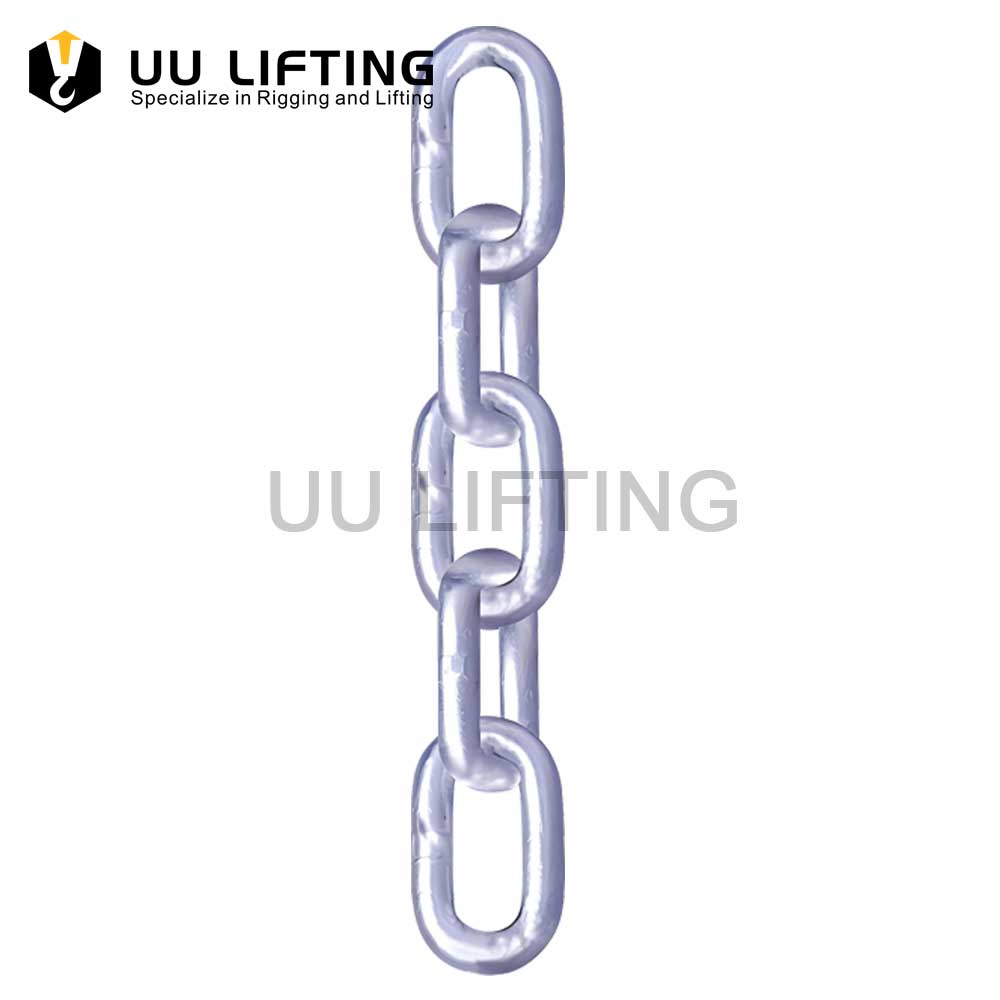
Australian Standard Medium Link Chain Specifications:
Material
Carbon Steel
Standards
AS4344
Surface Finish
Supplied In Self Colour, Electro-Galvanized And Hot-Dipped Galvanized Surface
Application
Manufacturing, Marine and Agricultural industries
Packaging
Custom Packaging Available
Australian Standard Medium Link Chain Sizes:
Australian Standard Medium Link Chain Sizes
Australian Standard Medium Link Chain Sizes
Chain Size
W.L.L.
DIA.
L
W
Length Per 100kg
(mm)
(mt)
(mm)
(mm)
(mm)
B.F.
H.D.G.
3
0.06
3.15
15.7
13.1
511
498
4
0.11
4
18.6
16
320
305
5
0.19
5
22
19.4
203
193
6
0.32
6.3
26.1
23.5
129
120
8
0.53
8
32.2
29.5
77.8
74.1
10
0.83
10
39.1
36.2
48.5
47.1
12
1.35
12
46
44
34
33.3
13
1.5
13
49.1
46.1
29.7
27.7
16
2.31
16
59.6
56.5
20.2
18.2
20
3.67
20
73.3
70
12.3
11.6
24
5.31
24
87
83.6
8.5
8.04
What is Australian Standard Medium Link Chain, and is it right for your job?
Australian Standard medium link chain is a general-purpose welded steel chain. It offers a balance between the strength of a short link and the flexibility of a long link. It’s ideal for lashing, mooring, and agricultural use, but is not rated for overhead lifting.
What are the key specifications for this chain?
Key specifications relate to Australian Standards like AS 2321. They cover material grade, dimensions, and manufacturing quality. “he “medium “ink” specifically refers to the pitch, the internal length of each link, providing a balance between flexibility and strength for non-lifting tasks.
Material Grades
The grade of the steel tells you its strength, for general-purpose chains like medium liyou’ll often see them made from Grade L steel, as specified in Australian Standards. This grade provides sufficient strength and durability for tasks like lashing cargo, securing farm equipment, or general tie-down applications. It’s the workhorse grade, reliable and cost-effective for jobs that don’t involve lifting.
Dimensions and Pitch
“he “medium “ink” name is all about the dimensions. The pitch, or the inside length of the link, is longer than a short link chain but shorter than a long link chain. This design is intentional. It provides a good middle ground. You get more flexibility than a stiff short link chain, which is useful when you need to wrap the chain around objects. It’s not so long that it sacrifices too much strength or becomes prone to snagging.
Surface Finishes
The finish protects the chain from rust and corrosion. I choose the finish based on how my customer will use the chain.
Self-Coloured: This is a basic, black finish. It’s most affordable but offers minimal rust protection. It’se for indoor use or in dry environments.
Hot-Dip Galvanized (HDG): For outdoor use, especially in marine or coastal areas, HDG is my go-to. The chain is dipped in molten zinc, creating a thick, durable, and highly corrosion-resistant coating.
Electro-Galvanized: This process uses electricity to apply a thin layer of zinc. It provides some rust protection and a bright, shiny appearance; it’s as robust as HIt’HIt’s. It’s a good option for general use when a clean look is desired.
How does the medium link chain compare to the short and long link types?
Medium link chain is the versatile middle ground. Short link offers maximum strength but is stiff. Long links provide great flexibility and are lighter, but have a lower safe working load. Medium link balances these characteristics, making it a great multi-purpose option for lashing and mooring.
The Comparison Breakdown
This table shows the main differences at a glance.
A short link chain has the highest strength-to-size ratio because its links are compact. This also makes it fit perfectly over the gears of an anchor windlass. A long link chain is the opposite. The longer links make it very flexible and lighter per meter. Still, you sacrifice a lot of strength. It’s great for applications that need length and flexibility but not high load capacity, like a farm gate.
Medium link chain sits right in the sweet spot for many jobs. It’s possible enough to handle easily, but strong enough for serious lashing and securing work—it’s a two-default recommendation for general transport and agricultural tie-downs.
Why is choosing a certified supplier for this chain so important?
A certified supplier guarantees quality and compliance. I learned this the hard way. It ensures the chain’s material, heat treatment, and load ratings are accurate. This protects you from liability, ensures safety, and upholds your brand, especially if you’re a distributor like me.
A Personal Story: The Cost of Unverified Quality
I decided to try a new, very low-cost supplier from a country I hadn’t worked with before. Their price for a large order of medium link chain was too good to pass up. They even sent me a document that looked like a test certificate. I placed the order, feeling proud of the deal I had secured. I was thinking about the profit I would make by rebranding and distributing it in the US market.
The Unraveling
The shipment arrived, and it looked fine visually. I shipped it out to one of my biggest customers, a large agricultural equipment distributor. Two weeks later, I got an angry call. Their quality control team had rejected the entire batch. The link dimensions were inconsistent. Some were closer to long links, and others were short. Worse, one of their teams had a chain snap while tensioning a piece of equipment for transport. Luckily, no one was hurt, but the point was clear: the product was unsafe and unusable.
The Aftermath and the Lesson
The fallout was a nightmare. I had to pay to have the entire shipment returned. I had to refund my customer. Most importantly, I damaged the trust I had spent years building. The few thousand dollars I thought I’d saved cost me ten times that in losses and damaged my reputation. That day, I changed my entire purchasing philosophy. I now only work with suppliers who provide transparent, verifiable certifications, like UU LIFTING. I need to know the materials are traceable and that every batch is tested. Efficient communication and reliable shipping aren’t just bonuses; they are essential. It ensures that the product I sell under my brand is safe, reliable, and something I can stand behind.
OUR FACTORY
Raw materials of our products are made of high-quality steel that meets the standards, and the raw materials are traceable. And multiple production lines and machines minimize lead times for rigging and lifting equipment.
Raw Material
Forged
Cast
Chain Machine
Heat Treatment
Powder Plastified
Package
Warehouse
MANUFACTURING PROCESSES
With eight automatic forging and semi-automatic forging line of up to 1600ton press machines and specialized drillng, tapping, heat treatment and inspection equipment. Strict and standardized production process ensures you receive perfect products.
QUALITY CONTROL
All rigging and lifting products are subjected to strict working tension and breaking the tension test. Complied with ISO9001 and CE certification. Our promise to you: Guaranteed safety at work for people and materials.