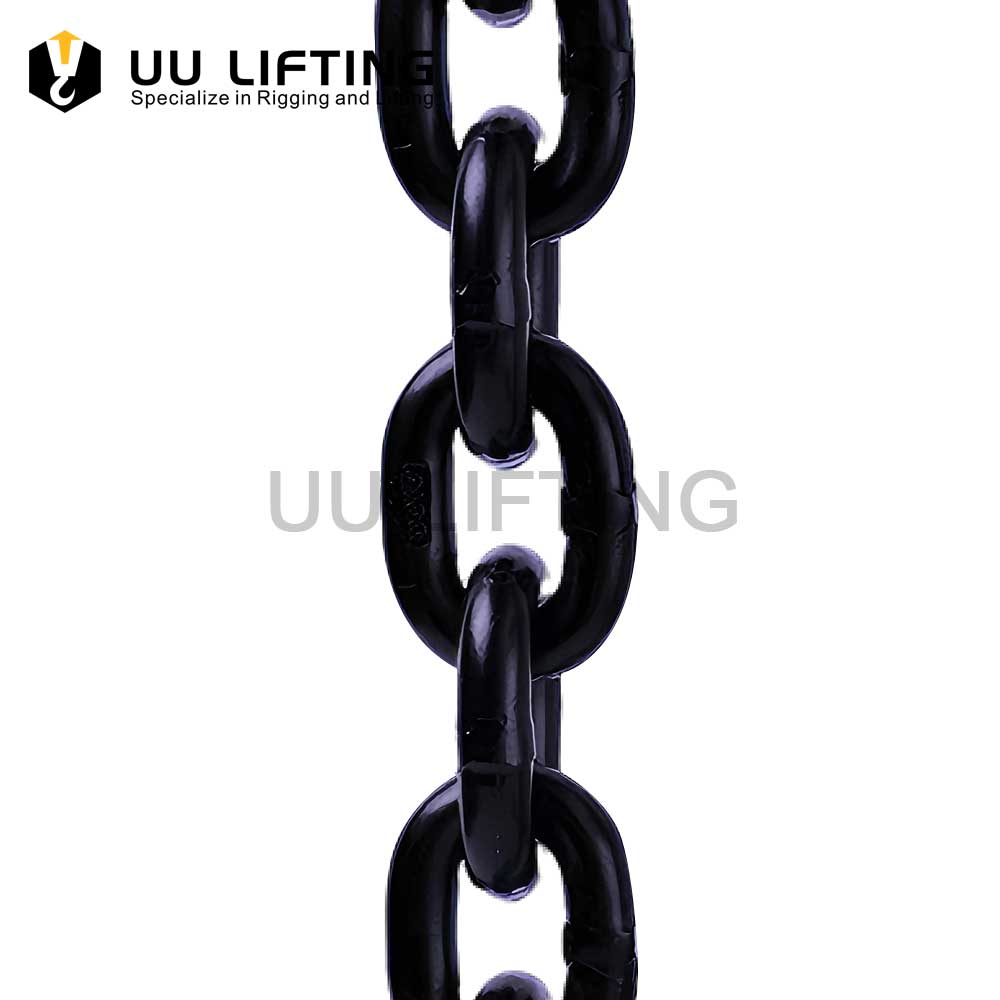
Grade 80 Chain is manufactured from high quality, high tensile alloy steel and is hardened and tempered to produce a chain with a load bearing capacity in excess of three times that of mild steel chain.
Specification
Additional information
Material
Alloy Steel
Standard
Meets or exceeds OSHA, Government, NACM, and ASTM specification requirements
Meets or exceeds OSHA, Government, NACM, and ASTM specification requirements
DIN EN818-2 G80 Lifting Chain Sizes:
DIN EN818-2 G80 Lifting Chain Sizes
DIN EN818-2 G80 Lifting Chain Sizes
Material Diameter
Working Load Limit
Proof Test (Min)
Breaking Force Min
Inside Length
Inside Width
(mm)
(kg)
(Lbs.)
(kn)
(kn)
(mm)
(mm)
5
800
1760
19.6
31.4
16
5.3
6
1120
2470
28.3
45.2
18
7.8
7
1500
3310
38.5
61.6
21
9.1
8
2000
4410
50.3
80.4
24
10.4
10
3150
6940
78.5
126
30
13
13
5300
11680
133
212
39
16.9
16
8000
17640
201
322
48
20.8
19
11200
24690
284
454
57
22
15000
33070
380
608
66
28.6
26
21200
46740
531
849
78
33.8
32
31500
69450
804
1280
96
41.6
What Is a DIN EN 818-2 G80 Lifting Chain and Why Is It So Strong?
DIN EN 818-2 G80 lifting chain is a high-strength chain made from heat-treated alloy steel. It is specifically designed and certified for overhead lifting applications. It offers a 4:1 safety factor and is much stronger than standard steel chain, making it your go-to for safe lifting.
What Makes G80 Chain Material So Special?
G80 chain is not just steel. It is a high-quality, high-tensile alloy steel. This material is specially formulated. Then it is hardened and tempered through a precise heat treatment process. This gives it superior strength, wear resistance, and the flexibility needed for safe overhead lifting.
When people ask me what the “secret” is, I tell them it’s all about the material and the manufacturing process. It’s not magic, it’s engineering. The process starts with selecting the right raw materials. We use high-quality alloy steel that contains specific elements such as manganese and chromium. These elements give the steel its initial strength. But the real transformation happens during heat treatment.
The Science Behind the Strength
The process is called “Quenching and Tempering.” First, we heat the chain to a very high, controlled temperature. Then, we cool it down very quickly in a liquid. This is “quenching.” It makes the steel extremely hard but also brittle. A brittle chain is a dangerous chain. So, the next step is “tempering.” We reheat the chain to a lower temperature. This step removes the brittleness and adds toughness. This entire process creates a chain that is incredibly strong, resistant to wear, and can stretch slightly under extreme load before breaking. This stretch provides a vital warning sign in an overload situation.
Why Not Just Use Mild Steel?
For a buyer like Mark, the cost is always a factor. So, he asked me why he couldn’t just use a cheaper mild-steel chain. I laid out the differences for him very clearly. It is not an apples-to-apples comparison. One is a specialized tool; the other is not.
Feature
G80 Alloy Steel Chain
Mild Steel Chain
Material
Heat-Treated Alloy Steel
Low-Carbon Steel
Strength
Over 3x stronger
Standard
Safety Rating
Rated for Overhead Lifting
Not for Lifting
Wear Resistance
High
Low
Ductility
High, stretches before breaking
Low, can snap suddenly
This is why the G80 alloy chain has a load-bearing capacity more than three times that of a mild steel chain. It is the difference between a tool designed for a job and a general-purpose item. Using mild steel for lifting is a risk no serious business should take.
How Do You Read the EN 818-2 Standard and G80 Markings?
The markings are your guide to safety and compliance. “EN 818-2” is the European standard for short-link lifting chains. “G80” or “8” means the grade, showing its strength. You should always look for these markings on the chain links to ensure it is certified for lifting.
I always tell my customers that these markings are their guarantee of quality and safety. If a chain has no markings, you should never use it for lifting. It’s an unknown quantity, and the risk is too high. Think of the markings as the chain’s birth certificate and professional license, all in one. They tell you what it is, who made it (traceability), and what it is capable of. Let’s look closer at what they mean.
Decoding the Standard: EN 818-2
EN 818 is a family of European standards for lifting chains. Part 2, or EN 818-2, is very specific. It covers “Medium tolerance lifting chain for chain slings — Grade 8.” This standard is the rulebook. It dictates everything about the chain. It specifies the chemical composition of the alloy steel, the mechanical properties like strength and ductility, the exact dimensions of each link, and the required testing procedures. When a chain like ours complies with EN 818-2, it means it has passed all these strict requirements. It is your assurance that you are getting a product built for safety.
Understanding the Markings and Specifications
You will see markings stamped directly onto the chain links at regular intervals. The grade marking might be “G80”, “80”, “8”, or “T”. They all mean the same thing: Grade 80. You’ll also see the manufacturer’s mark. Now, let’s look at the numbers. The specifications table is crucial.
Nominal Size (mm)
Working Load Limit (t)
Min. Breaking Force (kN)
8.0
2.0
80.4
10.0
3.2
126.0
16.0
8.0
322.0
Here, the “Working Load Limit” (WLL) is the maximum mass the chain is certified to lift. The “Minimum Breaking Force” is the force at which the chain will break. Notice that the breaking force is at least four times the WLL. This is the 4:1 safety factor. It’s a critical safety margin built into the product.
Can You Use Any Hook or Link with a G80 Chain?
Do you think you can save money by mixing and matching rigging components? This is a very dangerous mistake. An incompatible component becomes the weakest link, and it can cause the entire assembly to fail.
No, you must only use components of the same grade. G80 chains require G80 components like hooks, master links, and connectors. Using a lower-grade part compromises the safety and load capacity of the whole sling. Incompatible parts create a serious hazard.
I once investigated an incident at a customer’s site. A heavy load had dropped. The chain itself was a perfect G80 chain. But the hook they used was an old, unmarked one they had lying around. The hook had bent open under the load. It was a costly lesson for them about the importance of a matched system. A chain sling is only as strong as its weakest component.
The “System” Approach to Safety
You must think of a lifting sling as a complete system. Every single part, from the main link at the top to the hook at the bottom, must have the same grade and capacity. This is why we don’t just sell chains. We provide the full range of certified G80 components to build a safe and compliant sling. This includes G80 eye hooks, self-locking hooks, shortening grab hooks, and master link assemblies. All of these components are designed to work together perfectly with the G80 chain. They are also governed by their own strict standards, like EN 1677, to ensure they are fit for purpose.
What to Look for in G80 Components
Just like the chain, G80 components have specific features you should check.
Material: They must be forged from high-strength alloy steel and heat-treated.
Markings: They must be clearly marked with “G80” or “8” and the manufacturer’s identification.
Testing: They are proof tested to 2.5 times their Working Load Limit. This is a real-world test to ensure their integrity.
Safety Factor: They must have the same 4:1 safety factor as the chain.
When you buy a complete G80 system, you are buying peace of mind. You know that every single piece has been designed, manufactured, and tested to the same high standard. It’s the only way to ensure safety in overhead lifting.
OUR FACTORY
Raw materials of our products are made of high-quality steel that meets the standards, and the raw materials are traceable. And multiple production lines and machines minimize lead times for rigging and lifting equipment.
Raw Material
Forged
Cast
Chain Machine
Heat Treatment
Powder Plastified
Package
Warehouse
MANUFACTURING PROCESSES
With eight automatic forging and semi-automatic forging line of up to 1600ton press machines and specialized drillng, tapping, heat treatment and inspection equipment. Strict and standardized production process ensures you receive perfect products.
QUALITY CONTROL
All rigging and lifting products are subjected to strict working tension and breaking the tension test. Complied with ISO9001 and CE certification. Our promise to you: Guaranteed safety at work for people and materials.