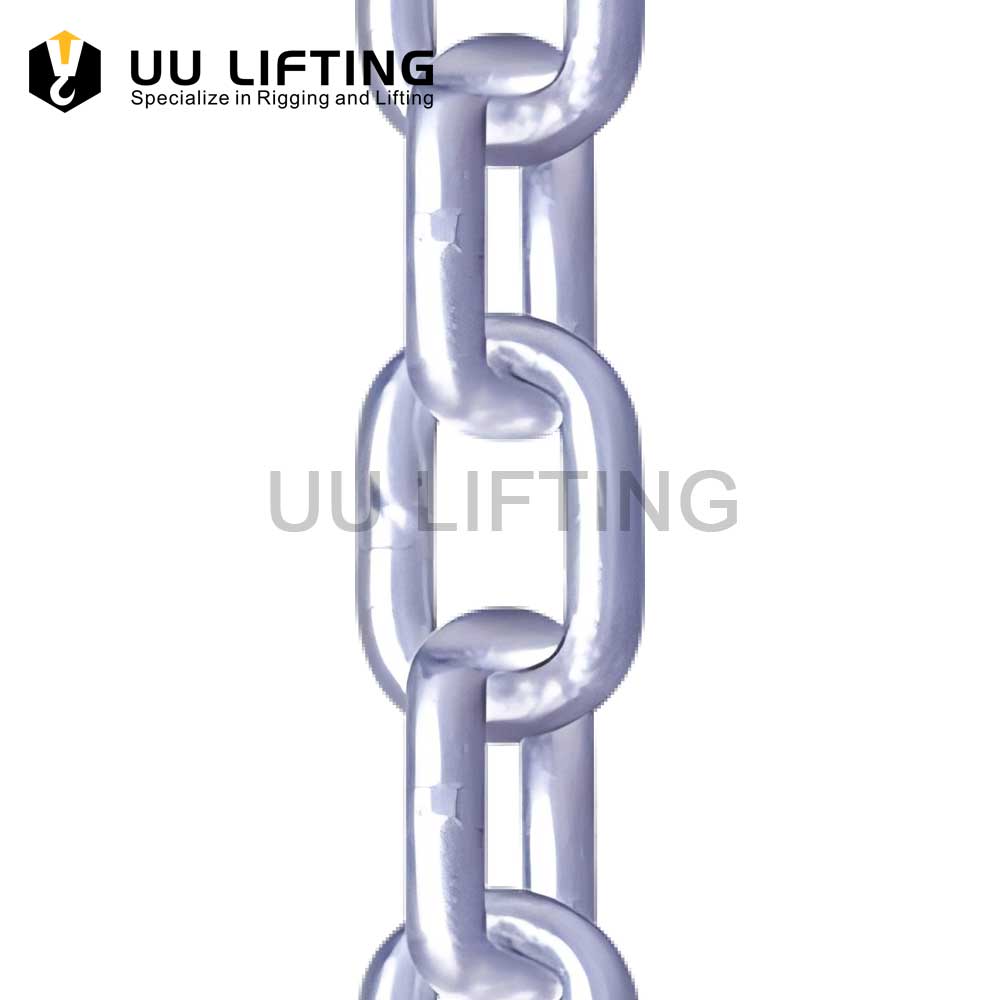
Use For Anchor Chain, Barrier, Insurance Against Burglary, Common Nonlifting Assignments.
Packaging
Custom packaging available
Din 766 Chainn Sizes:
Din 766 Chain Sizes
Din 766 Chain Sizes
Size
Inside Length
Inside Width
Outside Width
Length Per 11links
Weight Per M
(mm)
+/-(mm)
(mm)
+(mm)
-(mm)
(mm)
(mm)
(mm)
+(mm)
-(mm)
(kg)
2
0.2
12
0.2
0.2
3.5
7.5
132
1
0.5
0.07
3
0.2
16
0.2
0.2
4.2
11
176
1.4
0.7
0.16
4
0.2
16
0.3
0.2
5
13.7
176
2.1
1.1
0.32
5
0.2
18.5
0.4
0.2
6
17
203.5
2.4
1.2
0.5
6
0.2
18.5
0.4
0.2
7.2
20.2
203.5
2.4
1.2
0.8
7
0.3
22
0.4
0.2
8.4
23.8
242
3
1.4
1.1
8
0.3
24
0.4
0.2
9.6
27.2
264
3.2
1.5
1.4
9
0.4
27
0.5
0.3
10.8
30.6
297
3.6
1.8
1.8
10
0.4
28
0.5
0.3
12
34
308
3.7
1.9
2.2
11
0.4
31
0.5
0.3
13.2
37.4
341
4
2
2.7
12
0.3
36
0.6
0.3
14.4
40.8
396
4.4
2.2
3.1
13
0.5
36
0.6
0.3
15.6
44.2
396
4.6
2.4
3.8
14
0.6
41
0.7
0.4
16.8
47.6
451
5.4
2.7
4.4
16
0.6
45
0.8
0.4
19.2
54.4
495
6
3
5.7
18
0.9
50
0.8
0.4
21.6
61.2
550
6.6
3.3
7.3
19
0.4
53
0.9
0.4
22.8
64.6
583
7
3.7
7.97
20
1
56
1
0.5
24
68
616
7.4
3.7
9
23
1.2
64
1.1
0.5
27.6
78.2
704
8.4
4.2
12
26
1.3
73
1.2
0.6
31.2
88.4
803
9.6
4.8
15
28
1.4
78
1.3
0.65
33.8
95.2
858
10.2
5.1
18
30
1.5
84
1.4
0.7
41
102
924
11
5.5
19.5
32
1.6
90
1.5
0.75
43
108.8
990
11.8
5.9
23
What is DIN 766 Chain, and why is it essential for your anchor windlass?
DIN 766 is a German industrial standard for a calibrated, short-link chain. It is designed with very precise and uniform link dimensions. This ensures a perfect fit and smooth operation on a windlass gypsy, preventing dangerous slipping and jamming when you raise or lower your anchor.
What are the key specifications of DIN 766 chain?
The key specifications for DIN 766 chain are its nominal size (the wire diameter), the pitch (the internal length of each link), and its grade (e.g., Grade 30). These specifications guarantee the chain’s fit and strength for its intended application, like an anchor windlass.
What “Calibrated” Really Means
Calibration is not a suggestion; it is a requirement for this standard. It means every single link has a consistent size and shape. A windlass has a special wheel called a gypsy. This gypsy has pockets that are made to fit the chain links perfectly. If the links are inconsistent, the chain will jump, grind, and jam. A calibrated DIN 766 chain ensures smooth and reliable operation.
Understanding the Key Numbers
Here is a simple table to help you understand what to look for.
Specification
What It Means
Why It Matters for a Windlass
Nominal Size (d)
The diameter of the steel wire used to make the link.
This is the primary size reference, like “10mm chain”.
Pitch (t or L)
The internal length of each link.
This must match the gypsy on the windlass for a perfect grip.
Grade (e.g., G3)
The strength of the steel used.
Ensures the chain can handle the heavy loads of anchoring.
Finish
The protective coating, usually Hot Dip Galvanized.
The protective coating is usually Hot Dip Galvanized.
How is the DIN 766 chain different from the DIN 763 chain?
The main difference is the link dimension and calibration. DIN 766 is a short-link, calibrated chain made for windlasses. DIN 763 is a long-link, uncalibrated chain used for general purposes like barriers or securing cargo, not for lifting or anchoring with a windlass.
Link Dimensions: Short vs. Long
The most obvious difference is visual. For the same wire diameter, a DIN 763 chain link will be noticeably longer than a DIN 766 link. This short-link design of DIN 766 makes it stronger and less likely to twist or kink. It also allows it to bend smoothly around the small-diameter windlass gypsy.
Why Calibration is the Deciding Factor
Here is a clear comparison of the two standards.
Feature
DIN 766 Chain
DIN 763 Chain
Link Type
Short Link
Long Link
Calibration
Yes, strictly calibrated.
No, not calibrated.
Primary Use
Anchor windlasses, lifting systems.
Fencing, barriers, general lashing.
Windlass Fit
Designed to fit perfectly.
Will not fit or work correctly.
Interchangeable?
No. They cannot be swapped.
No. They cannot be swapped.
When you are sourcing a chain, you cannot substitute one for the other, even if they have the same material and diameter. Using DIN 763 on a windlass designed for DIN 766 will cause severe damage to the gypsy and create a very unsafe situation.
What are the common applications for DIN 766 chain?
The primary and most important application of the DIN 766 chain is for anchoring systems on boats and ships using a windlass. Its calibrated nature also makes it suitable for some industrial conveyor systems that require precise, repeatable chain movement.
The Perfect Match for Windlasses
A windlass gypsy has precision-machined pockets. These pockets are designed to securely grab each link of the chain. As the gypsy turns, it pulls the chain in or lets it out without slipping. This can only happen if every single chain link has the same dimensions. This is what DIN 766 guarantees. For any boat owner with a windlass, this is not just a feature; it’s a fundamental requirement for safe anchoring. There is no substitute here.
Industrial and Other Uses
While its main home is on the water, DIN 766’s properties make it useful in other areas. I have some customers in the food processing and manufacturing industries who use it. They build conveyor systems that move products along an assembly line. Because the chain’s movement is so predictable, it works well with automated machinery. The key takeaway is this: if your machine requires a chain with exact, consistent dimensions to function, DIN 766 is a strong candidate. For simple tasks like creating a barrier or tying down equipment on a truck, it is over-specified. A more economical chain, such as DIN 763, would be a better choice for those jobs.
OUR FACTORY
Raw materials of our products are made of high-quality steel that meets the standards, and the raw materials are traceable. And multiple production lines and machines minimize lead times for rigging and lifting equipment.
Raw Material
Forged
Cast
Chain Machine
Heat Treatment
Powder Plastified
Package
Warehouse
MANUFACTURING PROCESSES
With eight automatic forging and semi-automatic forging line of up to 1600ton press machines and specialized drillng, tapping, heat treatment and inspection equipment. Strict and standardized production process ensures you receive perfect products.
QUALITY CONTROL
All rigging and lifting products are subjected to strict working tension and breaking the tension test. Complied with ISO9001 and CE certification. Our promise to you: Guaranteed safety at work for people and materials.