3RD PARTY INSPECTION CERTIFICATE, SUCH AS ABS, BV, LR, NK, KR, CCS
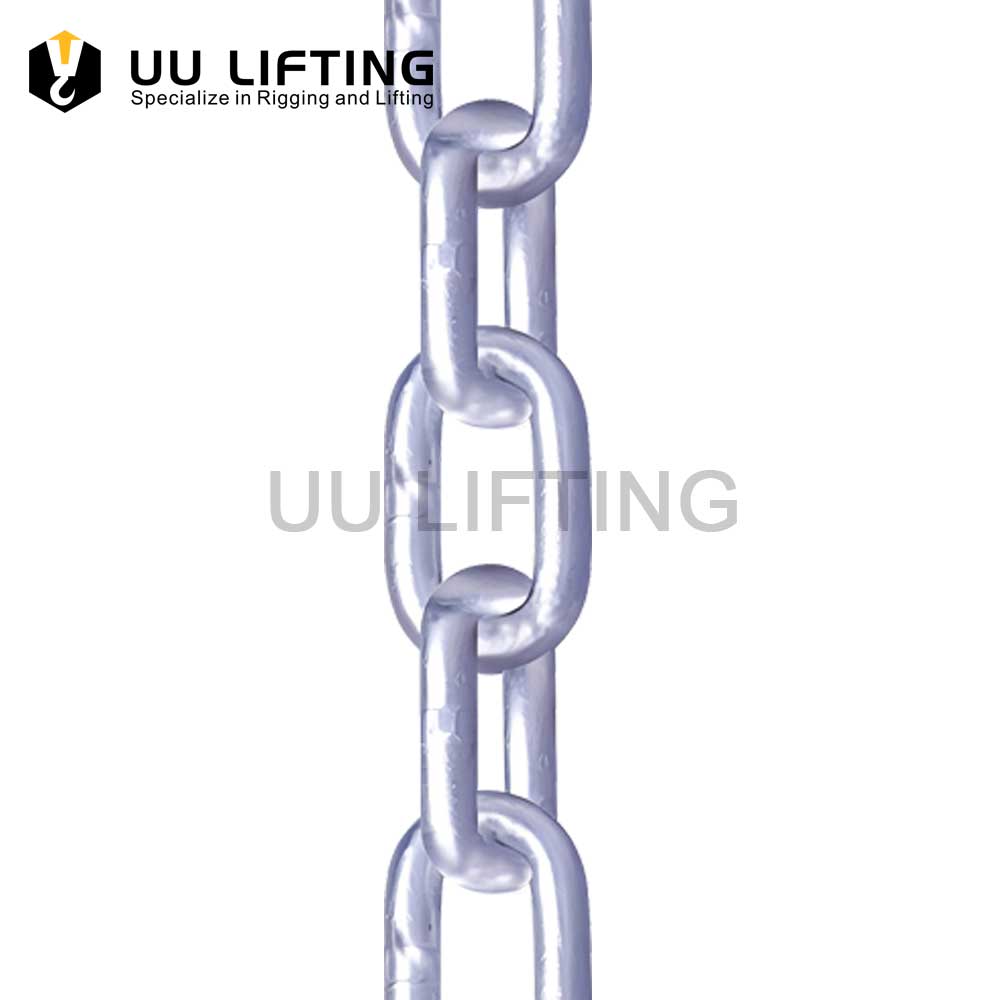
UK Standard Short Link Chain Sizes:
UK Standard Short Link Chain Sizes
UK Standard Short Link Chain Sizes
D
A
B
Test Load
Breaking Load
Netwt Per 200ft(Kg)
(in)
(mm)
(mm)
(mm)
(kg)
(kg)
B.F.
H.D.G.
1/8
3.20
16
12
200
400
11.40
11.74
5/32
4.00
18.5
14.5
300
600
18.60
19.00
3/16
4.70
19
17
400
800
26.20
27.00
7/32
5.50
20
19
550
1100
36.80
38.00
1/4
6.35
22
21
750
1500
50.00
51.50
5/16
7.94
26
26
1200
2400
80.00
82.40
3/8
9.50
28
32
1700
3400
122.00
125.70
7/16
11.11
33
36
2300
4600
164.00
169.00
1/2
12.70
39
43
3000
6000
210.00
216.00
5/8
15.80
45
53
4700
9400
334.00
344.00
3/4
19.00
55
63
6800
13600
485.00
499.00
7/8
22.20
64
74
9250
18500
656.00
675.00
1
25.40
73
84
12150
24300
870.00
896.00
What is a UK Standard Short Link Chain?
A UK Standard Short Link Chain typically refers to a chain compliant with the European standard EN 818-2. This standard specifies the safety requirements for Grade 80 short-link chains designed for use in chain slings and for general lifting, ensuring high strength and reliability.
How Are UK Short Link Chains Graded for Strength?
UK short link chains are graded based on the material’s tensile strength. For example, Grade 80 (G80) chain, common under EN 818-2, is made from high-strength alloy steel. This grade ensures it can safely handle the specified working load limits for overhead lifting applications.
Let’s break down the key strength indicators you’ll find on a spec sheet.
Understanding Load Ratings
The grade directly impacts these three critical values:
Working Load Limit (WLL): The maximum mass the chain is certified to lift. You must never exceed this limit.
Manufacturing Proof Force: The test load applied to the chain during production. It’s usually double the WLL. Every link is tested to ensure it is free of defects.
Minimum Breaking Force: The force at which the chain will fail. It’s typically at least four times the WLL, providing a significant safety factor.
Here’s a look at some common G80 chain specs from the EN 818-2 standard.
Nominal Size (mm)
Sizeing Load Limit (t)
Manufacturing Proof Force (kN)
Min. Breaking Force (kN)
8.0
2.0
50.3
80.4
10.0
3.2
78.5
126.0
13.0
5.3
133.0
212.0
16.0
8.0
201.0
322.0
I always tell my procurement team to verify these numbers on the supplier’s test certificates. A good supplier will provide them without hesitation. This is non-negotiable for me.
What are the Key Dimensions of a UK Standard Short Link Chain?
The key dimensions are the nominal Size (the Size of the link’s material), the pitch (the internal length of a link), and the external width. These measurements ensure the chain fits correctly on hooks, master links, and through lifting equipment without binding or stressing the components.
A ‘short link’ chain, as specified in EN 818-2, has specific proportions. This design makes it flexible and strong, but you have to match it to your equipment.
Critical Chain Dimensions
Here are the measurements you need to check:
Nominal Size (D): This is the diameter of the steel used to link. It’s the primary way we refer to a chain’s size, like ” Size 10 mm chain.”
Pitch (L): This is the internal length of one link. It determines how flexible the chain is and how it sits in a pulley or on a hook.
External Width (B): The widest point of the link. It’s crucial for ensuring the chain can pass through equipment openings.
Let’s see how these dimensions relate to the chain size.
Nominal Size (D) (mm)
Pitch (L) (mm)
External Width (B) (mm)
Internal Width (b) (mm)
8.0
24.0
27.5
11.5
10.0
30.0
34.5
14.5
13.0
39.0
45.0
19.0
16.0
48.0
55.5
23.5
Before placing any large order, I always get samples. I physically test them with our shackles, hooks, and other hardware. It’s a simple step that has saved me from huge headaches.
How Do You Ensure the Quality of UK Standard Short Link Chains?
Ensure quality by demanding full traceability of the raw materials, which should be high-quality alloy steel. Always ask for certificates of conformity and proof of force testing for the specific batch. A reliable manufacturer will have transparent production processes and provide all necessary documentation without hesitation.
This is where the rubber meets the road. As someone who has dealt with suppliers in China for years, I know that quality verification is the most important part of my job. I’ve seen fake certificates and been ghosted by sales reps. It’s frustrating. But good suppliers do exist, and they stand out by how they handle quality.
Here’s what I look for to protect my business.
My Quality Checklist
Traceable Raw Materials: I start at the very beginning. I ask where the steel comes from. The supplier should be able to provide documentation proving it’s high-quality alloy steel that meets international standards. If they can’t trace their raw materials, that’s a huge red flag for me.
Manufacturing Process: A good factory has modern production lines. They use automated processes for forming, welding, and heat treatment. This minimizes human error and ensures consistency. I often ask for videos of their production floor. It tells me a lot about their operation.
Testing and Certification: This is non-negotiable. Each batch of chain must include its own test certificate. This document should show the results of the proof force test and the break test. I don’t accept generic certificates. I need documentation that is specific to the batch I am purchasing. It’s the only way to be sure the chain meets the EN 818-2 standard.
Finding a supplier who is transparent about these three things is key. It builds the trust needed for a long-term business relationship.
OUR FACTORY
Raw materials of our products are made of high-quality steel that meets the standards, and the raw materials are traceable. And multiple production lines and machines minimize lead times for rigging and lifting equipment.
Raw Material
Forged
Cast
Chain Machine
Heat Treatment
Powder Plastified
Package
Warehouse
MANUFACTURING PROCESSES
With eight automatic forging and semi-automatic forging line of up to 1600ton press machines and specialized drillng, tapping, heat treatment and inspection equipment. Strict and standardized production process ensures you receive perfect products.
QUALITY CONTROL
All rigging and lifting products are subjected to strict working tension and breaking the tension test. Complied with ISO9001 and CE certification. Our promise to you: Guaranteed safety at work for people and materials.