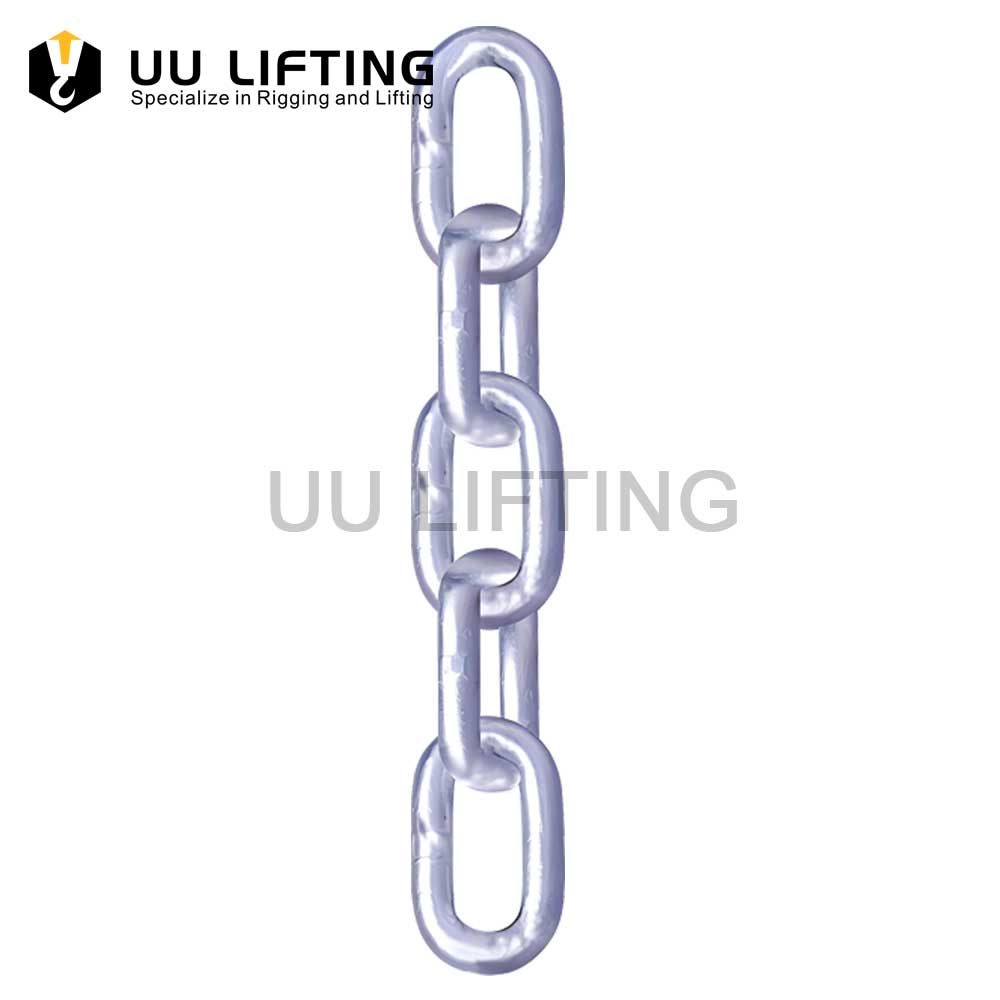
Australian Standard Long Link Chain Specifications:
Material
Carbon Steel
Surface Finish
Supplied In Self-Color, Electro-Galvanized, And Hot-Dipped Galvanized Surface.
Application
Manufacturing, Marine and Agricultural industries
Packaging
Drum + Steel pallets. Custom packaging available
Australian Standard Long Link Chain Sizes:
Australian Standard Long Link Chain Sizes
Australian Standard Long Link Chain Sizes
Chain Size
W.L.L.
DIA.
L
W
Length Per 100kg
(mm)
(kgs)
(mm)
(mm)
(mm)
B.F.
H.D.G.
5
190
5
29.3
21.8
217
206
6
320
6.3
34.5
26.1
135
128
8
530
8
41.2
31.9
82.2
78.1
10
830
10
49
38.7
52.9
50.2
What is Australian Standard Long Link Chain, and Why Does It Matter for Your Business?
Australian Standard Long Link Chain is a type of commercial, non-lifting chain defined by specific Australian standards. It features elongated links, making it lighter and more flexible than a lifting chain, ideal for applications like lashing, agriculture, and marine anchoring, where strength is needed but not for overhead lifting.
Getting the right chain is more than just a purchase; it’s about ensuring safety and efficiency for your operations. I’ve seen many buyers, especially those new to sourcing from China, get confused between the different chain types. They sometimes overspend on heavy-duty lifting chains for a simple job or, much worse, use a light-duty chain for a critical lift. Understanding the specifics of the Australian Standard long link chain will help you make smarter, safer, and more cost-effective decisions. This knowledge protects your investment and your reputation. Let’s dive into the details so you can source with confidence.
How is Long Link Chain Different from Short Link Chain?
The main difference is the pitch, or the internal length of the link. Long link chains have a longer pitch, making them flexible but weaker. Short link chains have a short, uniform pitch, which gives them superior strength and allows them to fit securely on lifting equipment.
When you are sourcing a chain, the distinction between long link and short link is one of the most important things to understand. It directly impacts safety and function. Short link chain, especially Grade T (80) or V (100) chain made to Australian Standard AS 2321, is the only type of chain that should be used for overhead lifting. Its short, calibrated links are designed to fit perfectly into the pockets of a chain block or lever hoist. If the links are too long, they won’t seat properly, leading to slipping and catastrophic failure.
A long chain of links is not designed for this. Its value lies in its flexibility and lighter weight. Think of it as a general-purpose tool.
Key Differences at a Glance
High-rated Working Load Limit (WLL)
Long Link Chain
Short Link Chain (to AS 2321)
Primary Use
Lashing, anchoring, fencing, general use
Overhead lifting, hoisting
Pitch (Internal Length)
Longer relative to diameter
Shorter, precisely calibrated
Flexibility
More flexible, can be knotted
Less flexible, rigid structure
Lifting Suitability
NEVER for overhead lifting
Specifically designed for lifting
Strength
Lower breaking load
High, rated Working Load Limit (WLL)
Standard Example
General hardware standards
AS 2321 (for lifting chains)
Choosing the wrong one isn’t a small mistake. It’s a fundamental error that can have serious consequences. Always match the chain type to the application.
What are the Key Specifications for this Chain?
Key specifications for general-purpose Australian Standard chains relate to material, finish, and minimum breaking strength. They are typically made from mild steel and finished with hot-dip galvanizing for corrosion resistance. These specs are less strict than those for Grade T lifting chains.
When you buy an Australian Standard long link chain, you’re not just buying a piece of metal. You are buying a product that should meet a set of performance expectations in Australian conditions. While there isn’t a single standard that covers all long link chains, as AS 2321 does for lifting, the requirements are often drawn from standards related to their use, such as those for marine equipment or trailer components.
### Material and Construction
Most long link chains are made from low-carbon or mild steel. It’s a cost-effective material that provides adequate strength for non-lifting tasks. The links are typically welded to form the chain. The quality of this weld is critical. A poor weld is a weak point waiting to fail.
### Finish and Corrosion Protection
Australia has diverse environments, from humid coastlines to the dry outback. The chain’s finish is crucial for its lifespan.
Hot-Dip Galvanized (HDG): This is the premium choice for outdoor and marine use. The chain is dipped in molten zinc, creating a thick, durable, and highly corrosion-resistant coating.
Zinc Plated (Electro-Galvanized): This process applies a thinner zinc layer. It offers some corrosion protection and is suitable for indoor or dry environments, but will rust much faster than HDG in outdoor conditions.
Self-Colour: This means the chain has no protective coating, just the raw steel. It is the cheapest option, but it will rust very quickly if exposed to any moisture. It is only suitable for applications where it will be painted or kept oiled.
For the Australian market, I almost always recommend hot-dip galvanizing for any chain intended for outdoor use.
When Should You Usea Long Link Chain?
Use a long link chain for applications where flexibility is more important than high strength and where overhead lifting is never involved. It is perfect for securing loads, agricultural fencing, marine mooring, and general-purpose utility use around a worksite.
Using the right tool for the job saves money and improves efficiency. A long chain of links is the perfect example of this principle. Its design makes it unsuitable for lifting, but it excels in many other areas where a short link chain would be cumbersome and expensive.
I once worked with a client who ran a large agricultural supply business. He was buying expensive Grade 70 transport chain for everything, including simple farm gates and temporary fencing. It was strong, but it was also heavy, inflexible, and costly. We showed him how a high-quality hot-dip galvanized long-link chain could do the job for a fraction of the price. The switch saved him a significant amount of money that he could then reinvest in his business.
### Common Applications
Marine & Boating: The longer links are less likely to clog with mud and seaweed, making them ideal for anchor chains on smaller boats and mooring lines.
Agriculture: It’s widely used for livestock fencing, hanging gates, and securing equipment in barns. It’s easy to handle and connect.
Transport & Lashing: It can be used as a light-duty tie-down or lashing chain. Note: It should not be used for critical load restraint systems on trucks, which require a specifically rated transport chain (like Grade 70).
General & Security: Great for creating barriers, hanging signs, or as a general utility chain in a workshop.
The key takeaway is versatility. As long as you respect its limitation—no lifting—it’s an incredibly useful and economical product to have.
How Can You Verify the Chain’s Quality and Compliance?
Verify quality by demanding batch-specific test certificates that show breaking force results. Ask for clear documentation of compliance with relevant standards. Most importantly, partner with a transparent manufacturer who welcomes third-party inspections and stands behind their product.
This is the biggest pain point I hear about from buyers like Mark, my American client. He specializes in rebranding and distributing rigging hardware. He once sourced a container of what he was told was galvanized chain for marine use. The price was great, but the product was a disaster. The “galvanizing” was just a thin, shiny zinc plating that started showing rust within weeks. His supplier in Vietnam became unresponsive. He had to scrap the whole shipment.
That experience taught him a hard lesson: trust must be verified. At UU LIFTING, we build that trust through transparency.
### Your Quality Verification Checklist
Demand a Batch Test Certificate: Do not accept a generic “type” certificate. Ask for the Material Test Certificate (MTC) and the breaking load test report for the specific production batch you are buying. It should be traceable to your order.
Understand the Finish: Ask your supplier to specify the finishing process. If you need it for outdoor use, confirm in writing that it is “hot-dip galvanized” and ask for the coating thickness in microns. A good supplier will know this information.
Inquire about Weld Quality: Ask about their welding process and quality control checks. A reliable manufacturer will have procedures to verify complete, consistent welds on every link.
Partner with a Transparent Supplier: The best way to guarantee quality is to work with the right people. A good partner will answer your technical questions, provide clear documentation, encourage factory visits, and be willing to work with a third-party inspector you hire. If a supplier is hesitant about any of this, it’s a major red flag.
Your reputation is built on the quality of the products you sell. Never compromise on your verification process.
OUR FACTORY
Raw materials of our products are made of high-quality steel that meets the standards, and the raw materials are traceable. And multiple production lines and machines minimize lead times for rigging and lifting equipment.
Raw Material
Forged
Cast
Chain Machine
Heat Treatment
Powder Plastified
Package
Warehouse
MANUFACTURING PROCESSES
With eight automatic forging and semi-automatic forging line of up to 1600ton press machines and specialized drillng, tapping, heat treatment and inspection equipment. Strict and standardized production process ensures you receive perfect products.
QUALITY CONTROL
All rigging and lifting products are subjected to strict working tension and breaking the tension test. Complied with ISO9001 and CE certification. Our promise to you: Guaranteed safety at work for people and materials.