3RD PARTY INSPECTION CERTIFICATE, SUCH AS ABS, BV, LR, NK, KR, CCS
UK Standard Medium Link Chain Sizes:
UK Standard Medium Link Chain Sizes
UK Standard Medium Link Chain Sizes
D
A
B
Test Load
Breaking Load
Netwt Per 200ft(Kg)
(in)
(mm)
(mm)
(mm)
(kg)
(kg)
B.F.
H.D.G.
1/8
3.20
20
12
200
400
10.40
11.00
5/32
4.00
23
15
300
600
17.40
18.00
3/16
4.70
25
18
400
800
24.40
25.00
7/32
5.50
26
19
550
1100
34.00
35.00
1/4
6.35
26
23
750
1500
48.80
50.00
5/16
7.94
32
29
1200
2400
76.00
78.00
3/8
9.50
35
35
1700
3400
111.00
114.00
7/16
11.11
38
38
2300
4600
154.00
158.00
1/2
12.70
50
45.5
3000
6000
194.00
200.00
5/8
15.80
60
56.7
4700
9400
303.00
312.00
3/4
19.00
76
69
6800
13600
432.00
445.00
7/8
22.20
90
80
9250
18500
586.00
603.00
1
25.40
105
95
12150
24300
770.00
792.00
What is a UK Standard Medium Link Chain?
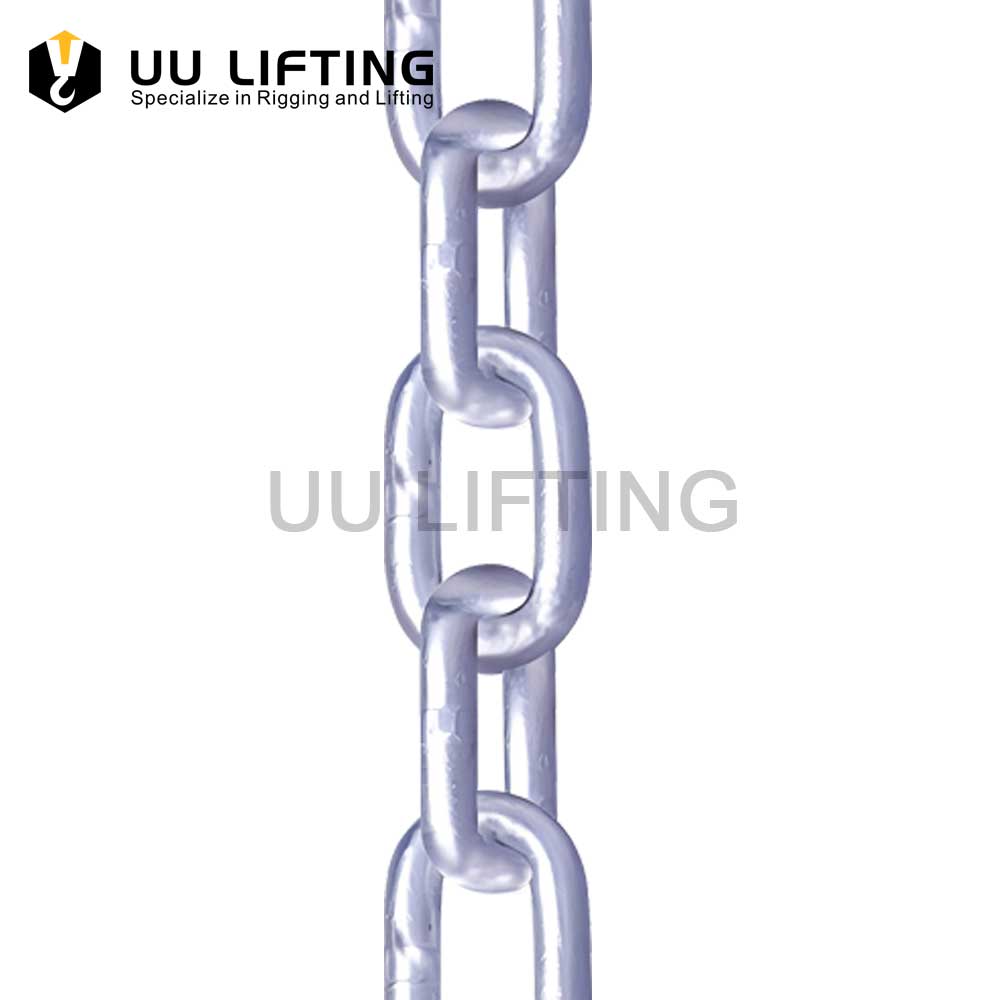
UK Standard Medium Link Chain is a general-purpose welded steel chain. Its link dimensions fall between those of short and long link chains. It is typically used for lashing, security, and agricultural purposes, not for overhead lifting. Its specifications are often defined by British Standards (BS).
How is the Medium Link Chaindifferent from the Short and Long Link Chains?
The main difference is the link’s internal length relative to its Diameter. Short link chains are strong and flexible, ideal for lifting. Long link chains are lighter but weaker. Medium link chains offer a balance, suitable for general-purpose use but usually not for overhead lifting.
Link Pitch and Flexibility
A short link chain has a small pitch. This design makes the chain very flexible. It sits securely in the pockets of a chain hoist or on a pulley without slipping. In contrast, a long link chain has a much larger pitch. It is less flexible and noticeably lighter for its length. A medium link chain sits right in the middle of these two. It’s more flexible than a long chain of links. But it is not as flexible as a short link chain. This middle-ground flexibility is what defines its range of uses.
Application and Strength
These physical differences determine how you can safely use the chain. I explained to Mark that a short link chain, like our EN818-2 Grade 80 chain, is designed and rated for overhead lifting. The links articulate well and distribute stress evenly across the chain. A long chain of links is never for lifting. It is better for things like fences or boat anchors, where reducing weight is more important than high strength. Medium link chain is the versatile option for lashing down cargo, securing equipment, and general hardware use where lifting is not involved.
Here is a simple table to show the differences:
Feature
Short Link Chain
Medium Link Chain
Long Link Chain
Primary Use
Overhead Lifting, Hoists
Lashing, Securing
Fencing, Anchoring
Flexibility
High
Medium
Low
Strength
Highest
Medium
Lowest
Weight
Heaviest
Medium
Lightest
Cost
Highest
Medium
Lowest
What Are the Key Specifications for UK Medium Link Chain?
Key specifications include material diameter, internal link dimensions (pitch), material type, and finish (e.g., zinc-plated, self-coloured). Most importantly, you need to check which British Standard (BS) it’s manufactured to, as this governs its dimensions and safe use applications.
Critical Dimensions
The Diameter of the wire is just the start. The internal length (pitch) and internal width are just as important. For a medium link chain, these dimensions are larger than for a short link chain of the same Diameter. This proportional difference defines it as a “medium link.” If the pitch is wrong, it might not work with standard fittings or equipment designed for it, causing problems on the job site.
Material, Finish, and Standard
The material is usually mild steel for general-purpose chains. The finish protects the chain against corrosion. A bright zinc-plated (BZP) finish is very common on UK standard chains because it offers good protection in many environments. The most critical part of the specification is the standard it’s made to. A common one is BS 4942. This standard defines the exact dimensions, materials, and testing protocols. When you check a supplier’s certificate, make sure this standard is clearly listed. It’s your guarantee of conformity.
Specification
What it Means
Why it Matters
Nominal Diameter (mm)
Thickness of the steel wire
Primary factor for strength
Pitch (mm)
Internal length of a link
Defines it as medium link; affects flexibility
Standard (e.g., BS 4942)
The rulebook for manufacturing
Guarantees dimensions and quality control
Finish (e.g., BZP)
Protective coating (Bright Zinc Plated)
Prevents rust and corrosion
Proof Force Test
A test load applied to every link
A test load is applied to every link
Why Is Choosing the Right Grade and Material So Important?
The material and grade determine the chain’s strength, or Working Load Limit (WLL). A higher grade, like the Grade 80 alloy steel we use for lifting chains, is much stronger than the standard mild steel used in general-purpose medium link chains. It’s the key to safety.
Mild Steel vs. Alloy Steel
Most UK standard medium link chains are made from mild steel. It’s a good, workable material, perfect for lashing and general use. It is not heat-treated to increase its strength. For overhead lifting, we must use alloy steel. We add elements such as manganese and chromium to steel. Then, we use a special heat treatment process of quenching and tempering. This process changes the steel’s internal structure. It makes the steel incredibly strong and highly resistant to stretching and fatigue.
What “Grade” Really Means
This is where grade comes in. A designation like ‘Grade 80’ or ‘G80’ is a promise. It promises that the chain is made from heat-treated alloy steel. It also promises to meet a specific minimum breaking strength. An ungraded mild steel chain has no such promise. This is why you must never, under any circumstances, use a general-purpose medium link chain for overhead lifting. The risk of sudden, catastrophic failure is far too high. A reliable supplier can always provide a material certificate to prove the steel’s composition and grade.
How Can You Verify the Quality of Your Medium Link Chain?
Always request a manufacturer’s test certificate. This document should show results from a proof load test. For lifting chains, it must also show the grade marking (e.g., ‘G80’). Visually inspect the welds and finish. For total assurance, consider independent third-party testing on a sample.
The Power of Documentation
Your most powerful tool is documentation. Don’t just accept a simple “certificate of conformity.” You should demand a manufacturer’s mill test report for the raw material and a final test certificate for the finished chain. This documentation traces the product from the steel coil to the final link. It should list the chemical composition of the steel. It must also show the results of mechanical tests, including the proof force applied and the minimum breaking force achieved. For our G80 lifting chains, we provide this for every single batch. This paperwork is your first and best line of defense against fraud.
Physical Inspection and Testing
When the chains arrive at your warehouse, check them yourself. Do the dimensions measured with calipers match the certificate? Are the welds clean and uniform, with no spatter or cracks? Is the finish consistent? For lifting chains, look for the grade markings stamped on the links every few feet. For ultimate peace of mind, especially with a new supplier, take a sample from the batch. Send it to an independent testing lab in your own country. A good supplier will not be afraid of this. In fact, we encourage it because it builds long-term trust.
OUR FACTORY
Raw materials of our products are made of high-quality steel that meets the standards, and the raw materials are traceable. And multiple production lines and machines minimize lead times for rigging and lifting equipment.
Raw Material
Forged
Cast
Chain Machine
Heat Treatment
Powder Plastified
Package
Warehouse
MANUFACTURING PROCESSES
With eight automatic forging and semi-automatic forging line of up to 1600ton press machines and specialized drillng, tapping, heat treatment and inspection equipment. Strict and standardized production process ensures you receive perfect products.
QUALITY CONTROL
All rigging and lifting products are subjected to strict working tension and breaking the tension test. Complied with ISO9001 and CE certification. Our promise to you: Guaranteed safety at work for people and materials.