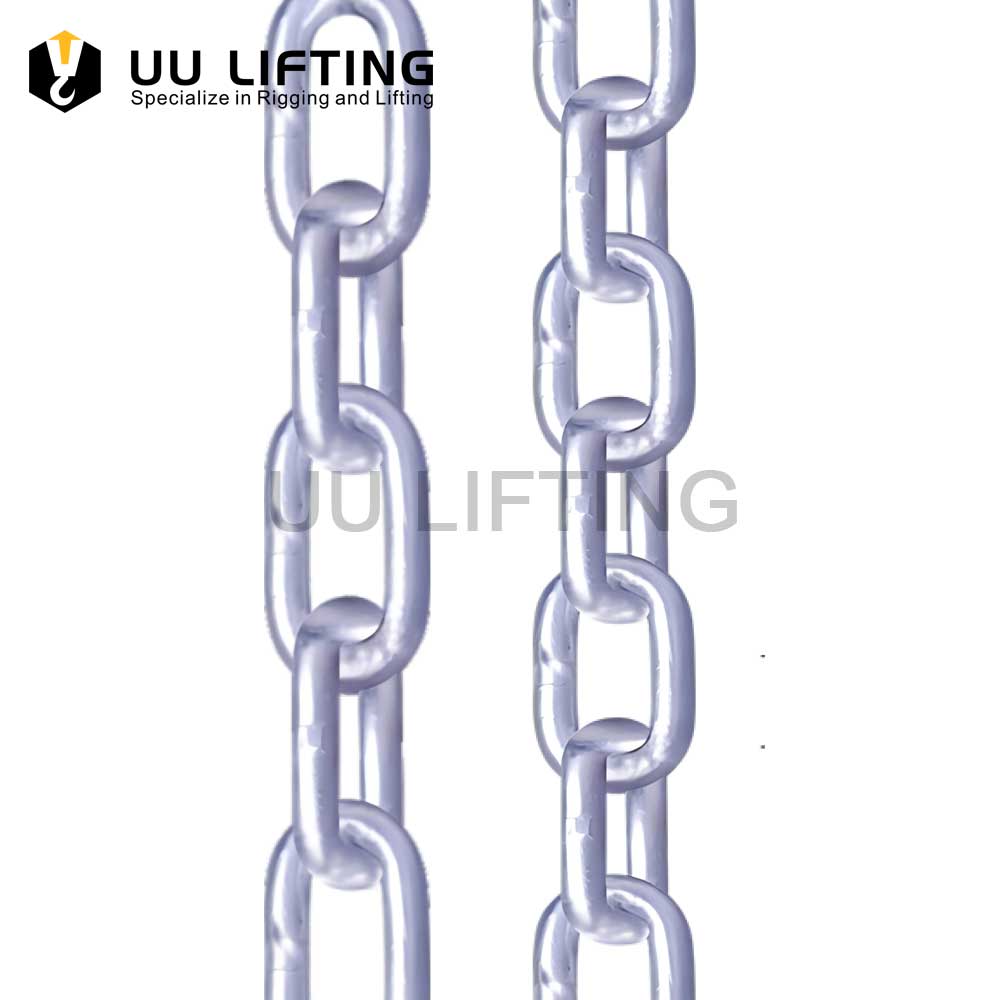
Electric Galvanized, Hot Dip Galvanized, Self-color.
Welded Construction
Good Strength and Durability
Application
Industrial, Agricultural, and Marine Applications, Offering High Strength and Durability.
Packaging
Sacks, Wrapping Wheels, Plastic Drums, Iron Drums, Wooden Boxes, Cartons, Etc. Custom packaging available
Din 5685 Welded Link Chain Sizes:
Din 5685 Welded Link Chain Sizes
Din 763 Welded Link Chain Sizes
Size
Inside Length
Outside Width
Working Load
Breaking Load
Weight Per M
Grade
(mm)
(mm)
(mm)
(N)
(N)
(kg)
2
12
8
500
1250
7
A
22
6
C
2.5
14
10
750
2000
11
A
24
10
C
3
16
12
1120
2800
16.5
A
26
15
C
4
19
16
2000
5000
30
A
32
27
C
5
21
20
3150
7750
50
A
35
43
C
6
24
24
4500
11500
73
A
42
63
C
7
28
28
6000
15000
100
A
49
86
C
8
32
32
8000
20000
130
A
52
110
C
9
36
36
10000
25000
165
A
59
141
C
10
40
40
12500
31000
205
A
65
175
C
11
44
44
15000
38000
250
A
72
211
C
12
48
48
18000
45000
290
A
78
255
C
13
52
52
21200
53000
345
A
82
295
C
What is DIN 5685 Chain and Is It Right For Your Application?
DIN 5685 is a German standard for commercial-grade, welded steel link chains. It is not rated for overhead lifting. This chain is mainly used for general purposes, such as fencing, barriers, and securing items, not for hoisting heavy loads. It offers a cost-effective solution for non-critical applications.
What are the different types of DIN 5685 chains?
DIN 5685 chains mainly come in two forms. Form A has short links, making it a bit stronger and less likely to snag. Form C has long links, which makes it lighter and more flexible. The choice depends on whether you need more strength or more flexibility for your job.
DIN 5685 Form A: The Short Link Chain
This type is also known as DIN 5685 A. The links are short and compact. This means there are more steel links for every meter of chain. The shorter pitch makes the chain stronger and more rigid than the long-link version. It is less likely to get tangled or snag on things. Because of this, it is often a good choice for security applications, like chaining gates or creating barriers. The extra steel makes it slightly heavier and usually a bit more expensive.
DIN 5685 Form C: The Long Link Chain
This version is called DIN 5685 C. The links are visibly more stretched out. A longer pitch means fewer links per meter. This makes the chain lighter and more flexible. It’s often cheaper than the short link version because it uses less material. This flexibility can be useful for things like agricultural fencing or hanging signs, where a little bit of drape and movement is okay.
Here is a simple table to show the difference:
Feature
DIN 5685 Form A (Short Link)
DIN 5685 Form C (Long Link)
Link Size
Short and compact
Long and stretched
Strength
Higher
Lower
Flexibility
Lower
Higher
Weight
Heavier
Lighter
Cost
Higher
Lower
Best Use
Security, barriers
Fencing, general hanging
What are the key specifications of DIN 5685 chains?
DIN 5685 chains are typically made from low-carbon steel, like Q195 or Q235. They are not heat-treated for strength. The most common surface finishes are electro-galvanized (zinc-plated) for basic rust protection or hot-dip galvanized for better, long-lasting outdoor protection.
Material Composition
Most DIN 5685 chains are made from low-carbon steel. This type of steel is easy to form and weld, which helps keep the cost down. However, it does not have the high strength of alloy steels. It is not heat-treated to increase its hardness or strength. This is a key reason why it’s a “commercial” chain. It’s designed for general-duty tasks where it won’t be put under extreme stress. The priority is cost-effectiveness, not high performance.
Surface Finishes
The finish protects the steel from rust. There are two common options.
Electro-Galvanized (Zinc-Plated): This process uses electricity to apply a thin layer of zinc. It gives the chain a shiny, smooth appearance. This finish offers basic protection against rust and is fine for indoor use or areas with very little moisture. It is the cheaper option.
Hot-Dip Galvanized (HDG): For this finish, the chain is dipped into a molten zinc bath. This creates a much thicker, more durable coating. The finish is dull and a bit rough, but it offers far superior rust protection. I always recommend HDG for any chain that will be used outdoors, especially in wet or coastal areas. It costs more, but it lasts much longer.
Finish
Appearance
Protection Level
Best for…
Electro-Galvanized
Shiny, smooth
Basic
Indoor, dry use
Hot-Dip Galvanized
Dull, rougher
Excellent
Outdoor, wet use
Is the DIN 5685 chain suitable for lifting?
Absolutely not. DIN 5685 chain is a commercial-grade chain and is not designed, tested, or certified for overhead lifting. Using it for lifting is extremely dangerous and goes against all safety regulations. For lifting, you must use rated chains, such as Grade 80 or Grade 100.
Why It’s Not For Lifting
There are clear reasons why you cannot use this chain for lifting.
Material: It’s made of low-carbon steel, not high-strength alloy steel. It will stretch and break under loads that a lifting chain can handle easily.
No Heat Treatment: Lifting chains are quenched and tempered (a heat treatment process) to make them incredibly strong and durable. DIN 5685 chains are not.
No Proof Testing: Every link of a proper lifting chain is proof tested to twice its working load limit (WLL) before it leaves the factory. This ensures there are no hidden defects. DIN 5685 chains do not undergo this mandatory test.
No Rating or Markings: Lifting chains are clearly stamped with their grade (e.g., G80, G100) and manufacturer’s mark. This is a legal requirement. DIN 5685 has no such markings because it isn’t rated for a safe WLL.
What to Use Instead?
For any overhead lifting, you must use a chain specifically designed for it. At UU LIFTING, we supply high-quality lifting chains for this exact purpose.
Grade 80 Chain (G80): This is the industry standard for lifting chains. It is made from alloy steel, heat-treated, and proof-tested. It is perfect for making chain slings and for all general lifting applications.
Grade 100 Chain (G100): This chain is about 25% stronger than Grade 80 of the same size. It allows you to use a smaller, lighter chain for the same load, which can be a big advantage.
Always choose a rated lifting chain from a reputable supplier. Your safety and your team’s safety depend on it.
How does DIN 5685 compare to other DIN chains?
DIN 5685 is a general-purpose, non-calibrated chain. In contrast, DIN 766 is a calibrated chain, meaning its links have uniform dimensions to work with windlasses. DIN 763 is a long-link chain, similar in application to DIN 5685 C, but made to a different specification.
The Importance of Calibration
The word “calibrated” is key. It means the chain is manufactured to very strict dimensional tolerances.
Non-Calibrated (DIN 5685): The link size can vary slightly from one link to the next. This is fine for making a fence or a security chain.
Calibrated (DIN 766): Every single link has a precise, consistent size and pitch. This is essential for anchor chains pulled by a boat’s windlass. The windlass has a special wheel (a gypsy) with teeth that fit the chain links perfectly. If the links are not uniform, the chain will jump, causing a very dangerous jam.
Application Differences
Because of their different properties, these chains are not interchangeable.
DIN 5685: The go-to chain for general hardware use. Think agriculture, decorative barriers, light-duty security, or hanging tools. It is not for lifting or for use in a windlass.
DIN 763: A long-link general-purpose chain. Its applications are very similar to DIN 5685 C. It’s used for many of the same purposes, such as fencing and agriculture. It is also not for lifting.
DIN 766: A calibrated short-link chain. Its primary use is for boat anchor windlasses. Because of its consistent link size, it provides smooth, reliable operation when raising or lowering an anchor.
Here is a final comparison table:
DIN Standard
Link Type
Calibration
Primary Use
Lifting?
DIN 5685 A/C
Short / Long
No
General Purpose
No
DIN 763
Long
No
General Purpose
No
DIN 766
Short
Yes
Anchor Windlass
No
OUR FACTORY
Raw materials of our products are made of high-quality steel that meets the standards, and the raw materials are traceable. And multiple production lines and machines minimize lead times for rigging and lifting equipment.
Raw Material
Forged
Cast
Chain Machine
Heat Treatment
Powder Plastified
Package
Warehouse
MANUFACTURING PROCESSES
With eight automatic forging and semi-automatic forging line of up to 1600ton press machines and specialized drillng, tapping, heat treatment and inspection equipment. Strict and standardized production process ensures you receive perfect products.
QUALITY CONTROL
All rigging and lifting products are subjected to strict working tension and breaking the tension test. Complied with ISO9001 and CE certification. Our promise to you: Guaranteed safety at work for people and materials.