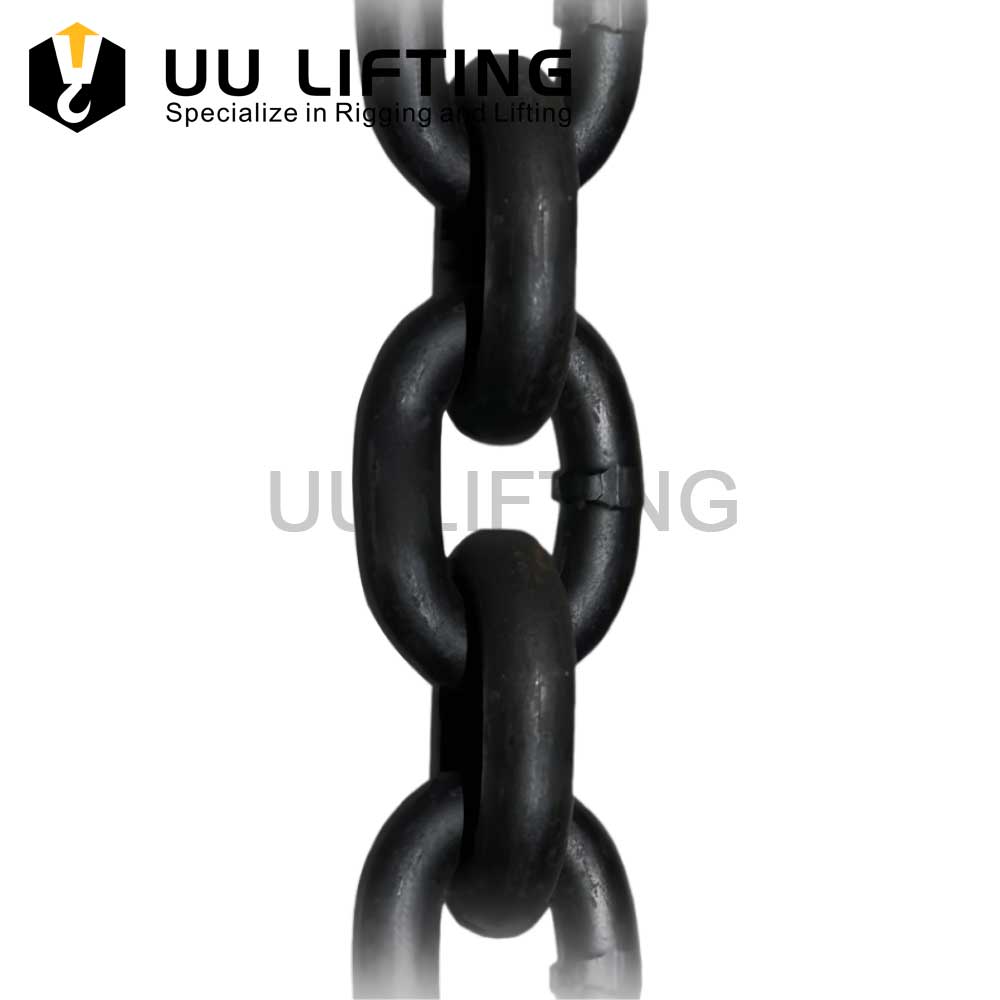
Hot Dip Galvanized, Self-Colored, Electroplated Zinc.
Application
Mooring and Log Booming
Barge Chain Sizes:
Barge Chain Sizes
Barge Chain Sizes
Size
A
B
MBL
Weight
(mm)
(mm)
(lbs)
(kg/pc)
1″ x 6links
127
51
55000
9
1″ x 6links
127
51
80000
9
1″ x 8links
127
51
55000
12
1″ x 8links
127
51
80000
12
What is a Barge Chain and Why is it Critical for Your Operation?
A barge chain is a very heavy-duty chain made specifically for mooring, towing, and connecting barges. It is built from high-strength, corrosion-resistant steel. Its main job is to handle the high forces encountered in harsh marine environments securely. It ensures barges stay put or move safely.
I’ve learned that a barge chain is much more than just a big, strong chain. As a buyer, I had to understand the small details that make a huge difference. These details separate a reliable product from a potential liability. If you’re sourcing rigging equipment, especially for marine use, you need to know these details too. It’s about protecting your investment, your cargo, and most importantly, your people. Let’s look at what really matters when you’re buying a barge chain.
What Makes Barge Chains Different from Regular Lifting Chains?
Barge chains are built for constant tension and harsh marine environments. They focus on resisting abrasion and corrosion. Lifting chains are designed for vertical lifts. They prioritize high tensile strength and fatigue resistance. You cannot use them interchangeably.
When I first started sourcing rigging, I almost made the mistake of thinking all high-strength chains were the same. A supplier in Asia once tried to sell me a Grade 80 lifting chain for a mooring application. He said, “It’s very strong!” He was right about the strength, but wrong about the application. The experience taught me to dig deeper.
Material and Design
Barge chains are designed to be dragged, submerged, and pulled for long periods. Their steel often contains more manganese, which makes it tougher and more resistant to wear and tear. Lifting chains, like the Grade 80 or Grade 100 I buy for overhead cranes, use different alloy steels. These are heat-treated to maximize the strength-to-weight ratio for vertical lifting. The link shape is also different. Barge chains can have shorter, thicker links to prevent kinking. This is important when the chain lies on the seabed.
Key Differences at a Glance
Feature
Barge Chain
Lifting Chain
Primary Use
Mooring, Towing, Lashing
Overhead Lifting
Material Focus
Toughness, Abrasion Resistance
High Tensile Strength
Link Design
Often shorter/thicker to resist kinking
Uniform, elongated for smooth running
Corrosion
High resistance is critical (e.g., galvanized)
Important, but less extreme exposure
Common Standards
Marine Class Societies (ABS, DNV)
Industrial Standards (ASME, EN)
Understanding this table is the first step to avoiding a bad purchase. Don’t let a salesperson convince you that “strong is strong.” The right type of strength is what counts.
How Do You Choose the Right Specification for a Barge Chain?
To select the right barge chain, you must consider the barge’s size (tonnage), the water type (freshwater or saltwater), and applicable regulations (e.g., ABS). These factors determine the required chain diameter, steel grade, and surface finish to guarantee a safe working load.
I remember a project where we were supplying a fleet in South America. The initial request was for a specific chain diameter. It seemed straightforward. But I pushed back and asked for more details about the vessels and the port conditions. It turned out the currents were much stronger than in their previous location. We ended up recommending a higher-grade chain. This kept the diameter the same but significantly increased the breaking strength. The client was happy, and we avoided a potential problem.
Calculating Strength and Understanding Grades
The most important value is the Minimum Breaking Load (MBL). This is the force at which the chain will break. This value must be much higher than any force the chain will experience from the vessel, wind, and currents. Don’t just guess. Work with an engineer or a knowledgeable supplier to calculate your needs. Marine chains often come in grades like U2 or U3. A higher grade, like U3, offers greater strength for the same chain diameter. This can reduce the overall weight, which is a big advantage.
The Importance of the Finish
The chain’s finish is not just for looks. It’s the primary defense against corrosion, especially in saltwater. Hot-dip galvanizing is the most common and effective finish for marine chains. It creates a thick, durable zinc layer that protects the steel. Some chains have a black tar finish, but galvanizing offers longer life. When you’re buying from a factory thousands of miles away, you need to trust that the finish was applied correctly. A poor finish will quickly lead to rust, weakening the chain and forcing you to replace it much sooner.
What Certifications Should You Demand for Barge Chains?
Always obtain a Mill Test Certificate (MTC) for material traceability and a proof-load test certificate. For marine chains, you must also require a third-party certificate from a class society like ABS, DNV, or LR. This is independent proof of quality.
This is my biggest pain point with some overseas suppliers. Early in my career, a shipment was delayed because the provided certificates were fraudulent. The port authority caught it, not us. We were lucky. Now, I am assertive about this. I don’t just ask for the paper; I verify it.
The Role of Classification Societies
Groups such as the American Bureau of Shipping (ABS), DNV, and Lloyd’s Register (LR) are the global authorities on marine equipment. They don’t just look at paperwork. Their surveyors go to the factory. They witness the proof load tests. They approve the manufacturing process. A chain with an ABS certificate means an ABS expert has physically verified that it meets their standards. This is the highest level of quality assurance you can get. It costs the manufacturer more, but it’s non-negotiable for serious buyers.
How to Spot a Fake Certificate
I tell my team to be detectives. Look for typos or weird formatting. Check that the technical data on the certificate exactly matches the product specification. Most importantly, find the classification society office contact information on the certificate and call them. Ask them to verify the certificate number. I have done this many times. It’s a simple call that has saved me from buying junk rigging more than once. Any hesitation from a supplier to let you do this is a major red flag. True quality suppliers like UU LIFTING are proud of their certifications and will help you verify them.
OUR FACTORY
Raw materials of our products are made of high-quality steel that meets the standards, and the raw materials are traceable. And multiple production lines and machines minimize lead times for rigging and lifting equipment.
Raw Material
Forged
Cast
Chain Machine
Heat Treatment
Powder Plastified
Package
Warehouse
MANUFACTURING PROCESSES
With eight automatic forging and semi-automatic forging line of up to 1600ton press machines and specialized drillng, tapping, heat treatment and inspection equipment. Strict and standardized production process ensures you receive perfect products.
QUALITY CONTROL
All rigging and lifting products are subjected to strict working tension and breaking the tension test. Complied with ISO9001 and CE certification. Our promise to you: Guaranteed safety at work for people and materials.