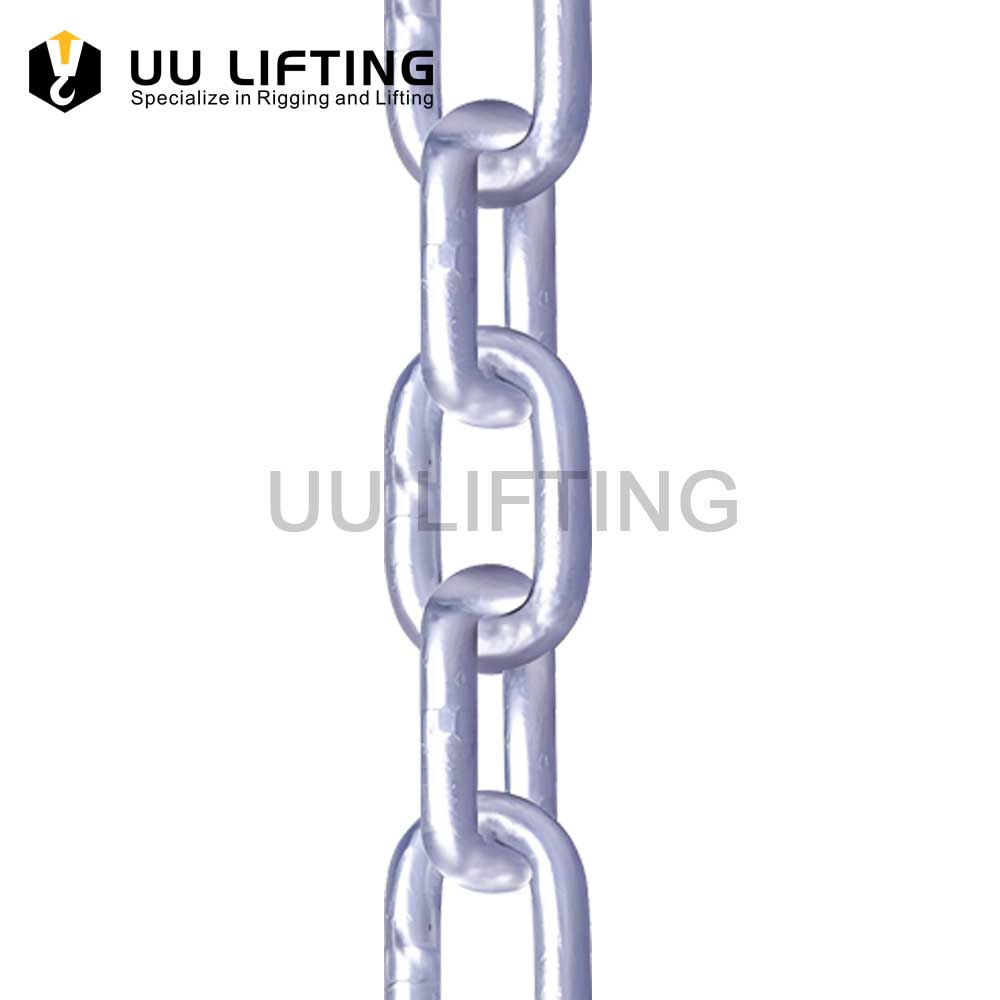
High Carbon Steel, Mild Steel And Stainless Steel Chains
Standards
DIN 764
Surface Finish
Hot Dip Galvanized, Electro-Galvanized Or Self-Color.
Features
Welded Chain
Application
Suitable For All General Purpose, Engineering, Industrial, Agricultural And Marine Applications
Packaging
Carton, Gunny Bag, Case Or Steel Drum. Custom Packaging Available
Din 764 Welded Link Chain Sizes:
Din 764 Welded Link Chain Sizes
Din 764 Welded Link Chain Sizes
Size
Inside Length
Inside Width
Outside Width
Length Per 11links
Weight Per M
(mm)
+/-(mm)
(mm)
+(mm)
-(mm)
(mm)
(mm)
(mm)
+(mm)
-(mm)
(kg)
4
0.2
16
0.3
5
14
176
1.6
31.3
7
400
0.2
0.9
5
0.2
18
0.4
7
18.2
198
1.8
51.4
11.8
680
0.2
1
6
0.2
21
0.5
8
21.5
231
2
74
16.5
850
0.2
1.1
8
0.2
28
0.5
11
29
308
2.2
131.5
32
1680
0.3
1.2
10
0.3
35
0.6
14
36
385
2.7
200
50
2630
0.3
1.5
13
0.4
45
0.7
18
47
495
3.5
350
80
4200
0.4
2
16
0.5
56
0.9
22
58
616
4.3
520
125
6700
0.5
2.5
18
0.8
63
1
24
65
693
4.7
650
160
8400
0.5
2.8
20
1
70
1.1
27
72
770
5.4
820
200
10000
0.6
3.2
23
1.2
80
1.3
31
83
880
6.2
1100
250
13000
0.7
3.5
26
1.3
91
1.5
35
94
1001
7
1400
320
16000
0.8
4
What Is A DIN 764 Welded Link Chain And Why Should You Care?
DIN 764 is a German standard for round steel link chains that are not calibrated and not tested to a specific load. They are mainly used for general purposes like fencing, barriers, and decorative applications, not for overhead lifting.
I’ve been in this business for decades. I learned the hard way that a small detail in a product code, like “DIN 764,” can mean the difference between success and a costly mistake. Let’s dig into what this standard really means so you don’t make the same errors I did. It is very important to understand the details before you place your next big order.
What Are The Key Specifications Of A DIN 764 Chain?
The main specifications for DIN 764 chains focus on dimensions like the nominal Size (wire diameter), the inside length (pitch), and the outside width. Crucially, it’s an untested chain, so it does not have a guaranteed working load limit (WLL) for lifting.
When I review a spec sheet for DIN 764 chain, I focus on a few core things. The most important thing to remember is that this chain is defined by its Size, not its strength. I remember a new buyer on my team almost ordered a pallet of what he thought was a lifting chain because the diameter looked right. It was a DIN 764. If I hadn’t caught it, we could have faced a serious safety incident. The “untested” part is not a suggestion; it’s a rule. This chain is for general use only, like for agricultural barriers or securing a gate. It is not for lifting anything. The material is typically a basic low-carbon steel. The finish can vary, from self-colored (oiled) to zinc-plated for rust resistance.
Key Dimensions
Here are the typical dimensions you’ll see on a spec sheet.
Nominal Size (d)
Pitch (t)
Width (b)
3 mm
24 mm
12 mm
4 mm
26 mm
14 mm
5 mm
28 mm
16 mm
6 mm
32 mm
20 mm
8 mm
40 mm
24 mm
10 mm
50 mm
30 mm
Always get the spec sheet from your supplier. Then, make sure the product you receive matches it exactly.
How Does DIN 764 Compare To Other Common Chain Standards?
DIN 764 chains are long-link and untested for a specific load. In contrast, DIN 763 is also a long-link chain but is sometimes tested. DIN 766 is a short-link, calibrated chain designed for specific uses such as anchor windlasses, where uniform link size is essential.
Understanding these differences has saved me thousands of dollars. Early in my career, I assumed all “long-link chains” were basically the same. That was a big mistake. The application dictates the standard you need. A chain for a decorative railing has very different requirements from a chain that runs on a gypsy wheel. If you supply the wrong one to your customer, your reputation is on the line. I always think about the end-use. This helps me select the right standard and ask the right questions of my supplier. It avoids confusion and ensures my customers get exactly what they need for their job.
Link Pitch
The pitch is the internal length of a single link. DIN 764 and DIN 763 are “long-link” chains. This means they are more flexible and weigh less per foot. DIN 766 is a “short-link” chain. Its links are more compact, making it stronger and better suited for applications where the chain must fit perfectly over a sprocket or windlass.
Calibration
Calibration is about consistency. A calibrated chain, such as DIN 766, has a very precise, uniform pitch. This is critical for anchor chains so they run smoothly on the windlass without jamming. DIN 764 is not calibrated. The link dimensions can vary slightly, which is fine for its intended use as a general-purpose chain.
Load Rating
This is the most important difference. DIN 764 is generally sold without a certified breaking load or Working Load Limit (WLL). It is not for lifting. Other standards, especially lifting chains such as Grade 80 or Grade 100, are specifically manufactured and tested for overhead lifting and come with certificates to verify their capacity.
Feature
DIN 764
DIN 763
DIN 766
Link Type
Long Link
Long Link
Short Link
Calibration
No
No
Yes
Load Tested
No
Sometimes
Sometimes
Primary Use
Fencing, general utility
General utility, barriers
Anchor chains, windlasses
What Are The Critical Quality Checks When Sourcing DIN 764 Chains?
For DIN 764 chains, you must verify the material is correct, usually low-carbon steel. Then check the weld quality on each link for completeness. Also, confirm that the surface finish, such as zinc plating thickness, meets your order specifications to prevent rust.
I’ve learned that you can’t just trust the paperwork—my worst experiences with suppliers involved receiving products that looked right but failed quickly. A shipment of chain with poor galvanization started rusting on a customer’s site within weeks. It was a nightmare. Now, I have a strict process for every order. It doesn’t matter if it’s a high-strength lifting chain or a simple utility chain like DIN 764. Quality control is not something I compromise on. This protects my company’s money and its reputation.
Material Verification
I always ask for a Material Test Certificate (MTC). I have dealt with suppliers who tried to use inferior steel to save money. A real MTC from a good manufacturer is non-negotiable for me. It is the first step to avoiding problems down the line. It tells me the chemical composition of the steel, so I know it meets the basic requirements.
Weld Integrity
This is where I get hands-on, or I have my agent on the ground do it. Look closely at the welds on the links. A good weld should be complete, smooth, and fully fused. You should not see any gaps, cracks, or excessive weld splatter. These are big red flags. A bad weld is just a future break waiting to happen, even in a non-critical application.
Finish and Dimensions
If you order galvanized chain, check the coating. Is it uniform? Is it thick enough to last? I also use calipers to spot-check the link dimensions against the spec sheet. I check the wire diameter, the pitch, and the width. Shipments can be delayed for weeks if you receive a full container of pout-of-spec product. It’s much better to check it before it leaves the factory.
OUR FACTORY
Raw materials of our products are made of high-quality steel that meets the standards, and the raw materials are traceable. And multiple production lines and machines minimize lead times for rigging and lifting equipment.
Raw Material
Forged
Cast
Chain Machine
Heat Treatment
Powder Plastified
Package
Warehouse
MANUFACTURING PROCESSES
With eight automatic forging and semi-automatic forging line of up to 1600ton press machines and specialized drillng, tapping, heat treatment and inspection equipment. Strict and standardized production process ensures you receive perfect products.
QUALITY CONTROL
All rigging and lifting products are subjected to strict working tension and breaking the tension test. Complied with ISO9001 and CE certification. Our promise to you: Guaranteed safety at work for people and materials.