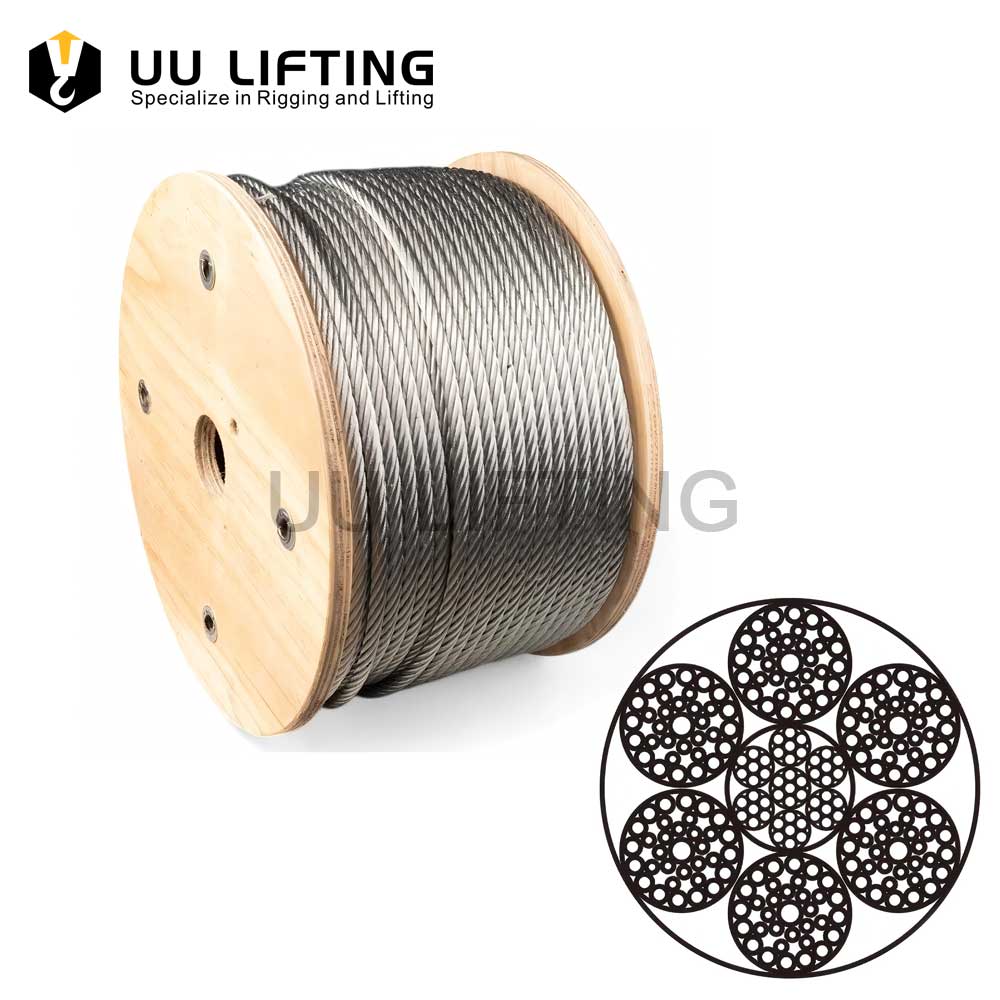
What Is a 6x41WS Steel Wire Rope and Why Is It So Strong?
A 6x41WS steel wire rope is a high-strength rope made of 6 strands, each with 41 wires arranged in a Warrington Seale pattern. This specific design offers excellent crush resistance and good flexibility, making it ideal for demanding industrial lifting and hoisting applications.
I’ve seen many clients, like Mark from the US, choose the wrong rope and face costly failures. They focus on price but do not understand the construction. The details, like the “WS,” make all the difference. Let me break it down for you so you can make a smarter choice. Let’s look closer at what makes this rope special.
How does the 6×41 Warrington Seale (WS) construction work?
The Warrington Seale (WS) construction combines two wire patterns in one strand. It has larger outer wires for abrasion resistance. It also has a mix of large and small inner wires for flexibility and strand stability. This dual-pattern design creates a versatile, durable wire rope.
Let’s break down the name “6x41WS” to understand its power. The “6” means the rope has six outer strands wrapped around a central core. The “41” tells us each of those six strands is made from 41 individual wires. This high wire count contributes to the rope’s strength and fatigue resistance.
The most important part is “WS,” which stands for Warrington Seale. This is not one pattern but a combination of two.
Understanding the Wire Patterns
Warrington Pattern: This pattern uses wires of different sizes within the same layer. It alternates between a large and a small wire. This increases the rope’s flexibility.
Seale Pattern: This pattern uses an equal number of large outer wires and smaller inner wires. The large outer wires offer excellent abrasion and wear resistance.
The WS construction takes the best of both. It typically has a Warrington layer on the inside for flexibility and a Seale layer on the outside for toughness. This combination creates a dense, stable strand that is highly resistant to crushing. When I talk with procurement officers, I use this table to simplify it.
Construction Type
Main Feature
Best For
6×19 Seale
High abrasion resistance
Drag lines, coarse conditions
6×37 Class
Very high flexibility
Crane ropes on small drums
6×41 WS
Excellent crush resistance, good flexibility
Winches, cranes, heavy hoisting
The 41 wires in a WS pattern increase the metal content of the rope’s cross-section. This provides better internal support. That is why it resists flattening on winch drums so well.
What are the best applications for 6x41WS wire rope?
6x41WS wire rope is best for applications involving high pressure and crushing forces. This includes main hoist lines on mobile and overhead cranes, winch lines, boom pendants, and heavy-duty drilling rigs. Its durability makes it a reliable choice for severe operating conditions.
The features of a 6x41WS rope directly translate to its performance in tough jobs. Its primary strength is its resistance to crushing and abrasion. This makes it a perfect solution for specific industrial challenges.
Why It Excels on Drums
Think about a winch with multiple layers of rope spooled onto the drum. The pressure on the bottom layers is immense. A less-dense rope, like a 6×37 class, can flatten or deform under this pressure. This damages the rope and can cause unsafe, jerky spooling. The dense, stable structure of a 6x41WS rope maintains its round shape. This ensures smooth operation and a much longer service life in multi-layer spooling situations.
Industry-Specific Uses
Construction and Cranes: It is a top choice for main and auxiliary hoist lines on crawler cranes, mobile cranes, and tower cranes where strength and reliability are critical.
Mining and Oilfields: The rope’s durability makes it ideal for heavy-duty drilling lines, winch lines, and other demanding applications in mining and oil exploration.
Marine and Ports: It is used for mooring lines and winch ropes, which must withstand heavy loads and harsh environmental conditions.
I remember a client in South America who switched to 6x41WS for their mining winches. They told me their rope replacement frequency dropped by 40%. The initial cost was slightly higher, but the long-term savings from less downtime and fewer replacements were huge. This is what I mean by looking beyond the sticker price.
How does the core type affect 6x41WS rope performance?
The core is the heart of the rope. For a 6x41WS rope, an Independent Wire Rope Core (IWRC) is standard. The IWRC is a small wire rope itself. It provides strong support, increases strength, and resists crushing far better than a fiber core (FC).
When you specify a 6x41WS wire rope, you must also consider its core. The core runs through the center and supports the outer strands. It keeps them in the correct position. The choice of core dramatically impacts the rope’s overall performance. For a high-performance rope like 6x41WS, one core type is clearly superior.
Independent Wire Rope Core (IWRC)
This is the standard and most recommended core for 6x41WS. The IWRC is literally a smaller, independent wire rope at the center of the main rope. This “rope within a rope” design offers several key benefits:
Increased Strength: An IWRC adds about 7.5% to the rope’s total minimum breaking strength.
Superior Crush Resistance: It provides a solid, unyielding foundation for the outer strands. This is critical for preventing rope deformation on winch drums.
Lower Stretch: Steel stretches less than fiber, providing more precise load control.
Heat Resistance: The all-steel construction makes it suitable for high-temperature environments where a fiber core would degrade.
Fiber Core (FC)
A fiber core is made from natural (like sisal) or synthetic (like polypropylene) fibers. While it offers more flexibility, it is not the right choice for 6x41WS applications. An FC can be compressed easily, which defeats the purpose of the crush-resistant WS construction. It cannot provide the rigid support needed for heavy loads and high-pressure spooling.
I always create this simple table for customers like Mark, who value quality details.
Core Type
Strength & Crush Resistance
Flexibility
Heat Resistance
Typical Use with 6x41WS
IWRC
Excellent
Good
Excellent
Standard Choice
FC
Poor
Excellent
Poor
Not Recommended
For a procurement officer, specifying IWRC is a non-negotiable quality point for this type of heavy-duty rope. It is a key detail I always confirm in my quotations to ensure the customer gets the performance and safety they expect.
OUR FACTORY
Raw materials of our products are made of high-quality steel that meets the standards, and the raw materials are traceable. And multiple production lines and machines minimize lead times for rigging and lifting equipment.
Raw Material
Forged
Cast
Chain Machine
Heat Treatment
Powder Plastified
Package
Warehouse
MANUFACTURING PROCESSES
With eight automatic forging and semi-automatic forging line of up to 1600ton press machines and specialized drillng, tapping, heat treatment and inspection equipment. Strict and standardized production process ensures you receive perfect products.
QUALITY CONTROL
All rigging and lifting products are subjected to strict working tension and breaking the tension test. Complied with ISO9001 and CE certification. Our promise to you: Guaranteed safety at work for people and materials.