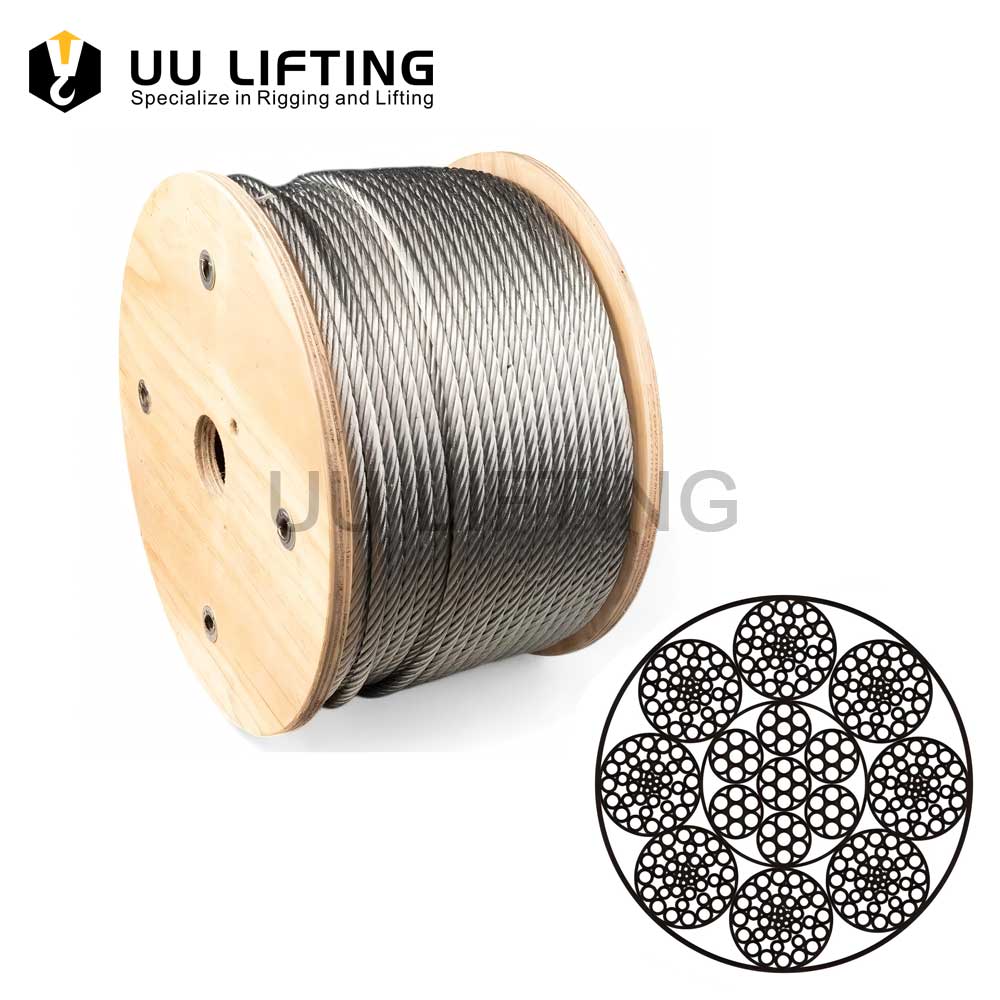
What is an 8x49SWS Line Contacted Wire Rope, and is it right for you?
An 8x49SWS is a high-performance wire rope. It has 8 strands with 49 wires each, in a special Seale-Warrington-Strand design. Its “line contact” construction reduces internal wear and fatigue, making it very durable and flexible for tough applications such as cranes and hoists.
Understanding the name is the first step. The real value lies in understanding how this construction benefits your business. I’ve had many conversations with customers, like Mark from the States, about this. He needs ropes that won’t fail on his customers’ cranes. He runs a distribution business, and his reputation depends on the quality of the products he supplies. Let’s dive deeper into what makes this rope so special and why it might be the solution you’re looking for. It’s about more than just steel; it’s about performance and safety.
How does the 8x49SWS construction improve performance?
Confused by technical terms like “line contact” and “SWS”? You worry that these are the SWS (Seale Warrington Strand) designs, which offer a good balance of crush resistance and flexibility. The “line contact
“Between wires, instead of point contact, spreads stress and reduces internal friction. This means less wear, higher fatigue resistance, and a longer service life for the rope.
Let me break this down. I often explain this to procurement officers who aren’t technical experts, but need to make smart buying decisions. They need to justify the cost, and understanding the ‘how’ is key. The magic of the 8x49SWS rope is in these two design details. They are not just fancy acronyms. These are the reasons this rope can handle demanding jobs day after day without failing. It’s about clever engineering that saves you money and headaches in the long run.
Understanding Line Contact
In many standard wire ropes, the wires in different layers of a strand only touch at small points. Think of it like balancing a ball on a flat surface. All the pressure is on one tiny spot. This is called “point contact.” This creates very high stress inside the rope. When the rope bends over a sheave or pulley, these points grind against each other. This causes internal wires to wear down and break much faster.
Line contact is different. The wires are shaped and arranged so they rest against each other along a continuous line. This is more like a cylinder resting on a flat surface. The pressure is spread out over a much larger area. This significantly reduces the stress on any single point. The result is less internal friction, less wear, and a significant improvement in the rope’s resistance to fatigue from constant bending.
The Seale-Warrington-Strand (SWS) Advantage
“SWS” stands for Seale Warrington Strand. This is a combination design that takes the best features of two other strand patterns.
Seale: A Seale pattern has a layer of large outer wires over a layer of smaller inner wires. The large outer wires provide excellent resistance to abrasion or external wear.
Warrington: A Warrington pattern has alternating large and small wires in its outer layer. This makes the strand more flexible.
The SWS construction combines these ideas. It gives you a rope with both high abrasion resistance and good flexibility. This balanced design makes it a versatile, high-performance choice.
Feature
Point Contact (e.g., Simple 6×19)
Line Contact (e.g., 8x49SWS)
Benefit for You
Internal Stress
High
Low
Rope lasts much longer
Fatigue Resistance
Lower
Higher
Safer for repetitive lifting
Internal Wear
Fast
Slow
Better long-term investment
What are the best applications for an 8x49SWS wire rope?
8x49SWS is ideal for demanding applications where flexibility and fatigue resistance are critical. This includes main hoist lines on mobile cranes, tower cranes, and overhead cranes. It also works well for boom hoist ropes and some heavy-duty winch lines.
My customer Mark sells to construction and port logistics companies. Their cranes are the heart of their business. If a crane’s hoist rope fails, the entire project comes to a halt. It costs them thousands of dollars per hour. For them, a rope isn’t just a rope; it’s a critical component that ensures uptime and safety. They need something they can trust. That’s where a rope like 8x49SWS comes in. It’s built for the jobs where downtime is not an option. Let’s look at exactly where it shines.
Dynamic Lifting Applications
This rope is a star in “dynamic” situations. This means any job where the rope is constantly moving, bending, and under load.
Crane Main Hoist Lines: This is the primary job for 8x49SWS. Tower cranes, mobile cranes, and factory overhead cranes all lift loads by running the rope through a series of sheaves and onto a drum. This constant bending is exactly what fatigues a lesser rope. The 8-strand construction and line-contact design of the 8x49SWS are ideal for resisting this fatigue.
Boom Hoist Lines: The ropes that raise and lower a crane’s boom also undergo significant stress and bending. An 8x49SWS provides the durability and reliability needed for this crucial function.
Heavy-Duty Winches: For winching operations that require a flexible rope that spools well on a drum, the 8x49SWS is an excellent choice. Its 8-strand construction makes it rounder and more stable on the drum than a 6-strand rope.
When to Consider Other Options
Honesty is important in this business. An 8x49SWS is not the perfect rope for every single job. For example, in very deep lifts with a single line of rope, “rotation resistance” becomes very important to stop the load from spinning. In these cases, a special rotation-resistant rope (such as a 19×7 or 35×7) is a better, safer choice. Also, for static jobs where the rope doesn’t move much, like a guy wire or support cable, the high fatigue resistance of an 8x49SWS is overkill. A more economical rope, like a standard 6×19, would be a more sensible choice. It’s all about matching the tool to the task.
How does 8x49SWS compare to common ropes like 6×19 and 6×37?
Compared to 6×19 and 6×37, an 8x49SWS offers superior flexibility and fatigue resistance thanks to its 8 strands and line-contact design. While 6×19 is more abrasion-resistant and 6×37 is more flexible than 6×19, the 8x49SWS provides a premium balance for demanding lifting jobs.
This is a question I get all the time. A customer like Mark needs to stock the right mix of products. He needs the cost-effective workhorses and the high-performance specialists. Understanding the trade-offs is how he best serves his market. The choice isn’t about which rope is “best” overall, but which is best for a specific application and budget. Let’s put them side-by-side. The differences are clear when you know what to look for.
The Trade-Off Triangle: Wear, Fatigue, and Cost
Think of choosing a wire rope as a balancing act. You are usually balancing three things: abrasion resistance (resistance to external wear), fatigue resistance (resistance to breaking from bending), and cost.
6×19 Construction: This is a very common and cost-effective rope. It has six strands, each with relatively few, large outer wires. These large wires make it very resistant to abrasion. If your rope is dragging on the ground or rubbing against something, a 6×19 is tough to handle. But, because it has fewer wires, it’s also stiffer and less resistant to bending fatigue.
6×37 Construction: This rope also has six strands, but with more and smaller wires in each strand. All those smaller wires make it much more flexible than a 6×19. It handles bending over small sheaves much better. The trade-off is that the smaller outer wires are less resistant to abrasion.
8x49SWS Construction: This rope is in a different class. With eight strands, it is more flexible and spools better on drums than 6-strand ropes. The SWS design provides a great balance of abrasion resistance and flexibility. Most importantly, the line contact engineering gives it superior fatigue resistance that neither 6×19 nor 6×37 can match. It’s the premium choice for performance.
Here is a simple table I use to help my customers decide.
Feature
6×19 Class
6×37 Class
8x49SWS Class
Abrasion Resistance
Best
Good
Better
Flexibility
Good
Better
Best
Fatigue Resistance
Good
Better
Best
Crush Resistance on Drum
Good
Good
Best
Cost
Low
Medium
High
For a distributor, having all three allows them to offer a “good, better, best” solution to their customers. For an end user, it means they can pick the most cost-effective rope that still performs the job safely.
OUR FACTORY
Raw materials of our products are made of high-quality steel that meets the standards, and the raw materials are traceable. And multiple production lines and machines minimize lead times for rigging and lifting equipment.
Raw Material
Forged
Cast
Chain Machine
Heat Treatment
Powder Plastified
Package
Warehouse
MANUFACTURING PROCESSES
With eight automatic forging and semi-automatic forging line of up to 1600ton press machines and specialized drillng, tapping, heat treatment and inspection equipment. Strict and standardized production process ensures you receive perfect products.
QUALITY CONTROL
All rigging and lifting products are subjected to strict working tension and breaking the tension test. Complied with ISO9001 and CE certification. Our promise to you: Guaranteed safety at work for people and materials.