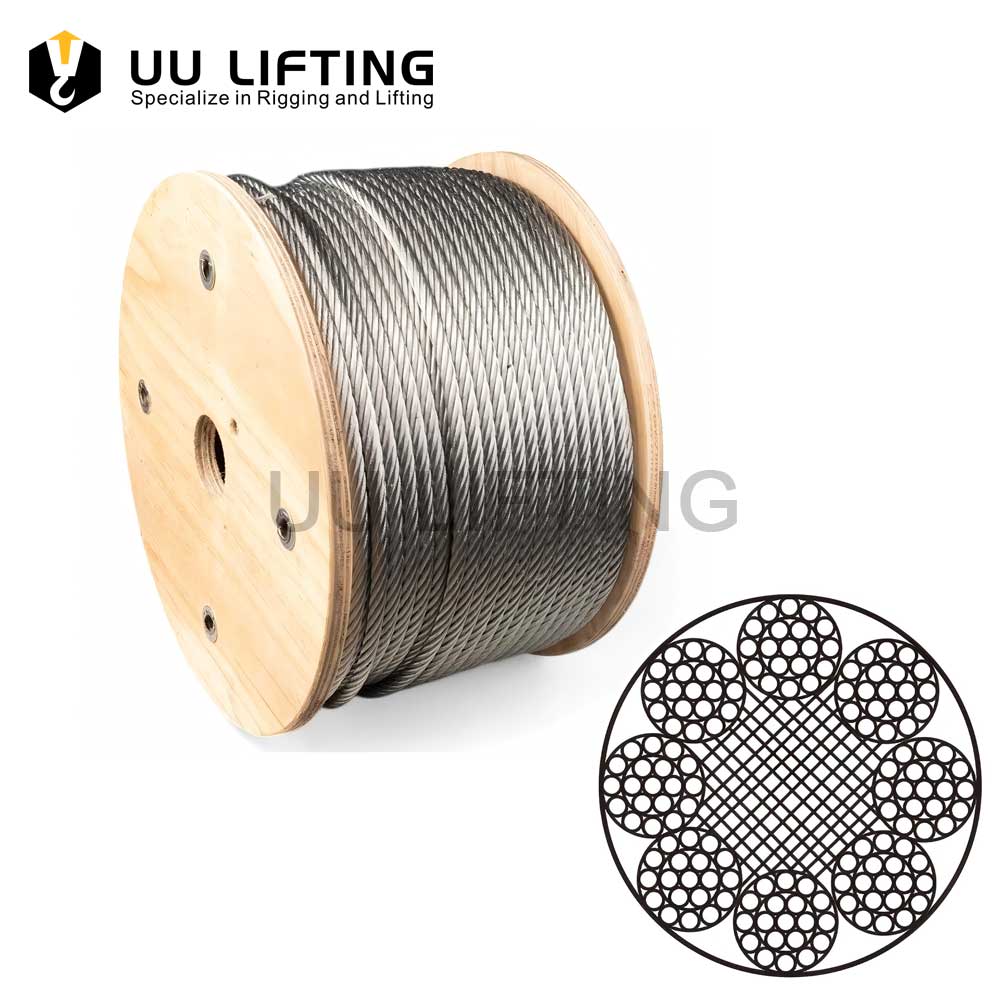
What Is an 8x25Fi Line Contact Wire Rope and Why Should You Care?
An 8x25Fi Line Contact wire rope is a special type of rope with eight strands. Each strand has about 25 wires arranged for line contact, not point contact. This design gives you excellent flexibility, fatigue resistance, and durability for your most demanding lifting jobs.
I often talk with clients about their frustrations with wire rope. I remember a conversation with Mark, an American company owner who buys a lot of lifting gear. He was tired of replacing his crane ropes so often. They would either wear down from abrasion or fail from fatigue after bending over the sheaves again and again. He needed something better. That’s when I introduced him to the 8x25Fi construction. It really opened his eyes to what a modern wire rope can do. So let’s dig into what makes this rope so special.
What does “8×25” actually mean
“8×25” is a code that describes the construction of a rope. “8” means it has eight outer strands. “25” is the class, meaning about 25 wires per strand. “I” stands for “Fille”, a design with small wires that fill gaps for better strength.
Let’s break this down further. It’s easy to understand when you see a wire rope designation; it’s telling you a story about how it was built. This is very important because the construction determines how the rope will perform.
Breaking Down the Code: 8x25Fi
The code gives you three key pieces of information.
8 Strands: The first number tells you how many strands are wrapped around the central core. An 8-strand rope is more flexible than a standard 6-strand rope. This makes it ideal for applications where the rope must bend over sheaves or drums.
25-Wire Class: This number classifies the rope. The wires are a mix of sizes. This design strikes a good balance between flexibility and abrasion resistance.
Fi – Filler Wire: This indicates the specific arrangement of wires within each strand. “Fill” r” construction uses tiny filler wires to fill in the spaces between two layers of larger wires. This makes the strand more solid, adds metallic area, and increases thrope’s’s strength and fatigue resistance.
The Core is Also Important
The designation usually includes the core type, like IWRC.
Component
Meaning
What It Does For You
8
8 strands around the core
Provides high flexibility for bending.
25
A class of ~25 wires per strand
Offers a great balance of flexibility and wear resistance.
Fi
Filler Wire strand design
Increases metallic density for better strength and fatigue life.
Core
Often IWRC (Independent Wire Rope Core)
Supports the outer strands and provides high crush resistance.
An IWRC is a small wire rope by itself, running down the middle. It gives the main rope significant strength and helps it keep its shape under heavy loads. This is what you want for most crane and hoist applications.
Why I” Line Conta” t” a Game-Changer for Wire Ropes.”
“Line Conta “t” means the wires inside a strand touch each other along a line, not just at a single point. This design spreads stress evenly. It reduces internal wear and dramatically improves fatigue resistance and service life compared to older designs.
The concept of line contact is probably the most important advantage of a rope like the 8x25Fi. I always explain this to clients like Mark, who are focused on quality and long-term value. The difference in performance is huge.
Point Contact vs. Line Contact
To understand the benefit, you first have to know about the older design: point contact.
Point Contact: In simple wire ropes, the wires in different layers are laid at different angles to one another. When the rope bends, these wires cross, touching at a single high-pressure point. This creates tiny notches in the wires. Over thousands of bends, these notches grow into cracks, and the wires break. This is internal fatigue.
Line Contact: In a Filler (Fi) wire rope, the wires are designed to nestle together. The smaller filler wires support the larger wires. When the rope bends, the wires touch along their entire length. The pressure is distributed along a line rather than a point. It’s like the difference between standing on one toe versus standing on your whole foot. The stress is much, much lower.
What Line Contact Means For You
This engineering detail has real-world benefits that you will see in your operations.
Longer Service Life: Because internal friction and notching are greatly reduced, the rope can withstand many more bending cycles before it needs to be replaced. This means less downtime and lower replacement costs over time.
Increased Safety: The rope wears more predictably. Fatigue breaks are less likely to happen suddenly. This gives your inspection teams a better chance to spot wear and retire the rope safely.
Better Value: While a line contact rope might have a slightly higher purchase price, its longer life makes the total cost of ownership much lower. This is the kind of long-term thinking that helps procurement officers and business owners save money.
What Are the Best Applications for 8x25Fi Wire Rope?
8x25Fi wire rope is perfect for dynamic, high-use applications that need flexibility, fatigue resistance, and crush resistance. It is an excellent choice for crane hoist ropes, overhead lifting, and winch lines where ropes are constantly in motion.
Choosing the right rope is about matching its strengths to the demands of the job. The 8x25Fi is a high-performance rope, so it shines in certain areas. When I work with a customer, I always ask about the application first.
Key Application Areas
The 8x25Fi is not a general-purpose rope; it is a specialist.
Crane Hoist Ropes: This is the number one use. Mobile cranes and tower cranes require ropes that can be spooled on and off a drum thousands of times. Th8x25Fi’s flexibility and fatigue resistance are critical here.
Overhead Cranes: In factories and warehouses, overhead cranes work all day long. The 8-strand construction and line-contact design provide the reliability and long life required for these high-cycle environments.
Winch Lines: For heavy-duty winching and pulling, this rope offers a strong yet flexible combination, making it easier to handle and more durable.
When to Choose 8x25Fi
You should strongly consider this rope for your equipment if you face these issues:
Your current ropes are failing due to fatigue (many wires have broken from bending).
The rope runs over multiple sheaves or has a complex path.
The rope needs to resist crushing on a multi-layer drum (choose IWRC).
You prioritize long service life and operational safety over the lowest initial price.
For someone like Mark, who had frequent replacements on his company’s equipment, switching to an 8x25Fi was the perfect solution. It directly addressed his main pain point.
OUR FACTORY
Raw materials of our products are made of high-quality steel that meets the standards, and the raw materials are traceable. And multiple production lines and machines minimize lead times for rigging and lifting equipment.
Raw Material
Forged
Cast
Chain Machine
Heat Treatment
Powder Plastified
Package
Warehouse
MANUFACTURING PROCESSES
With eight automatic forging and semi-automatic forging line of up to 1600ton press machines and specialized drillng, tapping, heat treatment and inspection equipment. Strict and standardized production process ensures you receive perfect products.
QUALITY CONTROL
All rigging and lifting products are subjected to strict working tension and breaking the tension test. Complied with ISO9001 and CE certification. Our promise to you: Guaranteed safety at work for people and materials.