3RD PARTY INSPECTION CERTIFICATE, SUCH AS ABS, BV, LR, NK, KR, CCS
UK Standard Long Link Chain Sizes:
UK Standard Long Link Chain Sizes
UK Standard Long Link Chain Sizes
D
A
B
Test Load
Breaking Load
Netwt Per 200ft(Kg)
(in)
(mm)
(mm)
(mm)
(kg)
(kg)
B.F.
H.D.G.
1/8
3.20
23
12
200
400
10.40
10.70
5/32
4.00
27
15
300
600
16.60
17.50
3/16
4.70
31
17
400
800
22.40
23.30
7/32
5.50
32
19
550
1100
32.00
33.00
1/4
6.35
33
21
750
1500
43.50
44.80
5/16
7.94
48
31
1200
2400
68.00
70.00
3/8
9.50
60
37
1700
3400
96.00
99.00
7/16
11.11
71
41
2300
4600
126.00
129.00
1/2
12.70
85
48.5
3000
6000
167.00
172.00
5/8
15.80
114
61.5
4700
9400
256.00
264.00
3/4
19.00
125
75
6800
13600
381.00
392.00
7/8
22.20
140
88
9250
18500
527.00
543.00
1
25.40
155
100
12150
24300
696.00
716.00
What Makes the UK Standard Long Link Chain a Unique Choice for Your Needs?
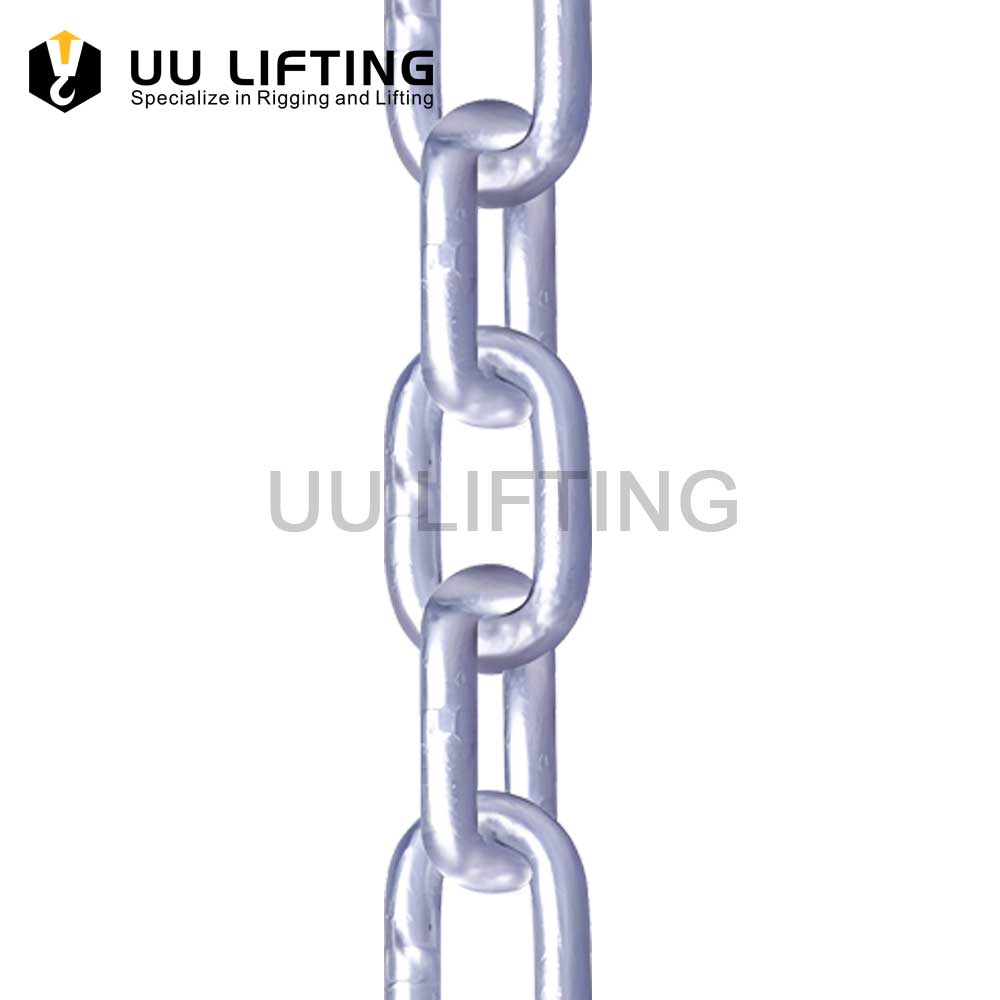
UK standard long link chain is a commercial-grade welded steel chain with elongated links. It’s not suitable for overhead lifting but is excellent for general purposes such as mooring, anchoring, and agriculture due to its flexibility and lighter weight compared to short-link chains.
How Does a Long Link Chain Differ From a Short Link Chain?
The main difference is the link’s internal dimensions. A long link chain has a greater internal length, making it more flexible and lighter per meter. Short link chains have a shorter pitch, making them stronger and suitable for lifting applications that engage with pocket wheels or sprockets.
A Closer Look at Link Dimensions
The “pitch” is the internal length of a chain link. Long link chains have a much larger pitch than short link chains of the same diameter. This simple difference has big consequences. The longer links make the chain more flexible and less likely to kink. It also means there is less steel per meter, making it lighter and often less expensive. Short link chains, on the other hand, have a compact design. This makes them stronger and heavier for their size.
Key Differences in Application
The most critical distinction is in their use. Short link chains are often “calibrated,” meaning their dimensions are very precise. This allows it to run smoothly over the sprockets in a chain hoist or windlass. Using a long link chain in a hoist would cause it to jam and fail.
Here is a simple table to show the differences:
Feature
Long Link Chain
Short Link Chain
Primary Use
General purpose (mooring, fencing, lashing)
Overhead lifting, load securing
Strength
Lower breaking load for same diameter
Higher breaking load for same diameter
Flexibility
More flexible, less kinking
Less flexible
Weight
Lighter per meter
Heavier per meter
Compatibility
Not for hoists or pocket wheels
Higher breaking load for the same diameter
Understanding this table is the first step to avoiding a bad purchase.
What Are the Key UK Standards for This Type of Chain?
While BS EN 818 standards cover lifting chains, commercial long-link chains often adhere to older British Standards such as BS 4942 or manufacturer-specific specifications. The key is to check for clear documentation of material, finish, and proof load testing, even if not for lifting.
Understanding the “Standard” in the UK Standard
The term “UK Standard” for a long link chain is often a commercial term. It refers to a traditional set of dimensions rather than a strict, modern safety standard for lifting. Lifting chains must conform to standards like BS EN 818. Commercial long link chains, however, might be made to older specifications, such as BS 4942, or, more commonly, to a manufacturer’s own internal standard. This doesn’t mean they are low quality. It just means they are not intended or certified for lifting people or valuable loads overhead. A trustworthy supplier will be very clear about this distinction.
What to Look for in Supplier Documentation
Even for a non-lifting chain, you need proof of quality. Your supplier should be able to provide clear documentation. Here’s what I recommend you ask for:
Material Specification: Confirms the type of steel used (e.g., Q235 mild steel).
Finish Details: Specifies the corrosion protection, like “Hot-Dip Galvanized to BS EN ISO 1461”. This is crucial for outdoor use.
Proof Load Certificate: Shows that a sample of the chain from the batch was tested to a specific load without deforming. This is a vital quality control step.
Manufacturer’s Test Certificate (MTC): This document provides traceability, linking the product back to its material origins and testing results.
If a supplier hesitates to provide these, it’s a major red flag.
How Do You Choose the Right Long Link Chain for Your Application?
First, confirm your application is not for lifting. Then consider the environment when choosing the right finish (e.g., galvanized for marine use). Finally, select a chain size with a minimum breaking load that safely exceeds the expected force, adding a good safety margin.
Choosing the right chain is easy if you follow a few logical steps. I walk my customers through this process to make sure they get exactly what they need without overspending. It’s about matching the product to the real-world conditions it will face.
A Step-by-Step Selection Guide
Define the Use Case: Be specific. Is it for a decorative fence, a security barrier, a boat mooring, or for lashing down equipment on a truck? This immediately tells you it’s a non-lifting job.
Assess the Environment: Where will the chain live? An indoor, dry location is very different from a salty marine environment or a wet farm field. This decision directly impacts the finish you need.
Determine the Finish:
Self-Coloured: Basically raw steel. Only for dry, indoor uses where rust isn’t a concern.
Bright Zinc Plated (BZP): Provides basic rust protection. Good for general indoor or occasional outdoor use in dry climates.
Hot-Dip Galvanized (HDG): The best choice for outdoor, marine, and corrosive environments. It provides a thick, durable zinc coating.
Calculate the Required Strength: For general use, you should look at the Minimum Breaking Load (MBL). Calculate the maximum force the chain will ever see and choose a size with an MBL that is several times higher. A 4:1 safety factor is a good rule of thumb.
Sizing Table Example (Typical)
Here is an example of what you might see on a specification sheet for a commercial long link chain.
Nominal Size
Breaking Load (Approx.)
Weight per Meter (Approx.)
6 mm
1,100 kg
0.8 kg
8 mm
2,000 kg
1.4 kg
10 mm
3,100 kg
2.2 kg
13 mm
5,200 kg
3.8 kg
This data helps you balance strength, weight, and cost for your project.
What Are Common Mistakes to Avoid When Sourcing Long Link Chain?
The biggest mistakes are confusing it with a lifting chain, ignoring the finish, and focusing only on price. Never use a long link chain for overhead lifting. Always match the finish to the environment. An unusually low price often signals poor materials or quality control.
I’ve been in this business a long time, and I’ve seen the same mistakes repeated. These are the issues that cause procurement officers the most headaches, from product failures to missed deadlines.
The Lifting Chain Trap
The number one mistake is using a long chain of links for overhead lifting. It is not designed for it. The welds are not to the same standard, and the material may not have the required properties for lifting safety. A supplier who is vague about this or suggests their long link chain is “good for lifting” is a supplier to avoid. This is a serious safety and liability issue.
Price vs. True Cost
Everyone wants a good price, but a low price is not always a good value. I had a client who bought a batch of zinc-plated chain for an outdoor project because it was cheaper than galvanized. Within a year, it was completely rusted and had to be replaced. The “true cost” includes the replacement chain, the labor to install it, and the downtime. The properly finished hot-dip galvanized chain would have been cheaper in the long run.
Communication and Logistics
This is a major pain point for buyers like Mark. When you source from overseas, clear and efficient communication is everything. If your sales contact can’t answer basic questions about test certificates or production lead times, it’s a bad sign. It suggests the entire company might be disorganized. At UU LIFTING, we make sure our clients have a dedicated contact who provides regular updates. Delayed shipments can mean missing your peak sales season, so a reliable logistics plan is just as important as the product’s quality.
OUR FACTORY
Raw materials of our products are made of high-quality steel that meets the standards, and the raw materials are traceable. And multiple production lines and machines minimize lead times for rigging and lifting equipment.
Raw Material
Forged
Cast
Chain Machine
Heat Treatment
Powder Plastified
Package
Warehouse
MANUFACTURING PROCESSES
With eight automatic forging and semi-automatic forging line of up to 1600ton press machines and specialized drillng, tapping, heat treatment and inspection equipment. Strict and standardized production process ensures you receive perfect products.
QUALITY CONTROL
All rigging and lifting products are subjected to strict working tension and breaking the tension test. Complied with ISO9001 and CE certification. Our promise to you: Guaranteed safety at work for people and materials.