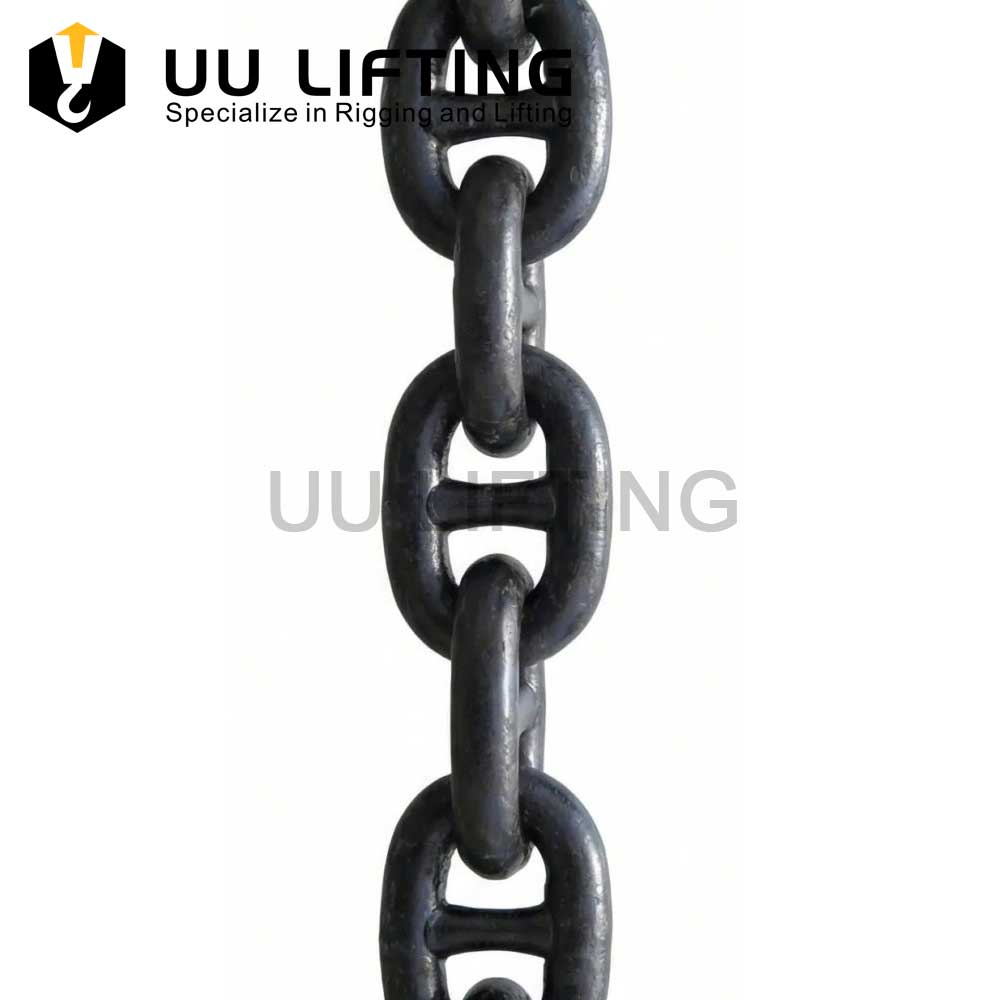
What is a Stud Link Chain, and Why Should You Care?
A stud link chain is a type of chain where each link has a metal bar, called a stud, across its center. This stud adds significant strength, prevents the chain from kinking or tangling, and increases its fatigue life. It is commonly used for ship anchoring.
That little bar in the middle of the link seems so simple. But it makes a world of difference. As a supplier, I’ve seen customers overlook this detail, and it can be a costly mistake. They focus on the grade of steel or the price per meter, but the design is just as important. So, let’s look closer at why this design exists and how it compares to other chains you might be considering. You need to know the difference to make the right choice.
How is a stud link chain different from a studless chain?
The main difference is the stud. A stud link chain has a center bar, while a studless chain is an open oval link. The stud increases the chain’s strength by about 15% and prevents kinking. Studless chains are more flexible and lighter, but not suitable for anchoring.
The visual difference is obvious. One has a bar, and the other doesn’t. But the performance difference is what really matters for your operations. I once spoke with a client, let’s call him Mark. He’s a sharp business owner who knows his stuff but isn’t a technical engineer. He asked if he could use a top-grade studless chain for a mooring application to save on costs. I explained that the student’s job is critical. It braces the link, preventing it from collapsing or deforming under heavy, shifting loads. This dramatically increases its fatigue resistance. The studless chain, while strong, would stretch and wear out much faster in that specific situation.
Key Performance Differences
Here is a simple table I use to explain it to my customers.
Feature
Stud Link Chain
Studless Chain
Strength
Higher breaking load
Lower breaking load
Kinking
Resists kinking and tangling
Prone to kinking
Weight
Heavier
Lighter
Flexibility
Less flexible
More flexible
Main Use
Mooring, Anchoring
General Lifting, Lashing
What are the main applications for stud link chains?
Stud link chains are primarily used in the marine and offshore industries. Their main job is for ship anchor chains and offshore mooring systems for oil rigs and buoys. Their strength and anti-kinking properties are essential for safety and reliability in these harsh, dynamic environments.
The number one use for stud link chain is in the marine world. You will not find a large commercial vessel without an anchor. The reason is simple: reliability.
Marine Anchoring
When a ship drops anchor, the chain piles up in the chain locker. A studless chain would twist and jam into a solid, tangled mess. The studs prevent this, ensuring the chain pays out and retrieves smoothly every time. The mechanism that handles the chain, the windlass, is designed specifically for the shape of a stud link chain.
Offshore Mooring
Think bigger than ships. Oil rigs, floating platforms, and large buoys need to stay in one place for decades. They use massive stud link chains for their mooring systems. In this case, the chain is under constant tension and motion. The stud’s ability to fight fatigue is critical here. I often remind my clients that their customers in these industries will demand certifications. They need proof from bodies like ABS or DNV that the chain meets strict standards. There is no room for error.
How do you choose the right stud link chain for your needs?
First, determine the required grade (e.g., Grade 2 or Grade 3) based on the strength required for your vessel or platform. Second, select the correct chain diameter (size). Finally, always insist on proper certification from a recognized classification society to guarantee quality and compliance.
Choosing the right chain is more than just picking one from a catalog. It’s a technical decision. I always guide my customers through three simple steps.
Step 1: Determine the Grade
The grade tells you the strength of the steel. Common grades are U2 and U3. Grade U3 is stronger than U2. This means you can sometimes use a smaller, lighter chain to get the same strength, saving weight on your vessel. The choice depends on your engineering requirements.
Step 2: Select the Size
This is the diameter of the bar used to link. This is determined by the weight of your vessel or platform and the expected environmental forces acting on it.
Step 3: Verify Certification
This is the most important step. For a buyer like Mark, who has faced issues with fake certificates, this is crucial. You must obtain a certificate from a recognized body such as Lloyd’s Register, ABS, or DNV. A serious manufacturer like us provides full traceability. We can show you the material origins, testing results, and the official, verifiable certificates. A low price is tempting, but if it comes without genuine certification, the risk is too high.
OUR FACTORY
Raw materials of our products are made of high-quality steel that meets the standards, and the raw materials are traceable. And multiple production lines and machines minimize lead times for rigging and lifting equipment.
Raw Material
Forged
Cast
Chain Machine
Heat Treatment
Powder Plastified
Package
Warehouse
MANUFACTURING PROCESSES
With eight automatic forging and semi-automatic forging line of up to 1600ton press machines and specialized drillng, tapping, heat treatment and inspection equipment. Strict and standardized production process ensures you receive perfect products.
QUALITY CONTROL
All rigging and lifting products are subjected to strict working tension and breaking the tension test. Complied with ISO9001 and CE certification. Our promise to you: Guaranteed safety at work for people and materials.