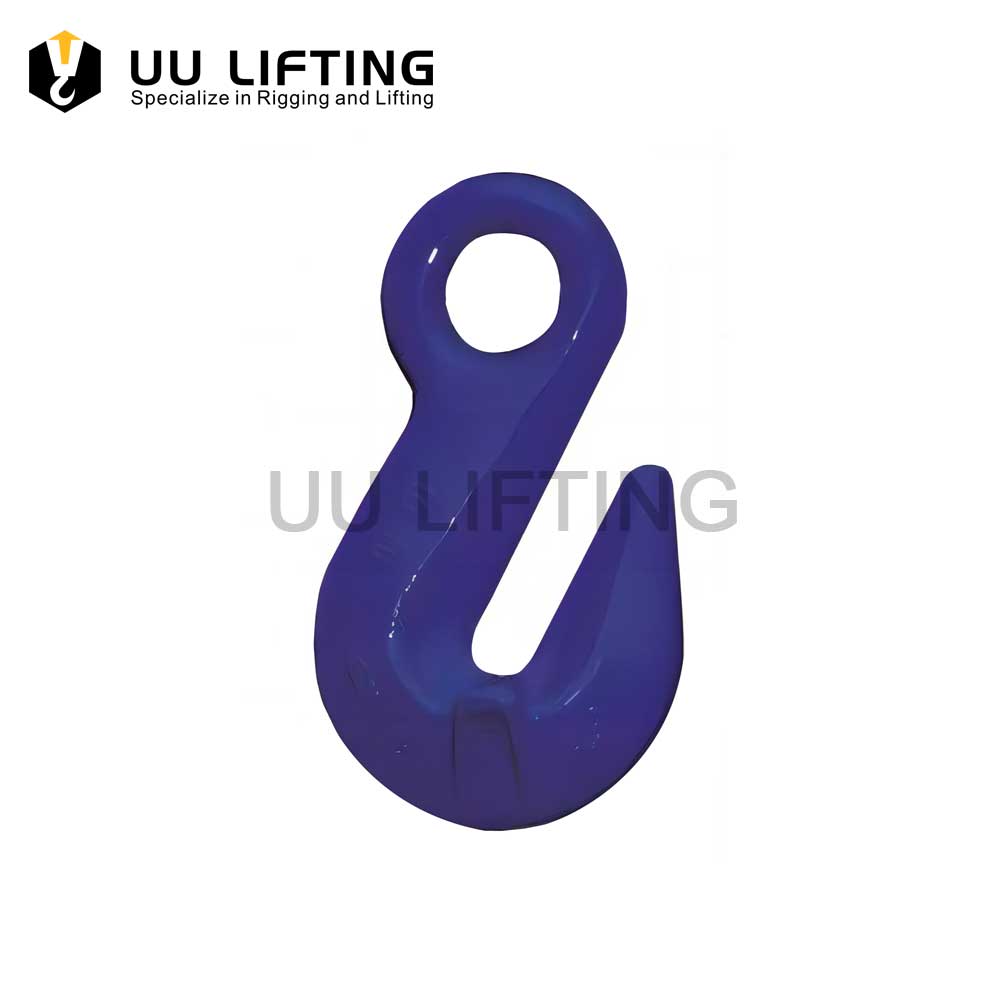
Okay, let’s break down “G100 Eye Shortening Grab Hook”: This term describes a specific type of hook used in lifting and rigging operations, particularly with chain slings. Here’s what each part means:
- G100 (Grade 100):
- This refers to the strength grade of the alloy steel used to make the hook.
- Grade 100 is a high-strength, heat-treated alloy steel. It offers approximately 25% more lifting capacity (Working Load Limit – WLL) than the more common Grade 80 components of the same size.
- G100 components are often color-coded (frequently blue, but can vary by manufacturer) for easy identification.
- In short, it means the hook is robust and designed for heavy-duty overhead lifting.
- Eye:
- This describes the attachment point on the hook.
- An “eye” type hook has a closed loop (the “eye”) at its top. This eye is designed to be connected to a chain (often via a master link or coupling link) or other rigging hardware, such as a shackle.
- This is distinct from, for example, a “clevis” hook, which would have a U-shaped bracket with a pin.
- In short, it’s the part of the hook used to connect it to the rest of the lifting sling.
- Shortening:
- This indicates the primary function of this particular grab hook.
- While all grab hooks can technically shorten a chain, “shortening grab hook” emphasizes that its design is optimized for adjusting the length of a chain sling leg.
- It allows the user to quickly and securely reduce the effective length of a chain by “grabbing” a link of the chain further up the sling leg.
- In short, its primary purpose is to shorten a chain sling.
- Grab Hook:
- This describes the style or type of hook.
- A grab hook has a specific, usually narrow, throat or saddle designed to engage and securely hold a link of a chain.
- The design ensures that the chain link seats properly in the hook and doesn’t slip out under load when used correctly.
- Important Note for Grab Hooks: When a grab hook is used to shorten a chain sling leg, the Working Load Limit (WLL) of that sling leg is typically reduced (often by 20%, but always refer to manufacturer specifications). This is because the load is not applied in the optimal position of a standard sling hook’s bowl or saddle.
- In short, it’s a hook specifically designed to “grab” and hold a chain link.
Putting it all together:
A
“G100 Eye Shortening Grab Hook” is a high-strength (Grade 100 alloy steel) hook designed for overhead lifting. It features an “eye” at the top for connection to a chain sling or other rigging components. Its primary purpose is to allow an operator to easily and securely “grab” a link of the chain to shorten the effective length of that chain sling leg, thereby providing adjustability.
Key features and considerations:
- High Strength: Due to the G100 material.
- Adjustability: Allows for changing sling leg lengths.
- Secure Connection: The eye provides a standard attachment point.
- Specific Use: Designed to cradle chain links for shortening.
- WLL Reduction: Crucially, using it to shorten a sling leg typically reduces the working load limit (WLL) of that leg. Always consult the manufacturer’s guidelines.
- Compatibility: This product is designed for use with the G100 chain and components for optimal performance and safety.
It’s a vital component for creating versatile and adjustable chain slings in various lifting applications.