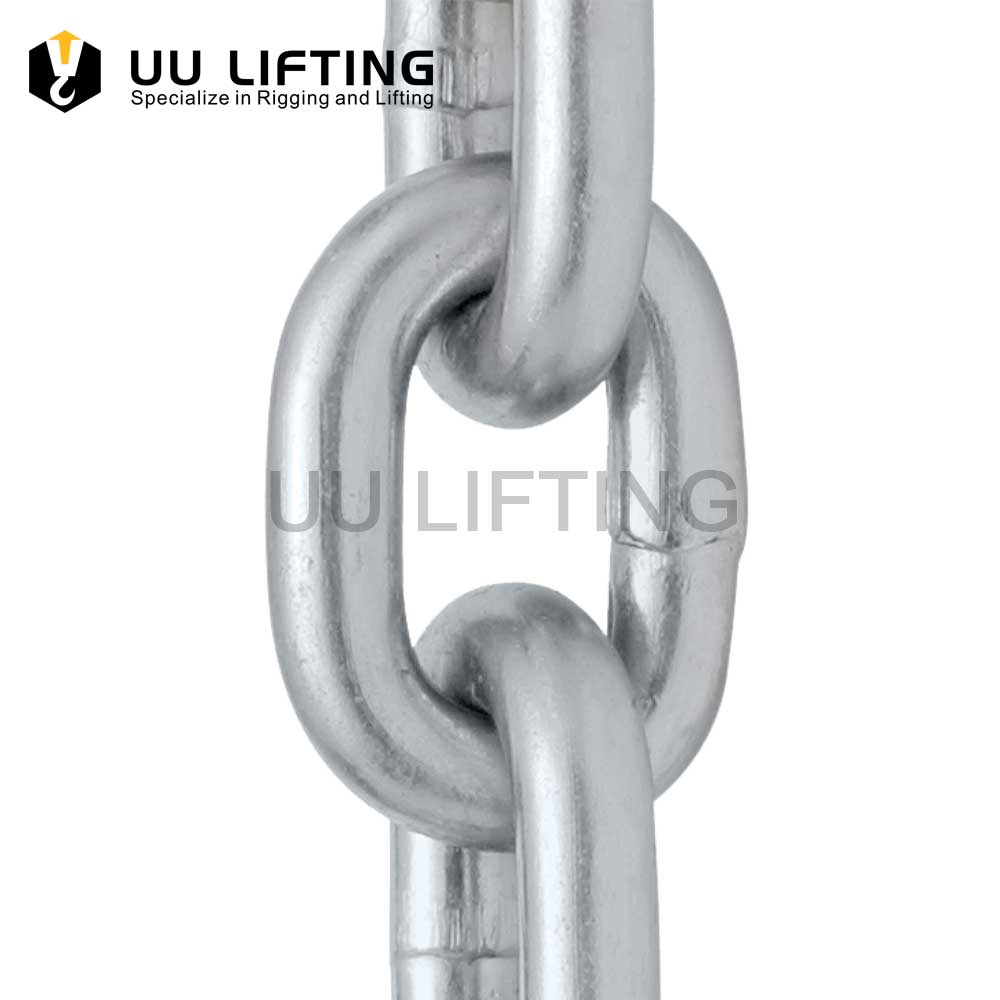
Self-colored, zinc plated, or Hot dip galvanized finish.
Short Link G30 Proof Coil Chain Sizes:
Short Link G30 Proof Coil Chain Sizes
Short Link G30 Proof Coil Chain Sizes
Finish
Trade Size
Wire Dia.
Inside Dim. Length (Nominal)
Inside Width (Nominal)
Ft. Per Package
Working Load Limit
Net Wt.
(in.)
(mm)
(in)
(in.)
(in.)
(Lbs.)
(kg)
(Lbs.)
Self-Colored
3/16
5.5
0.218
0.990
0.420
1500
800
363
615
Self-Colored
1/4
7
0.281
1.040
0.490
800
1300
590
608
Self-Colored
5/16
8
0.343
1.140
0.490
550
1900
862
561
Self-Colored
3/8
10
0.406
1.280
0.610
400
2650
1202
568
Self-Colored
1/2
13
0.531
1.560
0.810
200
4500
2042
524
Zinc
3/16
5.5
0.218
0.990
0.420
1500
800
363
615
Zinc
1/4
7
0.281
1.040
0.490
800
1300
590
608
Zinc Plated
5/16
8
0.343
1.140
0.490
550
1900
862
561
Zinc
3/8
10
0.406
1.280
0.610
400
2650
1202
568
Zinc
1/2
13
0.531
1.560
0.810
200
4500
2042
524
HDG
3/16
5.5
0.218
0.990
0.420
1500
800
363
615
HDG
1/4
7
0.281
1.040
0.490
800
1300
590
608
What Is Short Link G30 Proof Coil Chain?
G30 Proof Coil is a general-purpose, low-carbon steel chain. It is proof-tested but not rated for overhead lifting. Its short links offer flexibility, making it ideal for non-critical uses such as cargo securing, guard rails, and agricultural tasks where high strength isn’t required.
What does “oes “G30 Proof”Coil” actually mean?
G30″ is the grade, indicating a minimum tensile strength of 300 N/”m². “Proof”Coil” means every link is tested to twice its working load limit. This ensures quality for general duties, but it’s strictly not for overhead lifts. It’s a durable, general-purpose chain.
Grade 30 (G30)
The “G30″ part refers to the grade of the steel; it’s made from low-carbon steel. This makes it a cost-effective choice for many jobs. The nu”be” “30” refers to its tensile strength, specifically about 300 Newtons per square millimeter. It’s strong enough for many tasks, but it isn’t designed for extreme loads.
Proof “oil
“Proof”Coil” is a manufacturing promise. During production, we test the chain to a specific load. This load is higher than its official safe working limit. “his “proof”test” ensures there are no weak links.
Specification
Meaning
Importance
Working Load Limit (WLL)
The maximum safe force.
Never exceed this limit.
Proof Test Load
Test force applied at the factory.
WLL x 2
Breaking Strength
The force at which it fails.
WLL x 4 (approx.)
This testing guarantees reliability for its intended uses. But remember, this does not certify it for overhead lifting. That is a very important safety rule.
Why are short inks important for this chain?
Short links offer greater flexibility and a closer fit on wheels or sprockets, such as those on an anchor windlass. They are less likely to kink or tangle. This makes them more versatile and reliable for applications that involve wrapping around objects or running through machinery.
Flexibility and Fit
A short link chain has a smaller pitch. The pitch is the internal length of a single link. This means it can bend more easily and wrap around objects with a tighter radius. It fits snugly into the chain wheel’s pockets, which is critical for smooth operation. Long link chains are more prone to jumping off sprockets.
Strength and Weight
For the same material diameter, a short link chain is slightly heavier and stronger per foot than a long link chain. This is because there are more links, and thus more material, in the same length.
Feature
Short Link Chain
Long Link Chain
Flexibility
High
Low
Weight
Heavier
Lighter
Fit on Sprockets
Excellent
Poor
Common Use
Anchor, General Purpose
Fencing, Mooring
So, for most general-purpose jobs where the chain needs to be flexible, I recommend a short link as the standard for all my clients.
What are the common uses for the G30 chain?
G30 chain is excellent for general-purpose, non-lifting tasks. Its most common uses include agricultural machinery, guard rails, tailgate chains, light-duty towing, and securing equipment. It is a versatile choice where high strength is not the primary requirement. It is never for lifting.
Securing and Tie-Downs
This is a very popular use. Becit’s it’s strong but not overly heavy; it’s great for lashing down equipment on a trailer or in a truck bed. It holds things in place securely during transport.
Securing construction equipment
Tying down tarps
Vehicle tie-downs (light duty)
General Utility and Barriers
Its durability and low cost make it ideal for permanent or temporary installations. We see it used in many ways.
Guard Rails: Creating safety barriers in parking lots or industrial areas.
Fencing: Used in agricultural settings for gates and livestock containment.
Tailgates: A classic use on pickup trucks and trailers.
We see it used everywhere, from farms to construction sites. The rule I always tell my customers is simple: if you are not lifting something people’s heads, G30 is often your most economical and reliable choice.
How is G30 different from G43, G70, or G80 chains?
The main difference isin strength and material. G30 is a low-carbon steel for general use. G43 is a higher-strength carbon steel. G70 is heat-treated for transport load binding. G80 and higher are heat-treated alloy steel, specifically approved for safe overhead lifting applications.
Material and Manufacturing
The grades increase in strength as the material and manufacturing processes change.
G30: Basic low-carbon steel. It is not heat-treated.
G43 & G70: Higher carbon steel. G70 is heat-treated for extra strength and wear resistance.
G80, G100, G120: Alloy steel. These are quenched and tempered (heat-treated) to create the highest strength. This process is what makes them safe for lifting.
Here is a simple table I use to explain it to my customers.
Grade
Material
Main Use
Overhead Lifting?
G30
Low-Carbon Steel
General Utility, Barriers
NO
G43
High-Test Carbon Steel
Logging, Towing
NO
G70
Heat-Treated Carbon Steel
Load Binding, Transport
NO
G80
Heat-Treated Alloy Steel
Overhead Lifting
YES
As you can see, the grade number is a direct guide to its strength and approved use. Always choose the grade that is specifically designed for your task to ensure safety.
OUR FACTORY
Raw materials of our products are made of high-quality steel that meets the standards, and the raw materials are traceable. And multiple production lines and machines minimize lead times for rigging and lifting equipment.
Raw Material
Forged
Cast
Chain Machine
Heat Treatment
Powder Plastified
Package
Warehouse
MANUFACTURING PROCESSES
With eight automatic forging and semi-automatic forging line of up to 1600ton press machines and specialized drillng, tapping, heat treatment and inspection equipment. Strict and standardized production process ensures you receive perfect products.
QUALITY CONTROL
All rigging and lifting products are subjected to strict working tension and breaking the tension test. Complied with ISO9001 and CE certification. Our promise to you: Guaranteed safety at work for people and materials.