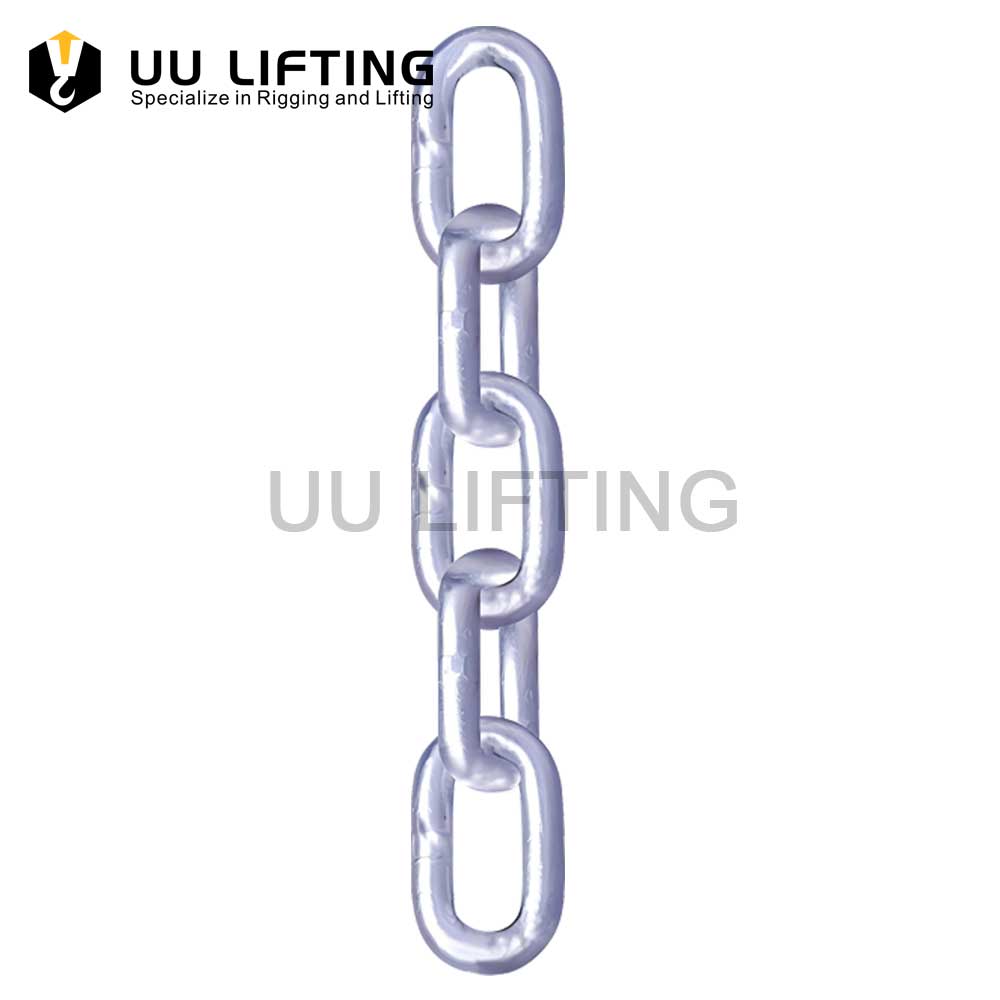
Australian Standard Short Link Chain Specifications:
Material
Carbon Steel
Standards
AS3775
Surface Finish
Self-Color, Electro-Galvanized, And Hot-Dipped Galvanized Surface
Link Type
Short Links Are Narrower And Tighter Than Standard Or Medium Links.
Application
General Purpose: Engineering, industrial, agricultural
Packaging
Custom Packaging Available
Australian Standard Short Link Chain Sizes:
Australian Standard Short Link Chain Sizes
Australian Standard Short Link Chain Sizes
Chain Size
W.L.L.
DIA.
L
W
Length Per 100kg
(mm)
(mt)
(mm)
(mm)
(mm)
B.F.
H.D.G.
6
0.32
6.3
18.9
21.5
114
108
8
0.53
8.0
24.0
27.5
70.5
67.0
10
0.83
10.0
29.5
33.5
45.2
42.9
12
1.50
12.5
37.5
40.6
29.5
28.0
16
2.31
16
47.0
54.0
17.6
16.7
What is Australian Standard Short Link Chain, and Why Does it Matter?
Australian Standard (AS 2321) short-link chain is a high-tensile steel chain designed for lifting. It is defined by its short, compact links, which provide strength and flexibility. The chain must meet strict manufacturing and testing rules to ensure it is safe and performs well in Australia.
What Really Defines a Chain as “Short Link”?
A “short link” chain is defined by its geometry. Specifically, it’s the ratio of its pitch (the internal length of a link) to its diameter. Generally, the pitch is about three times the diameter, which makes the chain strong, flexible, and perfect for lifting slings.
Let’s dive deeper into what this means in practice. The “pitch” is the inside length of a single chain link. The “diameter” is the thickness of the steel used to make that link. In a high-quality lifting chain, like one that meets the European EN 818-2 standard, this ratio is very consistent. For example, a 10mm diameter chain will have a pitch of 30mm. This 3-to-1 ratio is the key.
The Key Difference: Pitch-to-Diameter Ratio
This ratio isn’t just a number; it directly affects how the chain performs. A short link chain’s compact design allows it to bend and articulate smoothly. This makes it ideal for use in chain slings that need to wrap securely around a load. A long link chain, with a larger pitch, is less flexible and not designed for the dynamic stresses of overhead lifting.
Short Link vs. Long Link Chain
Understanding the right application for each type is crucial. I’ve seen customers try to use lashing chains for lifting, which is extremely dangerous. Here is a simple table to help you tell them apart.
Feature
Short Link Chain (for Lifting)
Long Link Chain (for Lashing/General Use)
Primary Use
Overhead lifting, Hoisting, Chain Slings
Lashing, Anchoring, Fencing, Mooring
Pitch Ratio
Roughly 3:1 (Pitch to Diameter)
Greater than 3:1
Strength
Higher Working Load Limit for its size
Lower Working Load Limit
Flexibility
More flexible, wraps well around objects
Less flexible, more prone to kinking
Safety
Rated for overhead lifting
NEVER use for overhead lifting
Choosing the right type is the first step in ensuring a safe lifting operation.
What Do Lifting Chain Grades Like G80 Actually Mean?
The grade of a lifting chain, like Grade 80 (G80), indicates its strength. It refers to the nominal stress in Newtons per square millimeter (N/mm²) that the chain can handle. A higher-grade number indicates a stronger chain and a higher working load limit (WLL).
Understanding the Numbers
Let’s make it simple. Grade 80 (often called Grade T in Australia) means the chain material has a minimum breaking strength of 800 Newtons per square millimeter. This is the industry standard for safe, overhead lifting. Higher grades, like G100 and G120, are made from even stronger steel alloys. They can handle 1000 N/mm² and 1200 N/mm², respectively.
Why Grade Matters for Buyers
This is important for a procurement officer like you. A higher grade gives you a better strength-to-weight ratio. For example, a 10mm G100 chain might be able to lift the same load as a 13mm G80 chain. The G100 chain would be lighter and easier for your end-users to handle. This can be a major selling point. It also means lower shipping costs for you when importing. The key is to balance performance with cost. For most general lifting applications, G80 provides an excellent combination of strength, reliability, and value.
How Do Australian Standards (AS) Compare to European (EN) Standards?
Australian Standard AS 2321 and European Standard EN 818-2 are both respected standards for Grade 80 lifting chains. They share the core goals of safety and performance. However, they can have small differences in manufacturing, testing, or marking rules.
As a manufacturer in China, we produce rigging products for clients worldwide. We make chains that meet EN standards, ASME standards for North America, and AS standards for Australia. The most important thing for us is to know exactly which standard the client needs.
The Goal is Universal: Safety
Both AS 2321 and EN 818-2 are designed to ensure the chain is safe for lifting people’s lives and valuable equipment. Both standards require strict controls over the alloy steel used. They both demand precise heat treatment. And they both mandate that every single link is proof-tested to a force twice the working load limit without deforming. The basic principles of safe engineering are the same.
Key Areas to Check
The small differences can cause problems for an importer. You must verify these details with your supplier.
Aspect
What to Verify with Your Supplier
Why It’s Important for the Australian Market
Marking
Is each link marked with the manufacturer, grade (“T”), and traceability code as required by AS 2321?
A chain marked “EN 818-2” may not be compliant on an Australian work site.
Certification
Can the supplier provide a test certificate that specifically states compliance with AS 2321?
A generic certificate is a major red flag. You need proof for the specific Australian standard.
Testing
Does the supplier understand and follow any unique batch testing or documentation rules in AS 2321?
Your supplier must prove they know and follow the exact standard you are buying for.
The main takeaway is this: you, the buyer, must clearly specify the standard you need. As your manufacturing partner, we can produce to that exact standard. This clear communication protects your business.
What Key Checks Are Essential When Sourcing Chains From China?
When sourcing from China, always verify the supplier’s raw material quality and control processes. Insist on seeing valid test certificates for the specific standard you need. Also, check their communication and technical understanding to avoid costly errors.
The “Three Pillars” of Vetting a Supplier
Based on my experience, here are the three most important areas to investigate.
Material and Manufacturing: It all starts with the steel. Ask where the raw material comes from and if it’s traceable. At our factory, we use only high-quality alloy steel that meets the standards, and we can trace every batch. We also welcome factory audits so you can see our forging, heat treatment, and testing processes for yourself.
Certification and Testing: This is critical. Mark’s story is a perfect example. You must demand a valid test certificate that matches your specific order and standard (like AS 2321). Don’t be afraid to ask for more proof. We often provide photos or videos of proof-load and break-load tests for our clients’ orders. This transparency builds trust.
Communication and Expertise: Inefficient communication was another of Mark’s big problems. Does your supplier take your order, or do they ask questions? A good supplier will act like a partner. Our sales team works with our engineers to understand your needs. We want to know the final application so we can ensure the product is perfect. This partnership approach prevents mistakes and delays.
OUR FACTORY
Raw materials of our products are made of high-quality steel that meets the standards, and the raw materials are traceable. And multiple production lines and machines minimize lead times for rigging and lifting equipment.
Raw Material
Forged
Cast
Chain Machine
Heat Treatment
Powder Plastified
Package
Warehouse
MANUFACTURING PROCESSES
With eight automatic forging and semi-automatic forging line of up to 1600ton press machines and specialized drillng, tapping, heat treatment and inspection equipment. Strict and standardized production process ensures you receive perfect products.
QUALITY CONTROL
All rigging and lifting products are subjected to strict working tension and breaking the tension test. Complied with ISO9001 and CE certification. Our promise to you: Guaranteed safety at work for people and materials.