Iron, Stainless Steel, and Specific Steel Grades Such as Q235b, 20mnv, and 25mnv
Surface Finish
Electroplating (Zinc Plating) and Baking Paint
Application
Transmission Chain: Used For Power Transmission In Various Machinery. Conveyor Chain: Utilized In Conveyor Systems For Transporting Materials. Drag Chain: Used In Industrial Setups For Pulling Or Dragging Heavy Loads. Specialized Industrial Applications: Employed In A Variety Of Other Dedicated Industrial Processes.
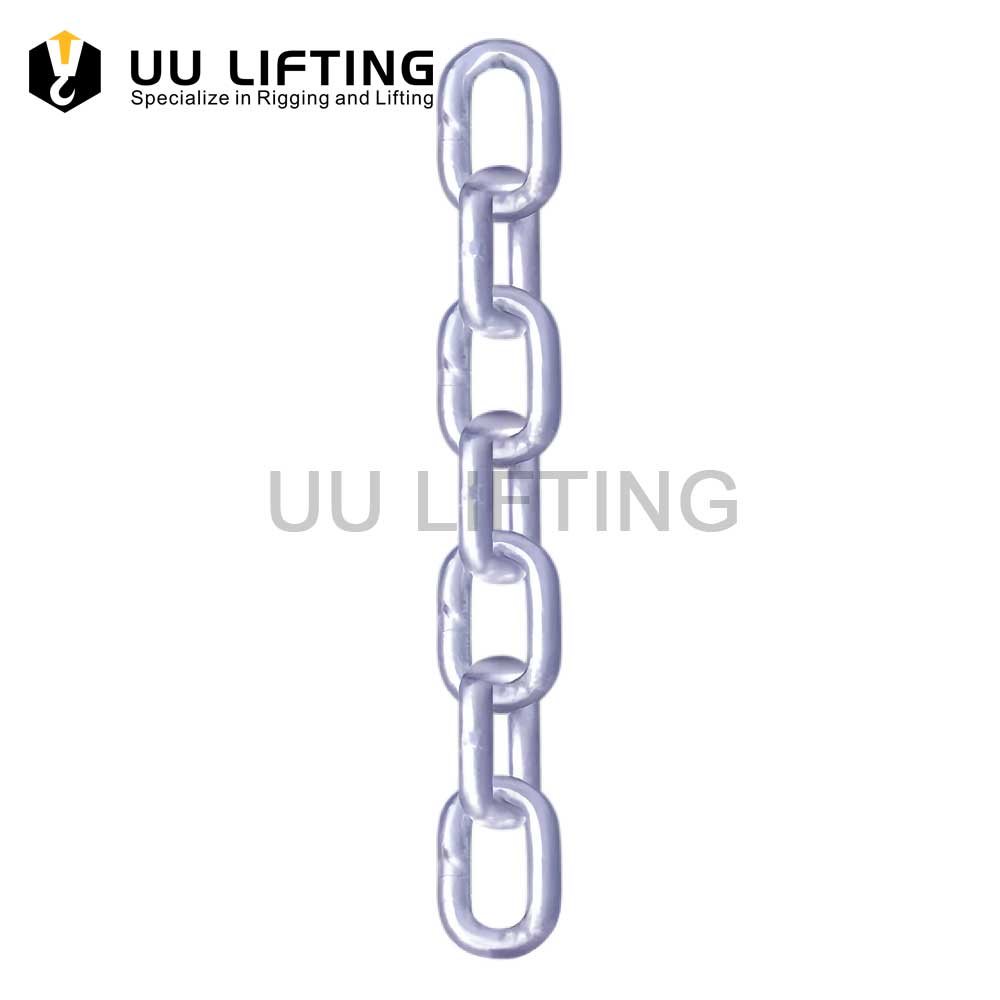
Korean Standard Long Link Chain Sizes:
Korean Standard Long Link Chain Sizes
Korean Standard Long Link Chain Sizes
Nominal Size
Material Size
Inside Length
Inside Width
Length Per PC
Weight Per PC
(mm)
(mm)
(mm)
(mm)
(m)
(kg)
4
3.9
34.3
6.2
30
7.26
4.5
4.5
44.4
9.2
30
9.46
5
4.8
45.0
11.0
30
11.31
6
6.0
47.0
12.0
30
18.00
7
6.8
50.0
11.4
15
11.19
12
12.0
50.0
18.0
15
42.00
15
14.8
64.0
23.0
15
61.44
19
19.0
75.0
25.0
10
71.00
What is the Korean Standard Long Link Chain and Why Should You Care?
Korean Standard Long Link Chain is a type of steel chain with elongated links, made to specific Korean industrial standards. It’s known for its flexibility, lighter weight, and good corrosion resistance, making it ideal for non-lifting applications such as anchoring, mooring, and general lashing.
I often get questions from clients like Mark about different chain types. They see all these standards and link sizes and get lost. It is a common problem. Let’s break down what makes this specific chain type unique and useful for your business.
What Makes a Long Link Chain ‘Korean Standard’?
“Korean Standard” (KS) means the chain is manufactured and tested in accordance with specific regulations set by the Korean Agency for Technology and Standards. This ensures consistency in material quality, dimensions, and performance, providing a reliable product you can trust for its specified purpose.
When I talk to buyers like Mark, one of their biggest fears is inconsistent quality. A product that works great one time might fail the next. This is where standards come in. The “Korean Standard” (KS) mark is a big deal. It is a promise of quality control. It is not just a label. It means the manufacturer followed a strict set of rules. These rules cover everything from the type of steel used to the final proof testing. Let’s look at the key elements.
Material Specifications
The standard dictates the grade of carbon steel. This ensures the chain has the right strength and durability. It takes the guesswork out of the raw material, so you know it’s not made from inferior scrap metal. This is a common pain point for buyers sourcing from new suppliers.
Dimensional Accuracy
Every link has to be a specific size and shape. The length, width, and wire diameter are all controlled. This is very important for how the chain fits with other hardware, such as shackles or hooks. Inconsistent sizing can make a whole system unusable.
Testing Protocols
The chain undergoes rigorous testing. This includes proof load tests to ensure it can handle its rated capacity without stretching or breaking. This standardization removes the guesswork. You know exactly what you are getting.
What Are the Key Advantages of Using This Type of Chain?
The main advantages are flexibility and lighter weight due to the longer links. It’s also more cost-effective than shortlinks or lifting chains. Plus, it’s typically hot-dip galvanized, which provides excellent rust protection, making it perfect for outdoor and marine use.
Let’s dig into why these benefits matter in the real world. I remember a client who used heavy, expensive lifting chains for simple lashing jobs. It was overkill and wasted money. The Korean Standard long link chain would have been a perfect fit for him.
First, flexibility. The longer links can twist and bend more easily than short links. This makes the chain simpler to wrap around objects or connect to anchors. It is just easier to handle, saving your crew on-site time and effort.
Second, weight. For the same length, it is lighter than a short link chain. This might not seem like a big deal, but it adds up quickly. It reduces shipping costs and makes it easier for your crew to manage long sections of chain.
Third, cost. It is generally more affordable. Because it is not rated for overhead lifting, it does not require the expensive alloy steel and complex heat treatment of a G80 or G100 chain. For general duties, it is the smart economic choice.
Here is a simple breakdown:
Advantage
Why It Matters
Ideal Application
Flexibility
Easier to handle and connect.
Mooring, Anchoring
Lighter Weight
Reduces shipping costs, easier on crew.
General Lashing, Fencing
Cost-Effective
Lowers project or inventory expenses.
High-volume utility use
Corrosion Resistance
Long lifespan in wet environments.
Reduces shipping costs and is easier on the crew.
How Does It Compare to Other Chain Types?
Compared to short link chains, it’s more flexible but less strong and not for lifting. Compared to high-grade alloy chains (G80/G100), it has a much lower strength-to-weight ratio and is strictly for non-lifting tasks like lashing, while alloy chains are for overhead lifting.
This is a critical point. I always tell my customers, including experienced ones like Mark, that using the right tool for the job is everything in this industry. A chain is not just a chain. Let’s compare them directly.
Long Link vs. Short Link
Think of them as cousins. They are often made from similar carbon steel. The big difference is the link shape.
Short Link: The links are more compact. This makes the chain stronger for its size and less likely to snag. It’s the standard for anchor chains that run through a windlass.
Long Link: The links are more elongated. This makes it more flexible and lighter. It is better for general securing or lashing where perfect link-by-link engagement is not needed.
Long Link vs. Alloy Lifting Chain (G80/G100)
Now we are talking about two completely different animals.
Alloy Chain: Made from high-strength alloy steel. It is heat-treated to be incredibly strong and durable. It is the only type of chain you should ever use for overhead lifting. It is also much more expensive.
Long Link Chain: Made from standard carbon steel. It is not for lifting. Using it to lift something is a serious safety risk. It is designed for static loads, like tying things down.
Where Are Korean Standard Long Link Chains Typically Used?
It’s primarily used in non-lifting applications. Common uses include boat anchoring and mooring lines, lashing cargo on trucks or ships, agricultural fencing, and general utility chains. Its galvanized finish makes it extremely popular in marine and farming environments.
Versatility is the keyword here. Because it balances cost, flexibility, and durability so well, you see this chain everywhere once you know what to look for. I have supplied it for all sorts of projects.
In the marine industry, it is a go-to choice. It is used for anchor chains on smaller boats or as mooring chains in a harbor. Hot-dip galvanization is essential here to combat constant exposure to saltwater corrosion.
In transportation and logistics, procurement officers use it to lash and secure loads on trucks or ships. It is strong enough to hold things down securely but flexible enough to work with different tie-down points.
In agriculture, farmers use it for everything. They use it for gates, fencing, securing equipment, and even for animal tethers. It is a tough, reliable, and affordable tool on the farm that can withstand the weather.
And finally, there are countless general utility uses. Think of things like creating barriers in a parking lot, securing a spare tire under a truck, or even using them for decorative purposes in architecture. It is a true workhorse chain.
OUR FACTORY
Raw materials of our products are made of high-quality steel that meets the standards, and the raw materials are traceable. And multiple production lines and machines minimize lead times for rigging and lifting equipment.
Raw Material
Forged
Cast
Chain Machine
Heat Treatment
Powder Plastified
Package
Warehouse
MANUFACTURING PROCESSES
With eight automatic forging and semi-automatic forging line of up to 1600ton press machines and specialized drillng, tapping, heat treatment and inspection equipment. Strict and standardized production process ensures you receive perfect products.
QUALITY CONTROL
All rigging and lifting products are subjected to strict working tension and breaking the tension test. Complied with ISO9001 and CE certification. Our promise to you: Guaranteed safety at work for people and materials.