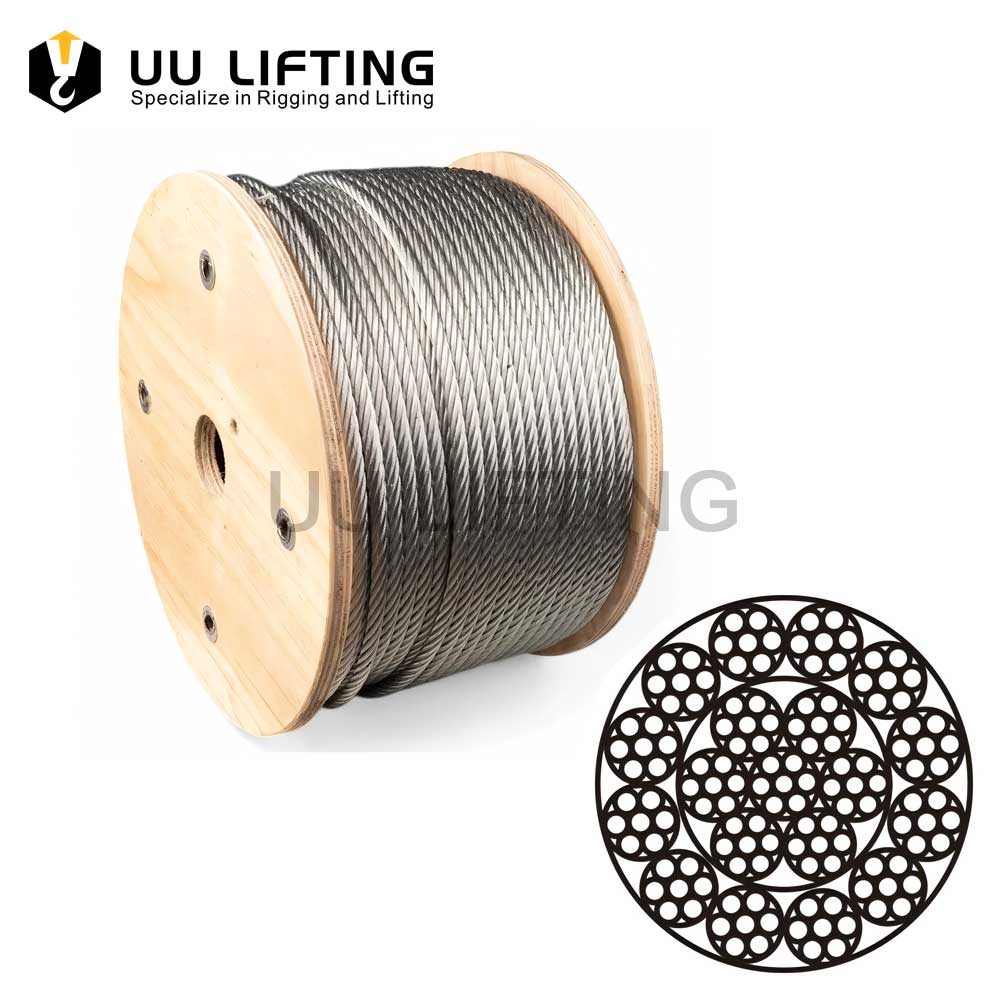
How Can an 18×7 Non-Rotating Wire Rope Improve Your Lifting Safety?
An 18×7 non-rotating wire rope is specially designed to prevent spinning under load. It has an inner core and outer strands laid in opposite directions. This construction makes the rope resist the twisting forces that cause a load to rotate, making it ideal for crane operations.
I’ve been in this business for a long time. I remember a conversation with Mark, a business owner from America. He was frustrated. His crews were dealing with loads spinning on the hook, especially on high lifts. It was slowing down work and even caused a few near misses. He was using a standard rope, thinking “a rope is a rope.” I explained that the construction of the rope is everything. Understanding this small detail can completely change the safety and efficiency of your operations. Let’s look closer at why that is.
What Does “18×7” Actually Mean for a Wire Rope?
The term “18×7” describes the rope’s construction. It means the rope is made of 18 strands wrapped around a central core. Each of those 18 strands is made from 7 individual wires. This specific build gives the rope its non-rotating properties.
When you buy wire rope, you are buying its design. The numbers are a simple code for that design. The first number tells you how many strands are in the rope. The second number tells you how many wires are in each strand. More wires per strand usually means more flexibility—fewer, larger wires offer better abrasion resistance.
For an 18×7 rope, you have 18 strands. This is much more than a standard rope,e like a 6×19. These extra strands are key to its special function, which we will discuss later. Each of those 18 strands has 7 wires. This combination provides a good balance for its intended job. Let’s compare it to some common types.
Construction
Strands
Wires per Strand
Primary Characteristic
18×7
18
7
Rotation Resistant
6×19
6
19
Good abrasion resistance
6×37
6
37
More flexible than 6×19
Understanding this basic code helps you see why different ropes exist for different jobs.
How Does a “Non-Rotating” Wire Rope Work?
Non-rotating ropes work because they are built with multiple layers of strands. The inner layer of strands is twisted in one direction, and the outer layer is twisted in the opposite direction. These opposing forces cancel each other out, preventing the rope from spinning under load.
Think about a standard rope. All its strands are twisted in the same direction. When you put a heavy load on it, the rope tries to untwist, causing the load to spin.
A non-rotating rope, like our 18×7, is much smarter. It is built in layers.
The inner core is made of strands twisted in one direction (let’s say, to the right).
The outer layer is made of strands twisted in the opposite direction (to the left).
When you lift a load, both layers tighten. The inner layer wants to twist one way, and the outer layer wants to twist the other way. Because these forces are equal and opposite, they cancel each other out. The rope stays stable. The load doesn’t spin. This is extremely important for safety, especially in single-line hoisting jobs where you can’t use tag lines to control the load.
When Should You Choose an 18×7 Over a Standard 6×19 Rope?
Choose an 18×7 non-rotating rope for single-line lifting, such as on mobile or tower cranes, where the load can spin freely. Use a standard 6×19 rope for general-purpose rigging, making slings, or when the load is guided and cannot rotate.
I often talk with procurement officers like Mark. They are sensitive to price, and a standard 6×19 rope is usually cheaper than an 18×7. So, the question is always about value and safety, not just cost. A 6×19 is a great, durable, all-around rope. But it will spin under load. If your application involves a free-hanging load lifted by a single line, that spin is a problem. The load can hit other objects, or the spinning itself can damage the rope.
An 18×7 is the solution for that specific problem. Its special construction costs more to manufacture, so the price is higher. But it eliminates the hazard of load rotation. This improves worksite safety and efficiency. It prevents damage to the cargo and surrounding structures.
Let’s break it down.
General-purpose slings, winching, and guided lifts.
18×7 Non-Rotating Rope
6×19 Standard Rope
Primary Use
Single-line crane hoisting, deep lifts.
It can be a hazard in unguided lifts.
Rotation
Resists rotation under load.
Will twist and spin under load.
Safety
Essential for unguided, single-line lifts.
Can be a hazard in unguided lifts.
Cost
Higher initial purchase price.
More cost-effective for general jobs.
For Mark, switching the main hoist line on his cranes to an 18×7 non-rotating rope solved his problem. His crews worked faster and more safely. The higher initial cost was easily paid back through fewer delays and a safer work environment.
OUR FACTORY
Raw materials of our products are made of high-quality steel that meets the standards, and the raw materials are traceable. And multiple production lines and machines minimize lead times for rigging and lifting equipment.
Raw Material
Forged
Cast
Chain Machine
Heat Treatment
Powder Plastified
Package
Warehouse
MANUFACTURING PROCESSES
With eight automatic forging and semi-automatic forging line of up to 1600ton press machines and specialized drillng, tapping, heat treatment and inspection equipment. Strict and standardized production process ensures you receive perfect products.
QUALITY CONTROL
All rigging and lifting products are subjected to strict working tension and breaking the tension test. Complied with ISO9001 and CE certification. Our promise to you: Guaranteed safety at work for people and materials.