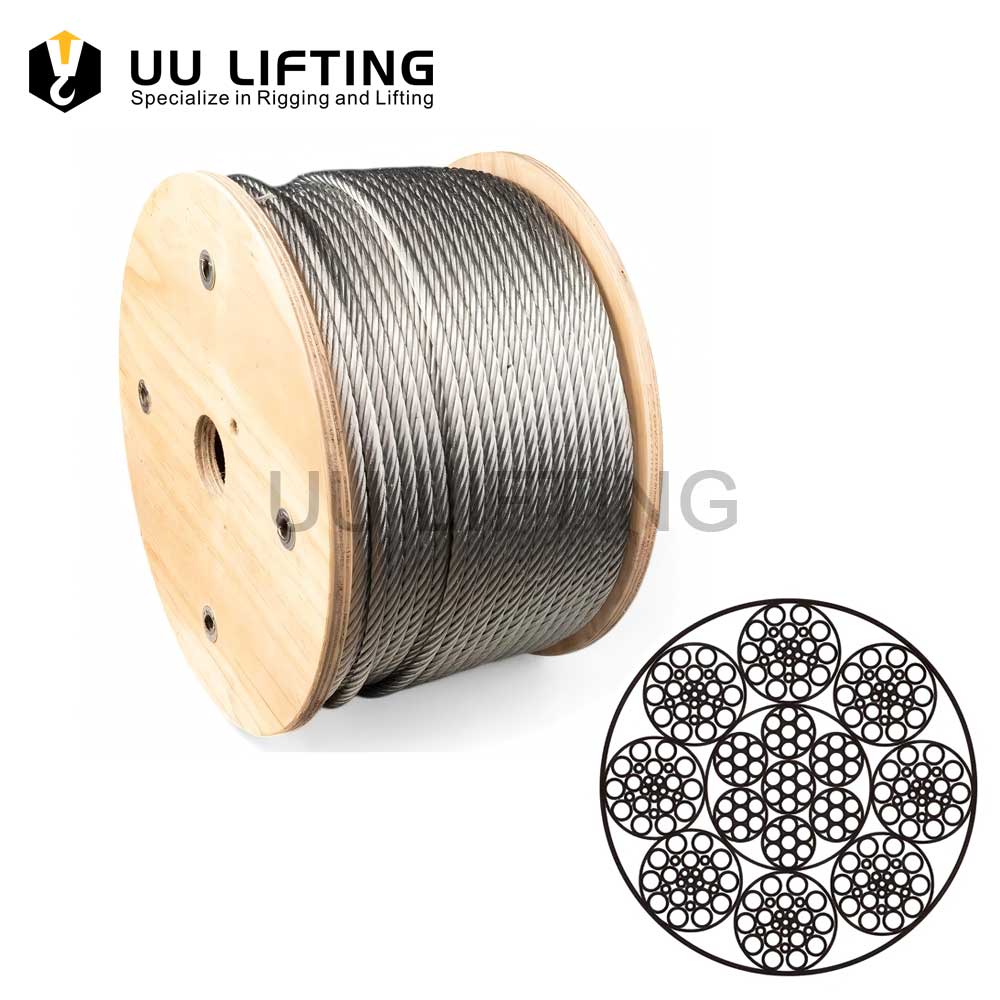
What Is 8x26WS Line Contact Wire Rope, And Why Should You Care?
An 8x26WS is a high-performance wire rope. It has eight strands, each with 26 wires, in a Warrington Seale pattern. This “line contact” design gives it excellent fatigue resistance, flexibility, and crush resistance, making it very durable for demanding lifting applications.
That’s the quick answer. But as a buyer, you need more details to make a smart purchase. I have spent years explaining this to customers, including experienced ones like my client Mark. He knows that the small details in construction make a big difference in performance and cost over time. Let’s break down what really matters when you’re choosing a rope.
What makes the ‘Warrington Seale’ (WS) construction so effective?
The ‘WS’ or Warrington Seale construction layers different-sized wires in a specific pattern. This creates “line contact” between wires, not “point contact.” This reduces internal stress and friction, drastically increasing the rope’s lifespan and resistance to wear.
The name “Warrington Seale” or “WS” tells you exactly how the wires are arranged inside each strand. It’s a combination of two different designs. The Warrington pattern involves a layer of wires with alternating large and small diameters. The Seale pattern has a layer of large outer wires over a layer of smaller inner wires.
When you combine them, you get the WS construction. The magic of this design is that it creates “line contact”. The individual wires in different layers rest against each other along a continuous line rather than at a single point. In simpler rope constructions, wires cross over each other and attach only to a single point. This point contact concentrates all the pressure and friction, causing the wires to wear down and break quickly. Line contact spreads that pressure and friction over a much larger area.
Point Contact vs. Line Contact
The core benefit is reducing internal, wire-to-wire abrasion. This is a major cause of rope failure from the inside out.
The Benefit of Reduced Friction
Less friction means less heat and wear. This directly translates to a longer service life, especially in applications where the rope is constantly bending and moving.
Feature
Point Contact (e.g., 6×19)
Line Contact (e.g., 8x26WS)
Internal Wear
High
Low
Fatigue Resistance
Good
Excellent
Stress Concentration
High (at points)
Low (spread along lines)
Rope Lifespan
Standard
Extended
Why choose an 8-strand rope over a 6-strand?
An 8-strand rope has more strands than a traditional 6-strand rope. This makes it more flexible and stable. It provides a better contact surface on sheaves and drums, improving performance and reducing wear on both the rope and your machinery.
For the same overall rope diameter, increasing the number of strands from six to eight has some major advantages. As a procurement officer, you are always looking for better performance and longer life, and this is one way to get it. I often discuss this with buyers who are looking to upgrade from standard ropes.
Improved Flexibility
More strands mean each strand is smaller. The entire rope becomes more flexible and can bend more easily around sheaves and drums. This reduces the internal stress that causes wires to fatigue and break.
Superior Crush Resistance
An 8-strand rope has a rounder, smoother surface than a 6-strand rope. This means it has more surface area to make contact with sheave grooves and winch drums. This spreads the pressure, making the rope highly resistant to crushing or flattening. This is extremely important when a rope is spooled in multiple layers on a drum, where the top layers can crush the bottom ones. A crushed rope is weak and unsafe.
Feature
6-Strand Ropes (e.g., 6×25)
8-Strand Ropes (e.g., 8x26WS)
Flexibility
Good
Excellent
Drum Spooling
Good
Excellent (less crushing)
Shape Stability
Good
Excellent (rounder profile)
Fatigue Life
Good
Excellent
What are the best applications for 8x26WS wire rope?
8x26WS wire rope excels in applications with repeated bending and high stress. It’s ideal for main hoist lines on mobile and overhead cranes, winch lines, and boom hoists. Its fatigue and crush resistance make it a top choice for heavy-duty lifting.
You must match the rope to the job. Using the wrong rope is inefficient and dangerous. The 8x26WS construction is a high-performance product designed for specific challenges. We supply this rope to customers in construction, manufacturing, and port logistics who cannot afford failures.
Crane and Hoist Lines
This is the number one application. The main hoist line on a crane runs continuously over sheaves as it lifts and lowers loads. The superior bending fatigue resistance of the 8x26WS design means it will last much longer and be more reliable in this role than a standard 6×19 or 6×37 rope.
Winching Operations
In any application where the rope is spooled onto a drum, especially when multiple layers are used, crush resistance is critical. The smooth, round profile of the 8-strand construction helps the rope spool evenly and resists damage from the pressure of the layers above it. This makes it perfect for heavy-duty winches.
Application
Why 8x26WS is Ideal
Key Benefit
Overhead Crane Hoist
Constant bending over sheaves
Fatigue Resistance
Mobile Crane Main Line
High loads, repeated bending
Fatigue & Strength
Multi-layer Winch Drum
Rope layers pile on each other
Crush Resistance
Boom Hoist Lines
Bending and load stability
Flexibility & Stability
OUR FACTORY
Raw materials of our products are made of high-quality steel that meets the standards, and the raw materials are traceable. And multiple production lines and machines minimize lead times for rigging and lifting equipment.
Raw Material
Forged
Cast
Chain Machine
Heat Treatment
Powder Plastified
Package
Warehouse
MANUFACTURING PROCESSES
With eight automatic forging and semi-automatic forging line of up to 1600ton press machines and specialized drillng, tapping, heat treatment and inspection equipment. Strict and standardized production process ensures you receive perfect products.
QUALITY CONTROL
All rigging and lifting products are subjected to strict working tension and breaking the tension test. Complied with ISO9001 and CE certification. Our promise to you: Guaranteed safety at work for people and materials.