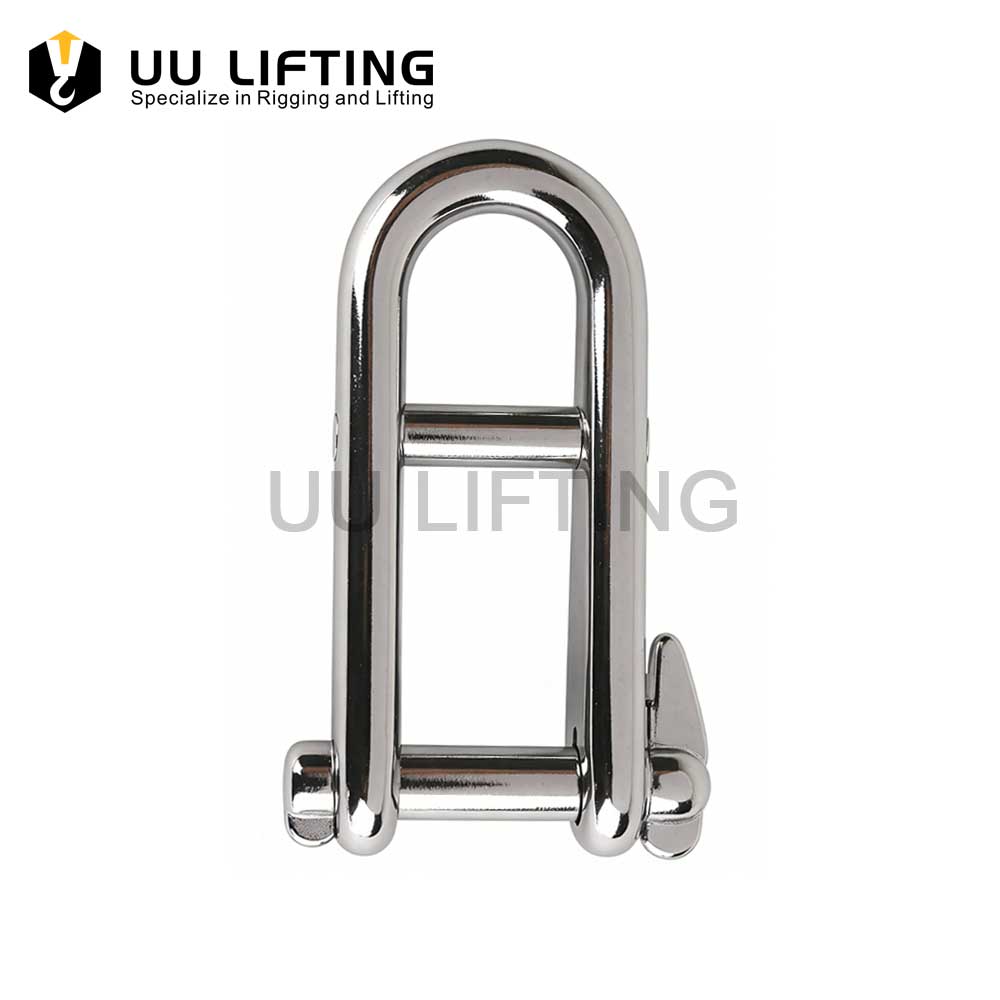
Stainless Steel Halyard Shackle with Key Pin Specifications:
MOQ
1 Pallet, 1 Ton or 3000USD
Material
Grade: 17-4 PH or 316 Stainless Steel
Surface Finish
High Polished Finish
Sizes
1/4″
Technique Procedure
Free Forging
Stainless Steel Halyard Shackle with Key Pin Sizes:
Stainless Steel Halyard Shackle with Key Pin Size
Stainless Steel Halyard Shackle with Key Pin Sizes
A Size (in)
Weight (lb)
Work Load Limit (lb)
Dimension (inch)
B
C
D
E
X
Y
Z
3/16″
0.07
500
0.20″
0.47″
1.48″
0.52″
1.29″
1.96″
0.39″
1/4″
0.11
750
0.24″
0.56″
1.70″
0.61″
1.47″
2.25″
0.45″
5/16″
0.25
1000
0.31″
0.75″
2.37″
0.84″
1.84″
3.15″
0.66″
What Exactly Is a Stainless Steel Halyard Shackle with a Key Pin?
A stainless steel halyard shackle with a key pin is a specialized connector, ideal for marine environments. Its stainless steel body resists rust. The key pin allows for quick, secure fastening and unfastening without losing the pin. This makes it well-suited for dynamic applications such as sailing.
Why Choose Stainless Steel for Halyard Shackles?
Stainless steel is the best choice for halyard shackles because of its excellent corrosion resistance. It withstands saltwater and harsh weather, ensuring long-term strength and reliability. This makes it perfect for marine, sailing, and outdoor applications where durability is critical.
I learned about material choice the hard way. Early in my career, I supplied a batch of standard galvanized shackles to a client in a coastal area. I thought I was saving them money. A few months later, I got an angry call from the client. The shackles were showing signs of rust, especially around the threads. This compromised their safety rating and made them hard to use. It was a costly mistake for me, but it was a great lesson. Now, I always ask my customers about the application environment. For marine or outdoor applications, stainless steel is my top recommendation. Not all stainless steel is the same; the grade is critical.
Stainless Steel Grades for Rigging
Grade
Key Feature
Best Use Case
AISI 304
Good corrosion resistance
General purpose, freshwater environments
AISI 316
Excellent corrosion resistance
Marine, saltwater, chemical exposure
17-4 PH
High Strength & Hardness
Aerospace fasteners, pump shafts, turbine blades, and medical devices.
For halyard shackles used in sailing, AISI 316 is the industry standard. This grade contains molybdenum. This element provides superior protection against chlorides, such as those in seawater. This ensures the shackle remains strong and reliable for many years, which keeps my customers happy.
How Does a Key Pin Mechanism Work?
A key pin shackle has a smooth pin with a “key” or tab at the end. The pin slides through the shackle eyes and is secured by a simple quarter-turn. This locks it into place, preventing accidental backing out. It’s much faster than a screw pin.
Think about the difference between a screw pin and a key pin. A screw pin shackle is excellent for many temporary jobs. However, you must tighten it correctly every time. If you do not, vibration can loosen the screw pin and cause it to fall out. This is a considerable risk in long-term or dynamic applications. I always tell my customers to check their screw pins before every lift. A key pin is different. It’s a type of captive pin, which means the pin is attached to the shackle body and won’t get lost. The locking mechanism is also more vibration-resistant.
Pin Type Comparison
Pin Type
Security Mechanism
Speed
Best For
Screw Pin
Threads
Moderate
Quick, temporary lifts and connections.
Bolt & Nut Pin
Bolt, nut, and cotter pin
Slow
Long-term, permanent, or high-vibration applications.
Key Pin
Pin and twist-lock key
Fast
Quick-release needs where the pin must stay attached.
The key pin combines speed and security. You push the pin in, twist it, and it’s locked. This is why they are often called “halyard” shackles. On a sailboat, you need to attach and detach sails or lines quickly and frequently. Sometimes you only have one hand free. A key pin is perfect for that scenario.
What Are the Key Applications and Limitations?
Stainless steel halyard shackles with key pins are primarily used in sailing and marine rigging. They are used to attach halyards to sails. Their main limitation is load capacity. They are not designed for heavy overhead lifting or static, high-load industrial applications. A bolt-type shackle is safer for those jobs.
Choosing the Right Shackle
Application
Recommended Shackle
Why?
Sailing / Marine
Stainless Halyard Shackle (Key Pin)
Fast, corrosion-resistant, and has a captive pin.
General Rigging (temp)
Screw Pin Shackle (Bow or Dee)
Versatile and easy to install for temporary jobs.
Overhead Lifting
Forged Alloy Bolt Type Shackle
Highest strength and security for critical loads.
Permanent Mooring
Galvanized Bolt Type Shackle
Long-term security and good corrosion protection.
Using a halyard shackle for heavy lifting is like using a screwdriver as a hammer. It might work for a moment, but it’s going to fail eventually, and that failure can be dangerous.
What Should You Check When Buying Halyard Shackles?
When buying, verify the material grade; it should be AISI 316 for marine use. Look for the Working Load Limit (WLL) markings and the manufacturer’s name. A smooth finish, free of cracks or burrs, indicates good quality. Always request material certificates from your supplier.
Quality Inspection Checklist
Inspection Point
What to Look For
Why It Matters
Markings
Clear WLL, manufacturer ID, steel grade (316).
This provides traceability and ensures the shackle is rated for the intended load.
Pin Fit
Pin should slide in smoothly and lock securely. No excessive wiggle.
A poor fit means the locking mechanism is weak and could fail under load.
Surface Finish
Smooth, polished surface. No sharp edges, cracks, or pitting.
Defects on the surface can be stress points that lead to cracking and failure.
Certificates
Request a Mill Test Certificate (MTC) and proof load test reports.
Request a Mill Test Certificate (MTC) and proof of load test reports.
Never be afraid to ask your supplier tough questions. A good supplier will be happy to provide documentation and explain their quality control process. If they can’t or won’t, that’s a big red flag.
OUR FACTORY
Raw materials of our products are made of high-quality steel that meets the standards, and the raw materials are traceable. And multiple production lines and machines minimize lead times for rigging and lifting equipment.
Raw Material
Forged
Cast
Chain Machine
Heat Treatment
Powder Plastified
Package
Warehouse
MANUFACTURING PROCESSES
With eight automatic forging and semi-automatic forging line of up to 1600ton press machines and specialized drillng, tapping, heat treatment and inspection equipment. Strict and standardized production process ensures you receive perfect products.
QUALITY CONTROL
All rigging and lifting products are subjected to strict working tension and breaking the tension test. Complied with ISO9001 and CE certification. Our promise to you: Guaranteed safety at work for people and materials.