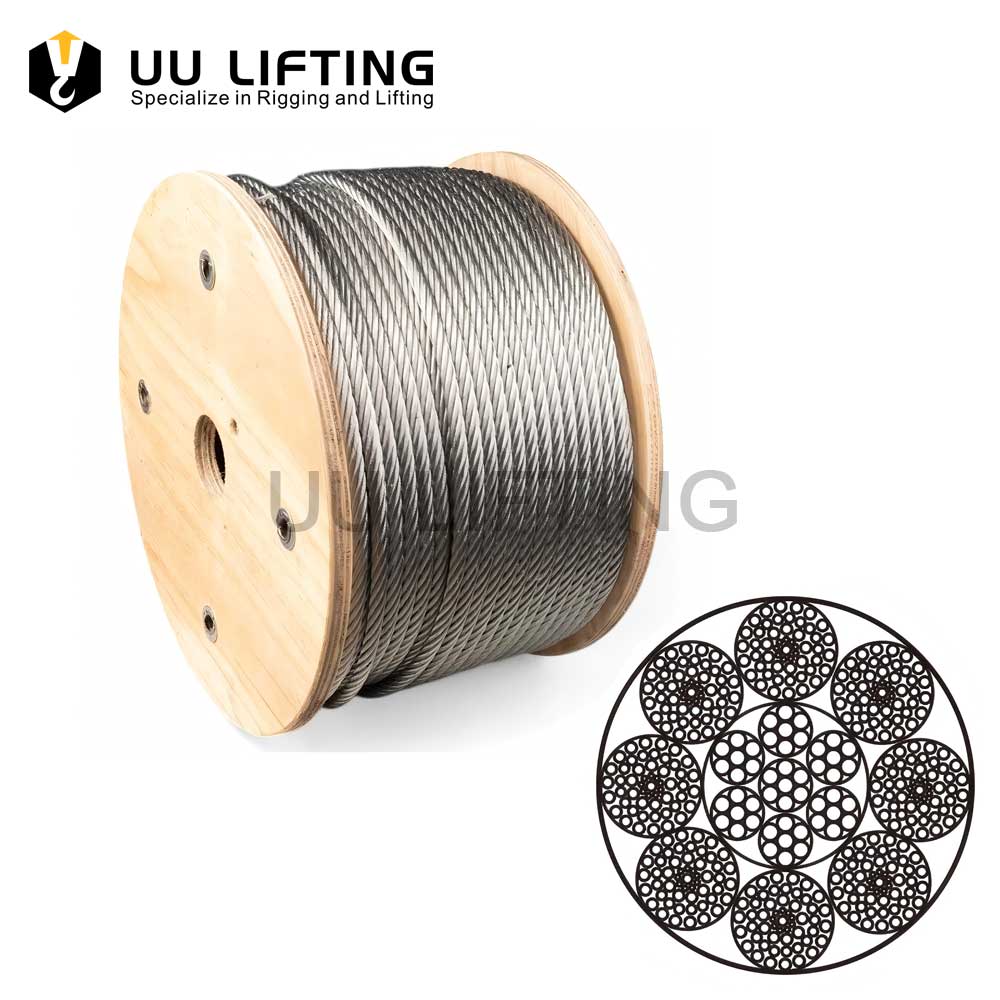
What Is an 8x55SWS Line Contacted Wire Rope, and Why Should You Care?
An 8x55SWS is a high-performance wire rope with eight strands. It features a special Seale-Warrington-Seale wire arrangement and line contact construction. This design offers superior flexibility, fatigue resistance, and a long service life, making it ideal for demanding lifting and hoisting applications.
I used to think all wire rope was basically the same. As a business owner, I looked for a good price and moved on. I learned a tough lesson a few years ago when a cheaper rope on one of my main cranes failed prematurely. The downtime and replacement costs were a huge headache. That’s when I decided I needed to understand the details I was ignoring. It’s not just about the initial price; it’s about the lifetime value and the safety of my operations. Understanding the specifications is the first step to making a smarter purchase. Let’s break it down.
What Does “8x55SWS” Actually Mean for My Application?
“8x55SWS” describes the rope’s build. “8” means eight outer strands for better drum winding. “55” means many wires per strand, giving it flexibility. “SWS” (Seale-Warrington-Seale) is a specific wire layering that balances abrasion resistance with fatigue resistance for tough jobs.
When I first started sourcing lifting equipment, I just asked for “wire rope.” I didn’t realize these numbers and letters told a critical story. Breaking down the code 8x55SWS helped me become a much better buyer.
Breaking Down the Code
8: This is the number of outer strands. Most standard ropes you see are 6-strand. An 8-strand rope provides a rounder profile and more surface contact with sheaves and drums. This is great for multi-layer spooling on a winch drum because it helps resist crushing.
55: This number represents the wires inside each of the eight strands. A higher wire count like this means the individual wires are finer, which makes the rope much more flexible and resistant to fatigue from bending.
SWS: This stands for Seale-Warrington-Seale. It describes a very specific, complex arrangement of wires within each strand. It combines different wire sizes in three layers to get the best of all worlds:
Seale: Larger outer wires for excellent abrasion resistance.
Warrington: An intermediate layer of alternating large and small wires for flexibility.
Seale: Another layer for structural stability.
This combination creates a rope that can withstand both external wear and internal bending stresses, which is exactly what I need for my most critical lifting jobs.
How Does “Line Contact” Improve Rope Performance and Lifespan?
Line contact means the wires and strands touch along a continuous line, not just at a single point. This distributes pressure evenly, reduces internal friction and wear, and significantly increases the rope’s fatigue resistance. Your rope will last much longer under repeated bending stress.
This was a game-changer for me. I never thought about how a rope wears out from the inside. My supplier in China, UU LIFTING, explained it with a simple analogy. Imagine trying to balance your weight on the tip of a needle versus the edge of a knife. The needle is “point contact,” and all the pressure is in one tiny spot. The knife is “line contact,” spreading the pressure out. Older, simpler rope designs have wires that cross over each other, creating tiny points of extremely high pressure. This internal point loading causes wires to wear and break from the inside out.
Line contact construction is much more sophisticated. The wires and strands are designed to nestle against each other, creating a long, linear contact area.
Line Contact vs. Point Contact
Feature
Point Contact (Older Designs)
Line Contact (e.g., 8x55SWS)
Internal Stress
Highly concentrated at points
Distributed evenly along lines
Internal Wear
High; wires “nick” each other
Low; wires slide smoothly
Fatigue Life
Shorter
Significantly longer
How it Fails
Premature internal wire breaks
Gradual, more predictable wear
By choosing a line contact rope, I’m investing in a product that fights its own internal enemy. The rope is more stable, lasts longer, and is ultimately safer because its wear is more predictable. This reduces the lifetime cost, which is what really matters to my bottom line.
When Should I Choose an 8x55SWS Rope Over a Standard 6×19 or 6×37?
Choose an 8x55SWS for demanding applications with high fatigue cycles, such as main crane hoists, boom hoists, or systems with multi-layer spooling. While a 6×19 is a good general-purpose rope, the 8x55SWS offers superior performance and a longer service life in critical operations.
As a procurement officer, this is the final question: when do I spend the extra money? After my bad experience with a cheap rope, I learned to match the rope to the job’s intensity. A standard 6×19 rope is a workhorse. It’s great for many applications, like slings or stationary rigging, where the rope isn’t constantly running over sheaves under heavy load. It’s cost-effective and reliable for those jobs.
However, for my main crane hoist, which is in use all day, the calculus changes. The constant bending, the high loads, and the multi-layer spooling on the winch drum are all “fatigue” factors that will destroy a lesser rope. This is where the 8x55SWS shines.
Application Comparison
Feature
6×19 / 6×37 (Standard)
8x55SWS (High Performance)
Best For
General purpose, static lines, low-cycle lifts
Main hoists, dynamic lifts, high-fatigue jobs
Fatigue Life
Good
Excellent
Abrasion Resistance
Fair to Good
Very Good
Crush Resistance
Moderate
Excellent
Flexibility
Good
Excellent
Value Proposition
Low initial cost
Best long-term ROI in demanding roles
Ultimately, I use the 8x55SWS rope for my most critical, high-use equipment. The higher initial investment is easily recouped through a longer service life, reduced downtime for rope changes, and the added peace of mind that comes with using the right tool for a demanding job.
OUR FACTORY
Raw materials of our products are made of high-quality steel that meets the standards, and the raw materials are traceable. And multiple production lines and machines minimize lead times for rigging and lifting equipment.
Raw Material
Forged
Cast
Chain Machine
Heat Treatment
Powder Plastified
Package
Warehouse
MANUFACTURING PROCESSES
With eight automatic forging and semi-automatic forging line of up to 1600ton press machines and specialized drillng, tapping, heat treatment and inspection equipment. Strict and standardized production process ensures you receive perfect products.
QUALITY CONTROL
All rigging and lifting products are subjected to strict working tension and breaking the tension test. Complied with ISO9001 and CE certification. Our promise to you: Guaranteed safety at work for people and materials.