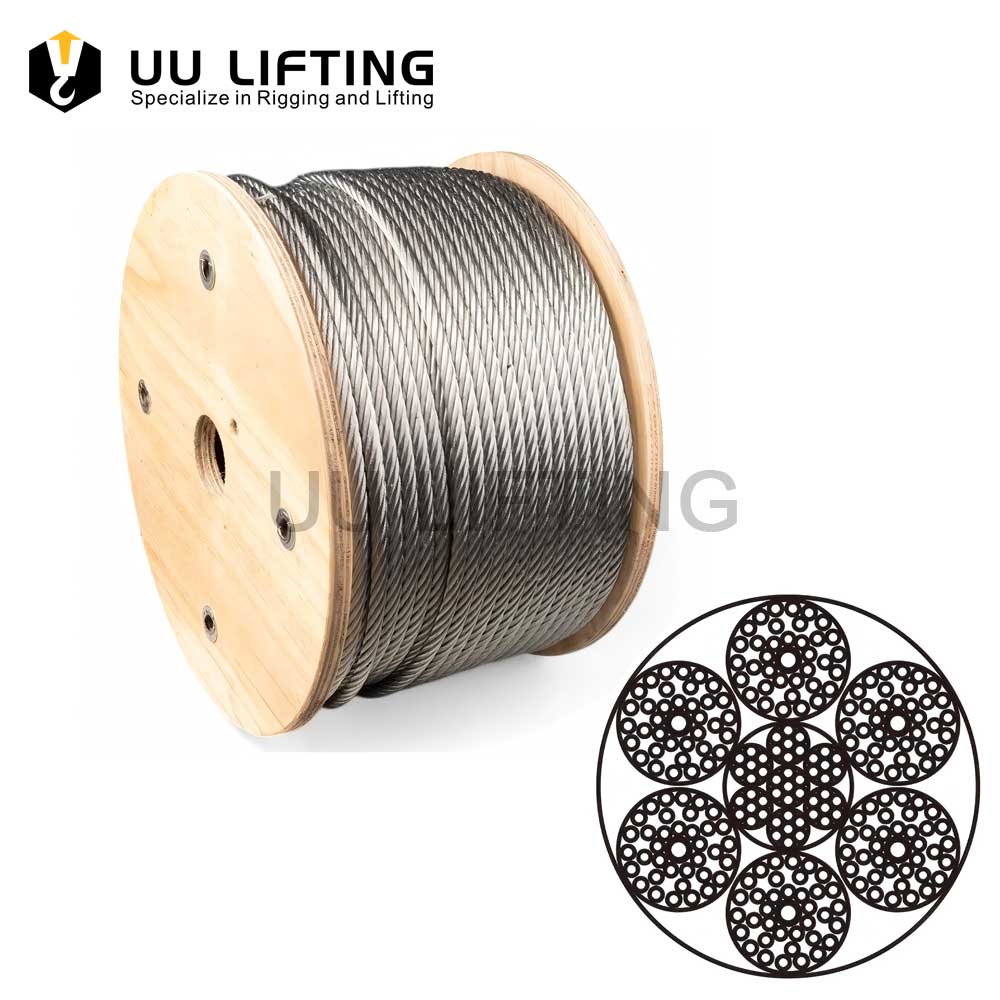
6x55SWS is a steel wire rope with 6 strands and an Independent Wire Rope Core (IWRC). Each strand contains 55 wires in a special Seale-Warrington-Seale pattern. This design provides excellent crush resistance and flexibility, making it perfect for demanding crane and winch applications.
I often talk to buyers like Mark, a business owner from America. He buys lifting gear from us in China and sells it in his home market. He’s great with sales but not a technical expert. He once told me his customers were complaining that their crane ropes were getting flat and damaged on the winch drums. He was selling them a standard rope, and it just wasn’t holding up. His problem highlighted a common issue: not all wire ropes are built for the same job. Understanding the specific construction, such as 6x55SWS, is key to solving these problems and keeping customers happy. Let’s look closer at what makes this rope so special.
How is a 6x55SWS wire rope constructed?
The 6x55SWS construction has 6 outer strands wrapped around a central steel core (IWRC). Each strand is made of 55 wires. These wires are arranged in a Seale-Warrington-Seale pattern, which combines different wire sizes for durability, flexibility, and crush resistance.
Let’s break this down further. When I explained this to Mark, I drew it out for him. The construction is the most important part. It determines how the rope performs under stress.
The Strands and Wires
First, the “6×55” tells you the basic layout. The rope has 6 main strands. Each of those strands consists of 55 individual wires. This is a high number of wires. More wires usually mean more flexibility. But the real magic is in how those 55 wires are arranged.
The SWS Pattern
“SWS” stands for Seale Warrington Seale. This sounds complex, but it’s just a way to combine different wire patterns to get the best features of each.
Seale: A Seale pattern has large outer wires. These big wires are great at resisting abrasion and wear.
Warrington: A Warrington pattern alternates between small and large wires in a single layer. This design makes the strand more flexible.
Seale-Warrington-Seale (SWS): This combines the patterns. It gives you the large, durable outer wires of a Seale construction and the flexible inner layers of a Warrington construction.
Pattern
Primary Advantage
Best Use Case
Seale
High abrasion resistance
Ropes that rub against surfaces
Warrington
Good flexibility
Ropes that bend over pulleys
SWS
Crush resistance & Flexibility
Crane hoist lines
The Core
Finally, this rope uses an IWRC, which means Independent Wire Rope Core. The core is a small wire rope itself. An IWRC provides strong internal support. It helps the outer strands resist crushing when spooled on a drum. The other option is a Fiber Core (FC), which offers more flexibility but much less crush resistance. For a 6x55SWS rope, IWRC is almost always the right choice because it is designed for high-stress applications.
What are the advantages of a 6x55SWS wire rope?
The main advantages of 6x55SWS wire rope are its excellent resistance to crushing, good flexibility, and high abrasion resistance. This combination extends its service life, especially on crane drums, reducing costs and improving safety.
When Mark’s customers had ropes going flat, they were experiencing a classic case of rope crushing. The rope they were using was not designed to withstand the pressure of being wound multiple layers on a crane’s winch drum. I told him the 6x55SWS was the solution. Here are the specific advantages I explained to him.
Superior Crush Resistance
This is the most important benefit. The combination of the solid steel core (IWRC) and the tightly packed SWS strands creates a very dense and stable rope. It holds its round shape under immense pressure. On a crane winch, the rope gets wound over itself again and again. A less dense rope would flatten, get damaged, and lose its strength. The 6x55SWS design prevents this. This makes it perfect for multi-layer spooling.
High Abrasion Resistance
The outer wires in the SWS pattern are large. This is the “Seale” part of the design. These large wires create a tough, durable surface. This surface can handle rubbing against the drum, sheaves, and other equipment without wearing down quickly. Ropes with many small outer wires will fray and break much faster under the same conditions.
Good Flexibility and Fatigue Resistance
Even though it is very strong and dense, the 6x55SWS is still flexible. The “Warrington” layers inside the strands help the rope bend without the wires fatiguing and breaking. A rope needs to be flexible enough to bend smoothly around sheaves and drums. If it’s too stiff, it will crack and fail. The 6x55SWS provides a great balance.
Property
6×19 Class
6×37 Class
6x55SWS
Crush Resistance
Good
Fair
Excellent
Abrasion Resistance
Excellent
Good
Very Good
Flexibility
Fair
Very Good
Good
Best For
Abrasion
Bending
Crushing
This balance of features leads to a much longer service life in the right application. For a distributor like Mark, providing a rope that lasts longer builds a strong reputation for quality.
What are the common applications for 6x55SWS wire rope?
6x55SWS wire rope is used for heavy-duty applications where crush resistance is the top priority. This includes main hoist lines for mobile and crawler cranes, boom hoist ropes, and other demanding winch systems that spool rope in multiple layers.
After I explained the construction and advantages to Mark, his next question was simple: “So, when should my customers use it?” This is the most important question for any buyer. Using a high-tech rope in the wrong place is just as bad as using a cheap rope for a tough job. I told him to think about the drum. If the rope is being wound into many layers under heavy load, 6x55SWS is likely the answer.
Crane Main and Auxiliary Hoist Lines
This is the primary application. Mobile cranes, tower cranes, and crawler cranes all use winches that spool many layers of rope onto a drum. The pressure on the bottom layers is huge. 6x55SWS is engineered to withstand this pressure without deforming. This ensures the rope maintains its strength and spools smoothly, which is critical for safe and efficient lifting operations.
Boom Hoist Ropes
The rope used to raise and lower the main boom of a crane also experiences high loads and multi-layer spooling. It is a critical component for the crane’s stability and operation. The reliability and crush resistance of 6x55SWS make it an excellent choice for this application, providing an essential safety factor.
Heavy-Duty Winching
Any industrial winch that operates under heavy load with a multi-layer drum can benefit from 6x55SWS. This includes applications in marine settings for mooring or towing, on drilling rigs for hoisting equipment, and in heavy construction for pulling large components into place. The rope’s durability ensures a long life even in these tough, demanding environments.
By recommending 6x55SWS to his customers with cranes, Mark solved their crushing-ropes problem. He became a trusted advisor, not just a seller.
OUR FACTORY
Raw materials of our products are made of high-quality steel that meets the standards, and the raw materials are traceable. And multiple production lines and machines minimize lead times for rigging and lifting equipment.
Raw Material
Forged
Cast
Chain Machine
Heat Treatment
Powder Plastified
Package
Warehouse
MANUFACTURING PROCESSES
With eight automatic forging and semi-automatic forging line of up to 1600ton press machines and specialized drillng, tapping, heat treatment and inspection equipment. Strict and standardized production process ensures you receive perfect products.
QUALITY CONTROL
All rigging and lifting products are subjected to strict working tension and breaking the tension test. Complied with ISO9001 and CE certification. Our promise to you: Guaranteed safety at work for people and materials.