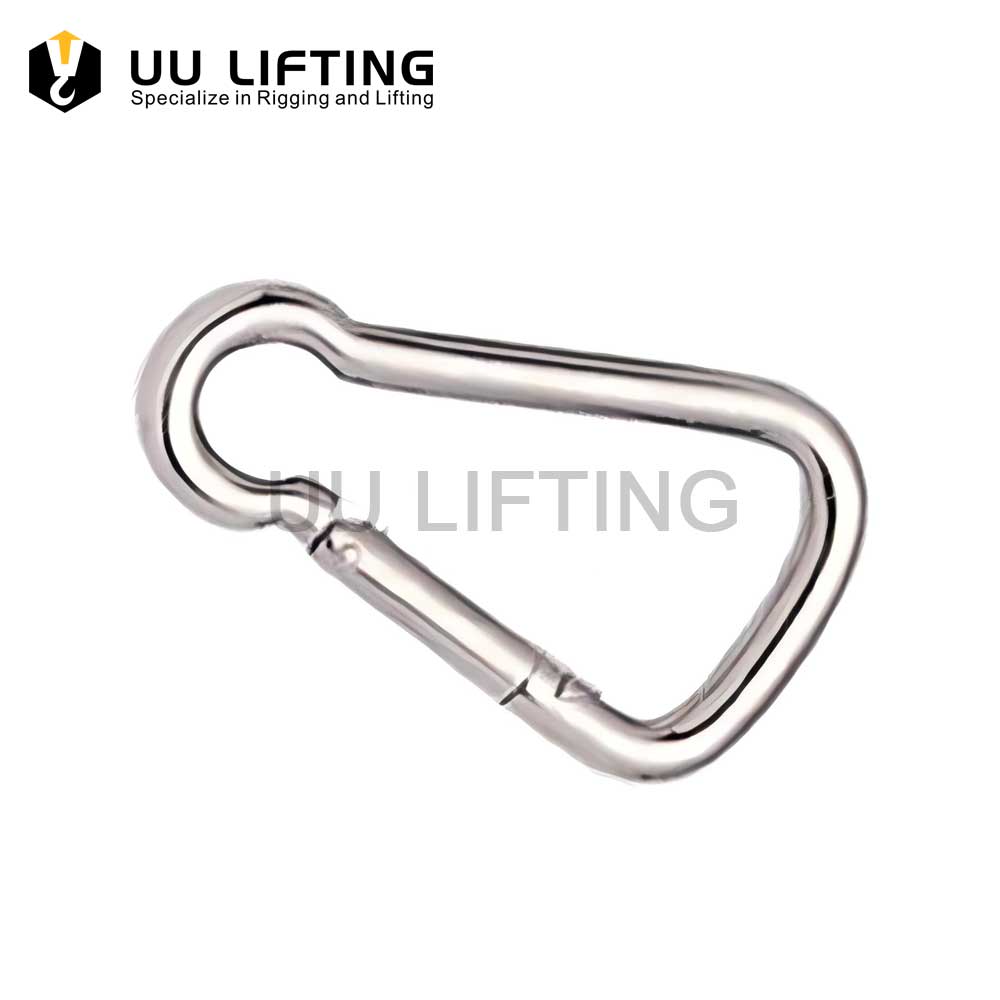
Description

An Oblique Angle Snap Hook is a type of fastening device that combines the features of a “snap hook” with a specific design characteristic related to its “oblique angle.”

Here’s a more detailed explanation:

  1. Snap Hook:
    • This is the fundamental part. A snap hook (often just called a “snap”) is a metal hook with a spring-loaded gate (the “snap” mechanism).
    • The gate opens to allow the hook to be clipped onto an object (like a D-ring, loop, rope, or another piece of hardware) and then springs shut to close the connection securely.
    • They are designed for quick and easy attachment and detachment.
    • Common examples include the clips on dog leashes, keychains, or some types of rigging hardware.
  2. Oblique Angle:
    • “Oblique” means slanting, not perpendicular (90 degrees) or parallel.
    • In the context of a snap hook, “oblique angle” refers to the orientation of the hook’s opening or the gate itself relative to the main body or the eye (the part where a strap or rope is attached).
    • Instead of the opening being straight in line with the eye or at a perfect right angle, it’s set at a slant.

So, an “Oblique Angle Snap Hook” is a snap hook where the gate and the opening are intentionally designed at a slanting angle.

Why have an oblique angle?

  • Easier Engagement: The angled opening makes it easier to clip the hook onto an attachment point, especially in awkward positions or when attempting to do it one-handed. The angle can help guide the attachment point into the hook.
  • Specific Applications: For certain uses, an angled approach might be more ergonomic or provide a more direct line of force or better clearance than a standard straight or right-angled hook.
  • Reduced Snagging (potentially): In some designs, the oblique angle might help prevent the hook from unintentionally snagging on other objects, though this is less common as a primary design driver.

In summary:

An Oblique Angle Snap Hook is a spring-loaded hook designed for quick connections, where the opening of the hook is set at a slanting angle to its main body. This angled design often aims to improve ease of use or suitability for specific connection scenarios.

OUR FACTORY
Raw materials of our products are made of high-quality steel that meets the standards, and the raw materials are traceable. And multiple production lines and machines minimize lead times for rigging and lifting equipment. 
RAW-MATERIAL
Raw Material
Forged-Plant
Forged
Cast Process
Cast
Chain Process
Chain Machine
Heat Treatment Plant
Heat Treatment
Powder Plastified Plant
Powder Plastified
Package Plant
Package
Warehouse Plant
Warehouse
MANUFACTURING PROCESSES
With eight automatic forging and semi-automatic forging line of up to 1600ton press machines and specialized drillng, tapping, heat treatment and inspection equipment. Strict and standardized production process ensures you receive perfect products.
MANUFACTURING-PROCESSES-shackle
QUALITY CONTROL
All rigging and lifting products are subjected to strict working tension and breaking the tension test. Complied with ISO9001 and CE certification. Our promise to you: Guaranteed safety at work for people and materials.
G70 Chain Test
Chain Test
Clamp Test
Clamp Test
Hook Test
Hook Test
Link Test
Link Test
Shackle Tension Test
Snap Hook Test
Snap Hook Test

Ask For A Quick Quote

We will contact you within 1 working day, please pay attention to the email with the suffix “@uulifting.com”