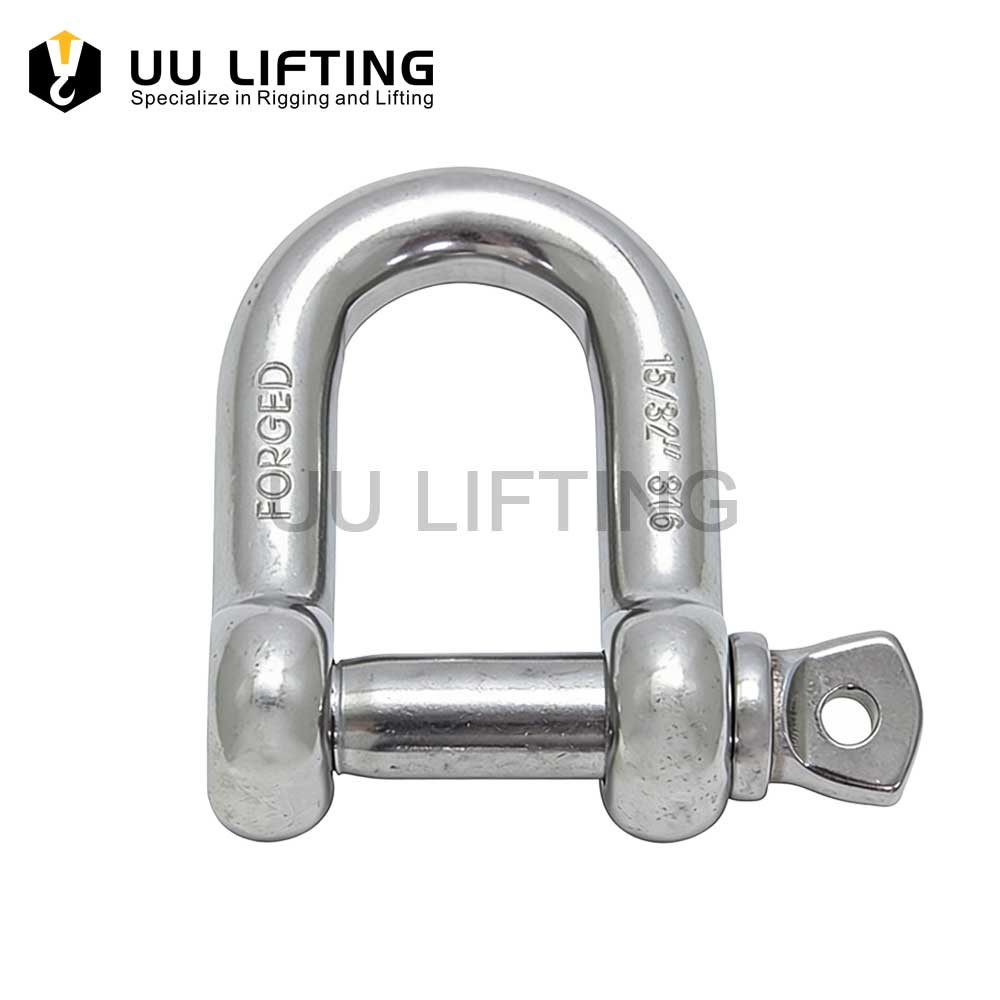
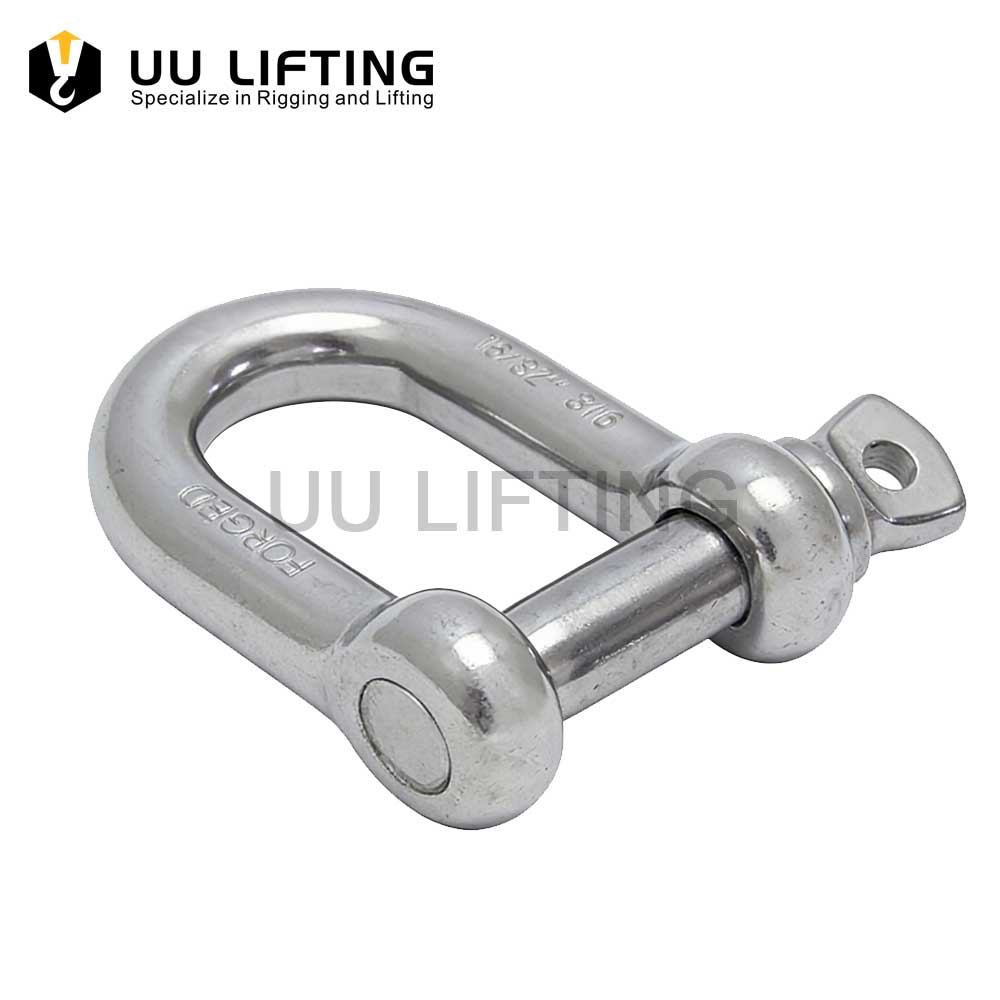
Stainless Steel Straight D Shackle with Screw Pin Specifications:
MOQ
1 Pallet, 1 Ton or 3000USD
Material
Grade 316/304 Stainless Steel
Surface Finish
High Polished Finish
Sizes
From 3/16″ to 3/4″
Technique Procedure
Free Forging
Stainless Steel Straight D Shackle with Screw Pin Sizes:
Stainless Steel Straight D Shackle with Screw Pin Sizes
Stainless Steel Straight D Shackle with Screw Pin Sizes
A Size (in)
Weight (lb)
Work Load Limit (lb)
Dimension (inch)
B
C
D
X
Y
Z
3/16″
0.03
500
0.19″
0.41″
0.66″
1.10″
1.15″
0.41″
1/4″
0.05
750
0.23″
0.52″
0.83″
1.30″
1.44″
0.47″
5/16″
0.13
1,000
0.31″
0.66″
1.10″
1.74″
1.85″
0.62″
3/8″
0.24
2,000
0.39″
0.83″
1.37″
2.24″
2.32″
0.78″
15/32″
0.42
3,000
0.47″
0.98″
1.65″
2.60″
2.80″
0.94″
5/8″
0.98
4,000
0.62″
1.31″
2.20″
3.40″
3.60″
1.20″
3/4″
1.94
5,500
0.77″
1.62″
2.77″
4.32″
4.70″
1.57″
What makes a stainless steel D shackle the right choice for your rigging?
A stainless steel straight D shackle with a screw pin is a U-shaped rigging connector made from corrosion-resistant steel. It is secured by a threaded pin that you can easily install and remove, making it an excellent choice for temporary, in-line lifting jobs, especially in harsh environments.
Why is stainless steel the ultimate material for shackles?
Stainless steel is the best material for shackles used in harsh conditions, such as marine or chemical environments. It naturally resists rust and corrosion. This quality ensures long-term strength and reliability without needing extra protective coatings, unlike other materials.
Key Benefits of Stainless Steel
The magic of stainless steel is in its composition. It contains chromium, which creates a passive, invisible layer on the surface. This layer protects the steel from reacting with oxygen and water, which causes rust. This makes it incredibly reliable.
Feature
Stainless Steel (AISI 304/316)
Galvanized Carbon Steel
Corrosion Method
Inherently resistant due to chromium content
A protective zinc coating is applied to the steel
Durability
Resists scratches without losing protection
Protection is lost if the zinc coating is damaged
Best Environment
Marine, chemical, and outdoor applications
General construction, dry environments
Maintenance
Very low, requires minimal upkeep
May need re-coating if the zinc layer wears off
Lifespan
Longer lifespan in corrosive environments
Shorter lifespan when exposed to harsh elements
When should you choose a D shackle over a bow shackle?
A D shackle, also called a chain shackle, is designed for straight, in-line lifting. Its narrow “D” shape is perfect for connecting to single-leg slings, chains, or wire ropes. It provides a secure, streamlined connection without additional space for lateral movement.
The shape of the shackle is not for looks; it’s for function. A D shackle is your go-to for simple, one-point lifts. Think of lifting a crate straight up with a single sling. The D shackle keeps the load aligned perfectly. A bow shackle, with its larger, rounded “O” shape, is different. It’s built to handle loads from multiple directions. You would use a bow shackle for a multi-leg sling bridle, where slings are pulling at an angle. Choosing the correct shape is a fundamental part of safe rigging.
D Shackle vs. Bow Shackle Applications
Let’s get more specific. The design of each shackle dictates its best use case. A D shackle centers the load within the loop, which is ideal for preventing shifting or side loading. A bow shackle’s wider loop provides more room, which is necessary when connecting multiple components or when side-loading is unavoidable.
Feature
D Shackle (Chain Shackle)
Bow Shackle (Anchor Shackle)
Shape
“D” or “U” shaped, narrow loop
“O” shaped, wide and rounded loop
Ideal Load
Straight, in-line pulls
Loads from multiple directions (side loads)
Best Use Case
Single-leg slings, chain connections
Multi-leg sling bridles, connecting to anchors
Main Advantage
High strength for in-line applications
Versatility for angled lifts
Is a screw pin shackle always the safest option?
Screw pin shackles are perfect for quick connections in temporary lifting jobs. However, they are not recommended for long-term or permanent installations. Vibration can cause the pin to rotate and loosen over time, creating a significant safety hazard.
I always stress this point to my customers. The screw pin is designed for convenience. It’s great for jobs where you are setting up and taking down the rigging on the same day. But if the shackle is part of a semi-permanent structure or will experience significant movement or vibration, you need something more secure. A pin that backs out is a silent danger. That’s why it is critical to physically check that the screw pin is tight before every single lift. It’s a small step that prevents huge accidents. For permanent applications, a bolt-type shackle with a cotter pin is the much safer choice.
Safe Use of Screw Pin Shackles
The choice between a screw pin and a bolt-type pin comes down to the application’s duration and dynamics. A screw pin is a simple, threaded pin that you tighten into the shackle’s body. A bolt-type pin uses a bolt, a nut, and a cotter pin for a triple-locked, secure connection. This design prevents the pin from rotating or loosening, even under constant vibration.
Pin Type
Screw Pin
Bolt-Type Pin
Connection
Fast and simple, just twist to secure
Slower, requires tools to tighten nut & insert pin
Security
Secure for short term, can loosen
Highly secure, locked with a nut and cotter pin
Best For
Temporary lifts, frequent connections
Long-term, permanent, or high-vibration tasks
Precaution
Must check tightness before every lift
Secure for the short term, can loosen
OUR FACTORY
Raw materials of our products are made of high-quality steel that meets the standards, and the raw materials are traceable. And multiple production lines and machines minimize lead times for rigging and lifting equipment.
Raw Material
Forged
Cast
Chain Machine
Heat Treatment
Powder Plastified
Package
Warehouse
MANUFACTURING PROCESSES
With eight automatic forging and semi-automatic forging line of up to 1600ton press machines and specialized drillng, tapping, heat treatment and inspection equipment. Strict and standardized production process ensures you receive perfect products.
QUALITY CONTROL
All rigging and lifting products are subjected to strict working tension and breaking the tension test. Complied with ISO9001 and CE certification. Our promise to you: Guaranteed safety at work for people and materials.