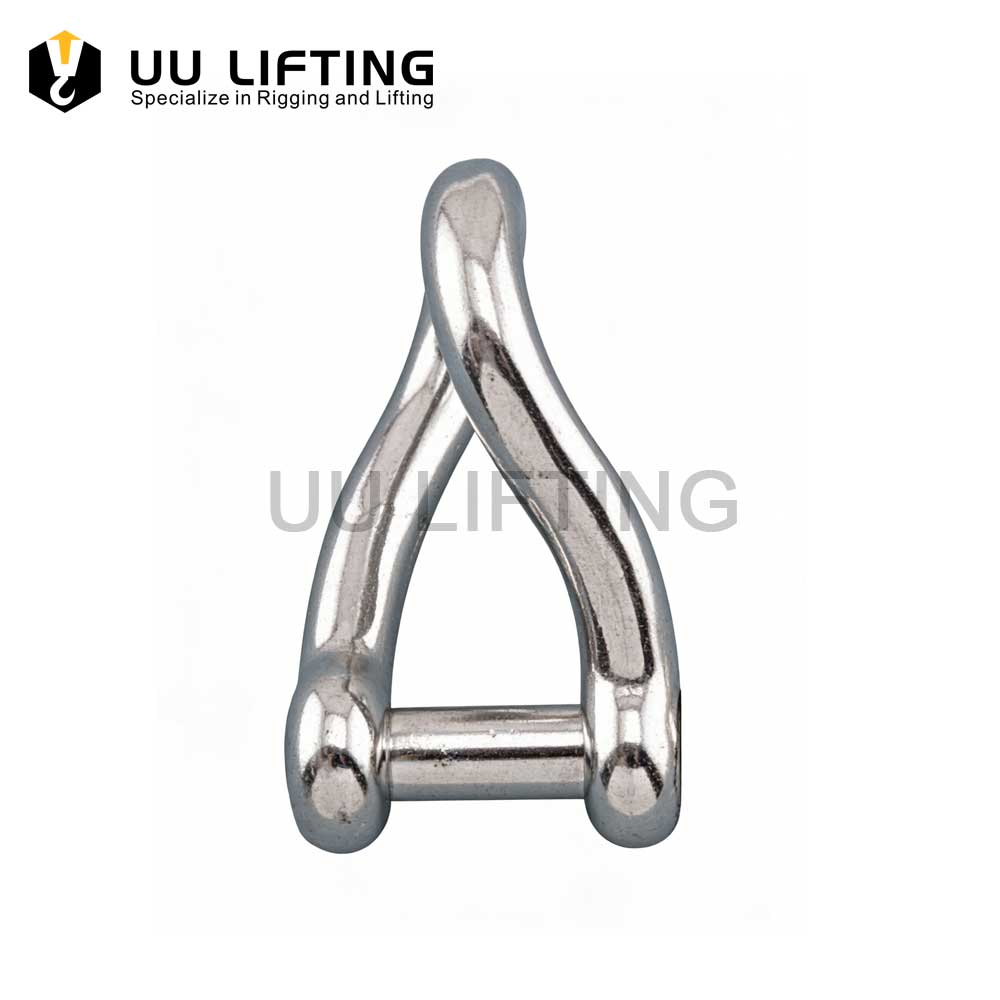
Stainless Steel Twist Shackle with No Snag Pin Specifications:
MOQ
1 Pallet, 1 Ton or 3000USD
Material
Grade: 316 Stainless Steel
Surface Finish
High Polished Finish
Sizes
From 1/4″″ to 1/2″
Technique Procedure
Free Forging
Stainless Steel Twist Shackle with No Snag Pin Sizes:
Stainless Steel Twist Shackle with No Snag Pin Sizes
Stainless Steel Twist Shackle with No Snag Pin Sizes
A Size (in)
Weight (lb)
Work Load Limit (lb)
Dimension (inch)
B
C
D
E
X
Y
Z
1/4″
0.05
750
0.23″
0.42″
1.00″
0.48″
1.00″
1.59″
0.95″
5/16″
0.13
1000
0.31″
0.63″
1.30″
0.66″
1.36″
2.07″
1.26″
3/8″
0.27
1200
0.38″
0.71″
1.80″
0.75″
1.64″
2.66″
1.51″
1/2″
0.47
1500
0.47″
0.95″
2.20″
0.85″
2.00″
3.34″
1.87″
What is a Stainless Steel Twist Shackle with No Snag Pin?
A stainless steel twist shackle with a no-snag pin is a specialized rigging connector. Its body is twisted 90 degrees for perpendicular attachments. The flush pin design prevents snagging, and the stainless steel offers superior corrosion resistance, making it perfect for marine environments.
What makes a “Twist” shackle so unique?
A twist shackle has a body that is forged with a 90-degree twist. This design aligns the shackle’s body and pin at a right angle. It allows perpendicular connections without stressing the components or the shackle.
In-Line vs. Perpendicular Connections
A standard D-shackle or bow shackle is designed to work in a single plane. The load should pull straight through the body and the pin. If you need to connect something at a 90-degree angle, you might be tempted to side-load the shackle, which is extremely dangerous. Or you might add another piece of hardware, which introduces a failure point and additional cost. The twist shackle eliminates this issue. Its U-shaped body is literally twisted during manufacturing. This means the top of the shackle and the pin are naturally oriented at 90 degrees to each other. I remember a customer, an architect’s procurement officer, who was sourcing hardware for a large tensile fabric structure, and using standard shackles caused the webbing to bunch and twist. It looked unprofessional and put uneven stress on the anchor points. Switching to twist shackles solved the problem instantly. The connection was clean, and the load was distributed correctly.
Reducing Component Stress
The main benefit of this design is that it keeps all components in their natural orientation. It prevents the twisting of webbing slings, wire rope, or chain. This reduces wear and tear and maintains the full strength of your rigging assembly. A twisted sling or rope is a weakened sling or rope. Using a twist shackle ensures a fair lead and a proper load path.
Feature
Standard Shackle
Twist Shackle
Connection Plane
In-line (0 degrees)
Perpendicular (90 degrees)
Best Use Case
Connecting items in a straight line.
Connecting items at a right angle.
Effect on Slings
Can cause bunching if used for angles.
Prevents twisting of webbing and rope.
Simplicity
May require extra connectors for angles.
Simplifies rigging by reducing components.
How does a “No Snag” pin improve safety and efficiency?
A “no snag” or “snag-free” pin is designed to sit flush with the shackle’s body. Its head is often countersunk with a smooth, slotted drive. This streamlined design allows ropes, webbing, and other lines to glide over it without catching.
The Problem with Protruding Pins
Think about a standard screw pin shackle. The shoulder of the pin sticks out from the side of the shackle body. While this makes it easy to tighten with a tool or by hand, it also creates a perfect catch point. The same is true for a bolt-type shackle, where the nut and cotter pin extend outward. During a dynamic lift or in applications where lines are constantly moving, this protrusion is a liability. I learned this lesson early on during a visit to a marine hardware distributor. For sailors, a jib sheet catching on a shackle pin during a race is a disaster. It can stop the sail from moving, and the sudden jerk can damage the equipment. The same principle applies directly to industrial lifting and safety equipment. A snag can be catastrophic.
Applications Where No-Snag Matters
The no-snag design is critical in any situation where lines might pass over the shackle.
Marine & Sailing: Essential for rigging sails and anchor lines, where ropes are always in motion.
Arborist & Climbing: Prevents climbing ropes and rigging lines from catching as an arborist moves through a tree.
Fall Protection Systems: Ensure a safety lanyard or self-retracting lifeline moves freely without the risk of becoming hung up.
Theatrical Rigging: A seamless, lent movement of scenery and lighting battens.
The benefits are twofold. First, it improves efficiency. Workers don’t have to stop what they’re doing to free a caught line, which speeds up and smooths the entire process. Second, and more importantly, it drastically improves safety. It creates a predictable system where you can be confident that lines will not be impeded.
Why is Stainless Steel the right material for this shackle?
Choosing the wrong material for your rigging hardware can lead to rust and premature failure. Your investment is wasted, and safety is compromised. You need a material that you can trust in harsh conditions.
Stainless steel is the ideal material because of its superior corrosion resistance. It withstands saltwater, chemicals, and moisture without requiring a protective coating such as galvanization. This ensures long-term strength and reliability, especially in marine or outdoor environments.
When buyers like Mark ask me about corrosion, the conversation often turns to galvanized versus stainless steel. It’s a key distinction. Galvanizing is a process where a protective layer of zinc is applied to carbon steel. It’s a good, cost-effective solution for preventing rust. However, it’s just a coating. If that coating is scratched or chipped, the steel beneath will be exposed and begin to rust. Stainless steel, on the other hand, is inherently corrosion-resistant. The chromium in the alloy forms a passive, invisible layer of chromium oxide on the surface. If this layer is scratched, it instantly reforms, protecting the steel from rust and corrosion. For a product like a twist shackle with a no-snag pin, which is often used in demanding marine applications, this self-healing property is invaluable.
Choosing the Right Grade: 304 vs. 316
Not all stainless steel is the same. For rigging hardware, the two most common grades you’ll see are Type 304 and Type 316.
Type 304: The most common stainless steel. It offers excellent corrosion resistance in most environments. It’s a great choice for general construction, architectural, and food processing applications.
Type 316: Often called “marine grade” stainless steel. It contains molybdenum, an element that significantly increases its resistance to chlorides, like salt. This makes it the superior choice for any application involving saltwater or de-icing salts.
Feature
Galvanized Steel
Stainless Steel (Type 316)
Protection
Zinc coating
Inherent alloy property
Longevity
Good, but vulnerable to scratches
Excellent, self-healing surface
Best Environment
General outdoor, dry conditions
Marine, chemical, and wet conditions
Appearance
Dull, matte gray
Bright, polished finish
For a premium, specialized product like a twist shackle, choosing Type 316 stainless steel ensures it will perform reliably for years, even in the toughest coastal or chemical plant environments.
OUR FACTORY
Raw materials of our products are made of high-quality steel that meets the standards, and the raw materials are traceable. And multiple production lines and machines minimize lead times for rigging and lifting equipment.
Raw Material
Forged
Cast
Chain Machine
Heat Treatment
Powder Plastified
Package
Warehouse
MANUFACTURING PROCESSES
With eight automatic forging and semi-automatic forging line of up to 1600ton press machines and specialized drillng, tapping, heat treatment and inspection equipment. Strict and standardized production process ensures you receive perfect products.
QUALITY CONTROL
All rigging and lifting products are subjected to strict working tension and breaking the tension test. Complied with ISO9001 and CE certification. Our promise to you: Guaranteed safety at work for people and materials.