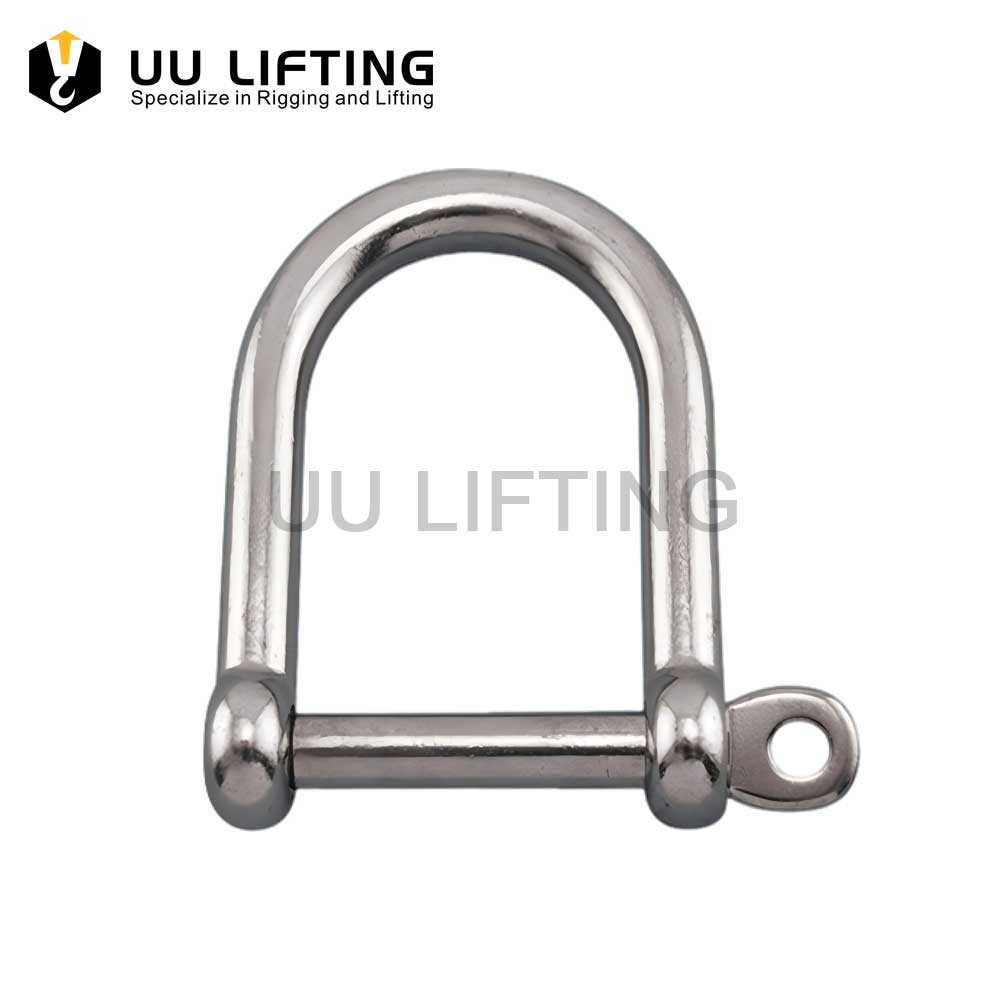
Stainless Steel Wide D Shackle with Screw Pin Specifications:
MOQ
1 Pallet, 1 Ton or 3000USD
Material
Grade 316/304 Stainless Steel
Surface Finish
High Polished Finish
Sizes
From 1/4″ to 1/2″
Technique Procedure
Free Forging
Stainless Steel Wide D Shackle with Screw Pin Sizes:
Stainless Steel Wide D Shackle with Screw Pin Sizes
Wide D Stainless Steel Shackle with Screw Pin Sizes
A Size (in)
Weight (lb)
Work Load Limit (lb)
Dimension (inch)
B
C
D
X
Y
Z
1/4″
0.07
750
0.24″
0.92″
1.31″
1.83″
1.89″
0.49″
5/16″
0.15
1000
0.32″
1.11″
1.22″
2.17″
2.02″
0.60″
3/8″
0.33
1200
0.40″
1.54″
2.14″
3.04″
3.12″
0.78″
1/2″
0.52
1500
0.47″
1.89″
2.59″
3.54″
3.63″
0.94″
What Is a Stainless Steel Wide D Shackle with Screw Pin?
A stainless steel wide D shackle with a screw pin is a D-shaped connector made from corrosion-resistant steel. It has a broader opening for larger slings and a threaded pin for quick, temporary connections in lifting and rigging, especially in marine or harsh environments.
What are the main components and materials of this shackle?
This shackle has four main parts: the D-shaped body (bow), the threaded screw pin, and the ears where the pin connects. It’s typically made from high-grade stainless steel, like AISI 304 or 316, for maximum strength and corrosion resistance.
Stainless Steel Grades Comparison
Grade
Key Feature
Best For
AISI 304
Good corrosion resistance
General industrial use, freshwater environments
AISI 316
Excellent corrosion resistance
Marine, saltwater, and chemical exposure
Choosing the right grade is vital. AISI 316 costs a bit more. But for a distributor like Mark, whose customers are in coastal areas, it’s a necessary investment. It prevents rust and ensures long-term safety. This material makes the shackle strong, durable, and low-maintenance.
How does the “wide” design affect its application?
The “wide” D-shape provides a larger internal area. This allows it to easily accommodate wider synthetic webbing slings or multiple sling legs without pinching. This ensures the load is distributed evenly across the sling, maintaining its full strength and preventing damage.
The “wide” part of the name is essential. I remember visiting a customer’s site where they used a standard D shackle with a wide polyester webbing sling. The sling was squeezed and bunched up. This is dangerous. When a sling is bunched, the load isn’t spread evenly. This can weaken the sling and reduce its working load limit.
The wide D shackle solves this problem. Its more expansive bow gives the sling a broader, flatter surface to rest on. This small change has a significant impact on safety and equipment lifespan.
Where a Wide D Shackle Helps Most
Synthetic Slings: It’s perfect for connecting to the eyes of wide webbing slings.
Load Distribution: It prevents the edges of your expensive slings from getting cut or frayed.
Anchor Points: It can connect to wider lifting points on machinery or structures.
I always remind my customers that even though it’s wider, it is still a D shackle. This means it is designed for straight, in-line pulls only. You should not use it for side loads or with multi-leg slings that pull at an angle. For that, you would need a bow or anchor shackle.
What are the advantages of using a screw pin mechanism?
A screw pin is a threaded pin that can be tightened or loosened by hand. Its main advantage is speed and ease of use. This makes it perfect for temporary lifts or applications that need quick assembly and disassembly. No extra tools are required.
The pin is what holds everything together. With this shackle, we use a screw pin. It’s a simple, innovative design. The pin has threads, just like a screw. You just turn it by hand to tighten or loosen it. There are no extra parts, such as nuts or cotter pins, to lose.
The main difference between pin types comes down to application. I explain it to my clients with a simple table.
Screw Pin vs. Bolt-Type Pin
Pin Type
Best For
Key Feature
Screw Pin
Temporary Lifts, Quick Assembly
Fast, no tools needed, easy to operate.
Bolt-Type Pin
Permanent/Long-Term, High Vibration
More secure with a nut and cotter pin.
The most significant advantage of the screw pin is speed. If you are setting up and taking down rigging multiple times a day, it saves considerable time. However, there’s a crucial safety rule I always emphasize. Screw pins are not for permanent or long-term installations. Vibrations from machinery can gradually loosen the pin. So, you must check that the pin is tight before every single lift. It’s a small step that prevents significant accidents. What Is a Stainless Steel Wide D Shackle with Screw Pin?
A stainless steel wide D shackle with a screw pin is a D-shaped connector made from corrosion-resistant steel. It has a broader opening for larger slings and a threaded pin for quick, temporary connections in lifting and rigging, especially in marine or harsh environments.
What are the main components and materials of this shackle?
This shackle has four main parts: the D-shaped body (bow), the threaded screw pin, and the ears where the pin connects. It’s typically made from high-grade stainless steel, like AISI 304 or 316, for maximum strength and corrosion resistance.
Stainless Steel Grades Comparison
Grade
Key Feature
Best For
AISI 304
Good corrosion resistance
General industrial use, freshwater environments
AISI 316
Excellent corrosion resistance
Marine, saltwater, and chemical exposure
Choosing the right grade is vital. AISI 316 costs a bit more. But for a distributor like Mark, whose customers are in coastal areas, it’s a necessary investment. It prevents rust and ensures long-term safety. This material makes the shackle strong, durable, and low-maintenance.
How does the “wide” design affect its application?
The “wide” D-shape provides a larger internal area. This allows it to easily accommodate wider synthetic webbing slings or multiple sling legs without pinching. This ensures the load is distributed evenly across the sling, maintaining its full strength and preventing damage.
The “wide” part of the name is very important. I remember visiting a customer’s site where they used a standard D shackle with a wide polyester webbing sling. The sling was squeezed and bunched up. This is dangerous. When a sling is bunched, the load isn’t spread evenly. This can weaken the sling and reduce its working load limit.
The wide D shackle solves this problem. Its more expansive bow gives the sling a broader, flatter surface to rest on. This small change has a significant impact on safety and equipment lifespan.
Where a Wide D Shackle Helps Most
Synthetic Slings: It’s perfect for connecting to the eyes of wide webbing slings.
Load Distribution: It prevents the edges of your expensive slings from getting cut or frayed.
Anchor Points: It can connect to wider lifting points on machinery or structures.
I always remind my customers that even though it’s wider, it is still a D shackle. This means it is designed for straight, in-line pulls only. You should not use it for side loads or with multi-leg slings that pull at an angle. For that, you would need a bow or anchor shackle.
What are the advantages of using a screw pin mechanism?
A screw pin is a threaded pin that can be tightened or loosened by hand. Its main advantage is speed and ease of use. This makes it perfect for temporary lifts or applications that need quick assembly and disassembly. No extra tools are required.
The pin is what holds everything together. With this shackle, we use a screw pin. It’s a simple, innovative design. The pin has threads, just like a screw. You just turn it by hand to tighten or loosen it. There are no extra parts, such as nuts or cotter pins, to lose.
The main difference between pin types comes down to application. I explain it to my clients with a simple table.
Screw Pin vs. Bolt-Type Pin
Pin Type
Best For
Key Feature
Screw Pin
Temporary Lifts, Quick Assembly
Fast, no tools needed, easy to operate.
Bolt-Type Pin
Permanent/Long-Term, High Vibration
More secure with a nut and cotter pin.
The most significant advantage of the screw pin is speed. If you are setting up and taking down rigging multiple times a day, it saves significant time. However, there’s a crucial safety rule I always emphasize. Screw pins are not for permanent or long-term installations. Vibrations from machinery can gradually loosen the pin. So, you must check that the pin is tight before every single lift. It’s a small step that prevents significant accidents.
OUR FACTORY
Raw materials of our products are made of high-quality steel that meets the standards, and the raw materials are traceable. And multiple production lines and machines minimize lead times for rigging and lifting equipment.
Raw Material
Forged
Cast
Chain Machine
Heat Treatment
Powder Plastified
Package
Warehouse
MANUFACTURING PROCESSES
With eight automatic forging and semi-automatic forging line of up to 1600ton press machines and specialized drillng, tapping, heat treatment and inspection equipment. Strict and standardized production process ensures you receive perfect products.
QUALITY CONTROL
All rigging and lifting products are subjected to strict working tension and breaking the tension test. Complied with ISO9001 and CE certification. Our promise to you: Guaranteed safety at work for people and materials.